How to Handle Flight Delays for Group Travel

How to Handle Flight Delays for Group Travel

A delayed flight can change far more than an arrival time. For a group traveling to New York City, one update on an airline app can affect a meeting schedule, wedding rehearsal, cruise departure, hotel check in, or the transportation waiting outside the terminal. Knowing how to handle flight delays means acting early, keeping everyone informed, and protecting the parts of the itinerary that can still be controlled.

For group organizers, the goal is not to eliminate every disruption. Weather, air traffic restrictions, mechanical inspections, and crew scheduling can all affect a flight. The goal is to make clear decisions quickly so passengers stay together, connections are protected, and ground transportation can adjust to the new plan.

How to Handle Flight Delays Before Your Group Lands

The first useful update is the one you receive before leaving for the airport. Monitor the airline app, flight number, and airport departure board, but do not rely on a single notification. Flight times can change more than once, especially during severe weather or a busy travel period.

Assign one person to monitor the flight and share confirmed information with the group. This prevents ten passengers from calling different people, receiving conflicting answers, and creating unnecessary confusion. For a corporate group, an executive assistant or event lead is often the best point of contact. For a family or wedding party, choose a traveler who is comfortable managing logistics and has access to all reservation details.

When a delay appears, confirm three facts: the revised departure time, the expected arrival time, and whether the airline has announced a gate change or aircraft change. Arrival estimates matter most when coordinating an airport pickup, but a change in departure terminal or gate can also affect how the group moves through the airport.

Contact the airline while options are still available

If the delay creates a missed connection or threatens a time sensitive plan, contact the airline as soon as possible. Use the airline app or customer service channel while also speaking with a gate agent if one is available. Earlier action can provide more rebooking choices, particularly when several passengers need to be placed on the same flight.

Ask whether the group can be rebooked together, whether seats are available on another routing, and whether checked bags will transfer automatically. If travelers have separate reservations, the airline may not treat them as one party unless you clearly explain the situation. Keep confirmation numbers, passenger names, and final destinations ready before making contact.

Airline assistance can vary based on the cause of the delay, the fare purchased, seat availability, and the airline’s policies. A weather related delay may be handled differently from a mechanical issue. Avoid making assumptions about hotel accommodations, meal support, or compensation until the airline confirms what it can provide.

Protect the Parts of the Itinerary You Can Control

A flight delay often creates pressure because travelers focus on the original schedule. Once the original plan is no longer possible, shift attention to the next fixed commitment. This may be a cruise boarding window, a client meeting, a stadium event, a dinner reservation, or a hotel check in deadline.

Call the hotel, event venue, cruise line, or meeting host with the updated arrival estimate. A quick, specific message is more helpful than saying the group is running late. Explain the revised flight information, the number of travelers affected, and the expected time you can realistically arrive. Many venues can offer practical guidance when they know the situation early.

For groups with a tight schedule, identify a reasonable priority. If luggage is delayed but the group must reach a conference session, travelers may choose to proceed with essential items and arrange bag delivery later. If a group is arriving for a wedding, the coordinator may need to decide which activities require every guest and which can begin without them. These choices depend on the event, but making them early reduces last minute stress.

Keep essential documents, medication, chargers, a change of clothes, and event specific items in a personal bag when possible. Checked baggage may arrive late, be routed separately after a rebooking, or take time to reach the carousel during a busy period. For school groups and other organized travel, the trip leader should also keep passenger lists, emergency contacts, and lodging details accessible at all times.

Coordinate Airport Transportation With Accurate Flight Details

Ground transportation should be managed as soon as the arrival time changes. A pickup scheduled for the original landing time may need to be adjusted, especially when a group is arriving at JFK International Airport, LaGuardia Airport, or Newark Liberty International Airport during a high traffic period.

Provide the transportation provider with the airline, flight number, updated arrival time, passenger count, and any changes to the terminal. Flight tracking is useful, but communication is still essential. A flight may land on time after a prior delay, then passengers may face a long wait to exit the aircraft, collect luggage, or meet the group at the designated pickup area.

For a group, do not send people outside separately while others are still waiting for bags or using the restroom. Select a clear meeting point inside the terminal, confirm that everyone is present, then proceed together when the driver or transportation coordinator provides instructions. This is especially helpful for visitors unfamiliar with airport pickup procedures.

A professionally scheduled private vehicle can give a group more control after a disruption. Instead of dividing travelers among multiple vehicles, everyone can continue to the hotel, office, venue, or home together. New York Bus Service can arrange airport transportation for groups with vehicle options that fit the passenger count, from Mercedes Benz Sprinter vans for smaller parties to minibuses and full size motor coaches for larger groups.

The best vehicle depends on more than the number of seats. Consider luggage volume, the age of passengers, the length of the ride, and whether the group needs to make more than one stop. A full size motor coach may be appropriate for a large group with substantial luggage, while a smaller vehicle may be a more practical fit for an executive team or family arriving on the same flight.

Keep Communication Calm and Useful

Delayed travel can make passengers anxious, particularly when they are tired or worried about missing an important event. The group leader sets the tone. Share confirmed information, explain the next step, and avoid promising an arrival time that has not been verified.

A simple update works well: the flight is now expected to arrive at a stated time, transportation has been notified, and the group will meet at a specific location after baggage claim. This gives travelers the information they need without overwhelming them with every airline update.

For corporate and event travel, notify the destination contact as well as the passengers. A meeting host may need to shift an agenda. A wedding planner may need to update vendors. A tour organizer may need to adjust a reservation. When everyone receives the same current information, the group can make practical adjustments without repeated calls and confusion.

When a Delay Becomes an Overnight Disruption

If a delay turns into a cancellation or an overnight stay, secure the next available flight before focusing on every other detail. Seats can disappear quickly when many flights are disrupted. Once the new itinerary is confirmed, arrange accommodations if needed and update all transportation plans.

Review the revised arrival date carefully. A reservation that was correct for Friday evening may need to move to Saturday morning, and a driver needs the new information rather than an assumption that the service will carry over automatically. If the group has scheduled transportation for multiple days, review each segment to see what else must change.

Keep receipts and written airline communications organized. They may be useful for travel insurance claims, company expense reporting, or discussions with the airline. Take screenshots of cancellation notices and revised itineraries in case app information changes later.

Flight delays are frustrating, but they do not have to unravel the entire trip. Clear leadership, prompt airline communication, realistic timing, and responsive ground transportation can keep a group organized from the terminal to its final destination. When plans shift, focus on the next confirmed step and give your travelers a comfortable, dependable way to move forward.


Sprinter Van Versus Limousine Service Choices

Sprinter Van Versus Limousine Service Choices

A group arriving at JFK with carry on bags, presentation cases, and a firm meeting time has different transportation needs than a couple leaving a wedding reception. That is why the Sprinter van versus limousine service decision should begin with the people, luggage, itinerary, and experience you need, rather than the vehicle image alone.

Both options provide private, professionally driven transportation, but they are designed for different types of trips. A limousine can create a formal, celebratory entrance for a small party. A Mercedes Benz Sprinter van gives more passengers room to travel together comfortably, with practical space for luggage and a schedule that may include several stops.

Sprinter Van Versus Limousine Service for Group Travel

The clearest difference is capacity. A Mercedes Benz Sprinter van can accommodate up to 14 passengers, making it a practical choice for airport transfers, executive teams, wedding parties, family outings, and private tours. Instead of dividing a group into several vehicles, everyone can travel with the same professional driver and arrive together.

Limousine service is often best suited to a smaller party and a more appearance focused occasion. It can be an appropriate choice for a couple, a VIP guest, or a small group celebrating a milestone. However, available seating, luggage space, and interior layout vary by vehicle. It is wise to confirm these details before reserving, especially when passengers are traveling to or from an airport.

For an organizer, keeping the full group in one vehicle can simplify more than the ride itself. There is one pickup plan, one driver contact, one arrival time, and fewer opportunities for guests to get separated in Manhattan traffic or at a busy venue entrance.

When a Sprinter Van Is the Better Fit

A Sprinter van is often the stronger option when comfort and coordination matter as much as appearance. Its upright interior and passenger seating create a more practical environment for people who need to board easily, speak with one another, or carry personal items. This is particularly useful for a group traveling between an office, hotel, restaurant, event venue, airport, or cruise terminal.

Airport transfers with luggage

Airport transportation requires more planning than a point to point evening ride. A group flying into LaGuardia, JFK, Newark Liberty International Airport, or Teterboro may have checked bags, carry on items, child seats, equipment, or documents that need to remain accessible. A Sprinter van provides a more suitable layout for many of these transfers, particularly when several travelers need to depart at the same time.

It also supports a more controlled arrival process. The driver can be scheduled around the flight plan, pickup instructions, and destination requirements. For corporate guests, families, and airline crews, having every traveler together helps the coordinator account for the group before leaving the airport.

Corporate and executive transportation

For executive assistants and corporate planners, a Sprinter van is usually selected for function. A team can travel from Manhattan to Long Island for a meeting, client event, or retreat without arranging separate rides for each traveler. The group can review the day, make calls when appropriate, or simply arrive rested and on time.

A limousine may be suitable when transporting one executive or a small number of distinguished guests. But when the assignment involves a department, visiting team, or several clients, the Sprinter van typically offers better passenger capacity and more straightforward logistics.

Weddings, celebrations, and private outings

Wedding transportation is where the answer truly depends on the moment. A limousine may suit a bride and groom departure or a formal photo opportunity. A Sprinter van may better serve the wedding party, close family members, or guests traveling between a hotel, ceremony, reception, and after party.

The same distinction applies to birthday dinners, concerts, sporting events, and Long Island wine tours. If the goal is to keep friends together safely and on schedule, a Sprinter van offers practical advantages. If the ride itself is intended to be an intimate, formal feature of the celebration, a limousine can be the right choice for a small party.

Comfort Means Different Things on Different Trips

A limousine is associated with a luxury experience, privacy, and a distinct visual impression. Those qualities can matter for a special occasion, particularly when the trip is short and the passenger count is limited. The vehicle can feel like part of the event.

Sprinter van comfort is more centered on space, access, and group usability. Passengers can enter and exit with less difficulty than they might in a lower vehicle, and there is room for a group to sit together without feeling divided. For trips that last longer, include luggage, or require multiple pickups, that practical comfort can be more valuable than a formal presentation.

Consider the passenger mix as well. Older relatives, guests in formal attire, travelers with bags, and colleagues carrying laptops may appreciate the easier boarding and more flexible interior of a van. A transportation provider can help match the vehicle to those real conditions.

Schedule and Service Matter More Than Vehicle Style

The best vehicle cannot solve an unclear itinerary. Before selecting transportation, establish the exact passenger count, pickup locations, desired arrival time, amount of luggage, and number of planned stops. For weddings and events, identify whether the vehicle will wait on site or return later for a final pickup.

New York area travel also requires realistic timing. Traffic patterns, venue access, airport pickup procedures, bridge and tunnel routes, and large event crowds can affect the plan. A professional driver and an organized transportation schedule provide value regardless of whether you reserve a limousine or a Sprinter van.

For groups with more than 14 passengers, it may be time to consider a minibus or full size motor coach instead. A 24 or 36 passenger minibus can keep a larger group together, while a motor coach can accommodate up to 56 passengers and may include a restroom and WiFi. Choosing a vehicle that fits the group from the start helps avoid overcrowding and unnecessary coordination.

Questions to Ask Before You Reserve

Start by asking whether every passenger needs to travel together. If the answer is yes, a Sprinter van is likely the more practical choice for groups of up to 14, while a larger vehicle may be needed for bigger parties. Next, confirm luggage needs, especially for airport transfers and weekend trips to the Hamptons.

Then consider the purpose of the ride. Is it a formal departure for two people, or a coordinated transfer for a wedding party? Is it a short celebration, or a full day of meetings and venue stops? Your answer will point naturally toward either limousine service or a Sprinter van.

Finally, share the complete itinerary with your transportation provider. Details such as flight information, hotel entrances, venue loading instructions, and return times allow the service team to plan a more dependable trip. New York Bus Service can help organizers select transportation that fits their passenger count, timing, and destination requirements.

A clear passenger count and a well planned itinerary will do more for a successful trip than choosing a vehicle based on appearance alone.

Sprinter Luggage Capacity for New York Groups

Sprinter Luggage Capacity for New York Groups

A Sprinter can comfortably carry a small group through New York City, but Sprinter luggage capacity is often the deciding factor between an easy airport transfer and a crowded ride. Passenger count alone does not tell the full story. A group of 12 executives with briefcases requires far less cargo room than eight travelers arriving at JFK with large checked bags, carry on luggage, and personal items.

For airport transfers, wedding transportation, private tours, and corporate travel, planning around both people and luggage helps protect comfort, timing, and the overall experience. The right vehicle lets every passenger sit comfortably while bags are loaded safely and accessibly.

What Determines Sprinter Luggage Capacity?

Mercedes Benz Sprinter vans can accommodate up to 14 passengers, depending on the configuration. However, the usable luggage area varies by vehicle layout, seating arrangement, and the type of bags your group brings. A van designed to maximize passenger seating will not have the same cargo room as a vehicle configured for a smaller group with substantial luggage.

The practical question is not simply, “How many bags fit?” It is, “How many passengers, what type of bags, and what level of comfort does this trip require?” That distinction matters when a group is traveling to or from an airport, where checked luggage is usually larger and less flexible than bags for an afternoon event.

A well planned reservation accounts for luggage before the vehicle arrives. This avoids placing bags in passenger areas, blocking walkways, or making the ride feel more confined than it should.

Bag size matters as much as bag count

Not every suitcase takes up the same amount of space. Soft duffel bags and compact carry on cases can be arranged more efficiently than rigid, oversized suitcases. Golf bags, garment bags, presentation materials, strollers, musical equipment, or sports gear require additional consideration as well.

For example, a group of 10 people with one small carry on each may travel comfortably in a Sprinter. A group of 10 with large checked suitcases may need a different seating plan, fewer passengers in the van, or a larger vehicle. Providing accurate luggage details at the time of booking gives your transportation provider the information needed to recommend the right option.

The trip type changes the recommendation

A Sprinter trip to a business dinner in Manhattan usually involves little more than coats, handbags, and briefcases. In that case, carrying close to the vehicle’s passenger capacity may be appropriate. An airport transfer from LaGuardia or Newark, on the other hand, can involve several full size suitcases per traveler.

The same is true for destination events. Wedding parties may carry formal attire, gift bags, and personal belongings. Families headed to a cruise terminal may bring more luggage than a typical weekend group. Long Island wine tour guests generally travel lighter, although coolers or purchases made during the day can affect available space on the return trip.

A Practical Guide to Passenger and Luggage Planning

The most reliable approach is to treat passenger capacity and luggage capacity as two connected limits. When one increases, the other may need to decrease. This is especially relevant for groups that want room to relax instead of filling every available seat.

For a light luggage trip, a Sprinter may be a comfortable fit for a larger group. For a trip with standard airport luggage, the ideal passenger count is often lower. For substantial luggage or special equipment, a minibus may provide the better experience even when the group itself is small enough for a van.

Here is how to think through common situations.

Airport transfers

Airport travel requires the most careful luggage planning. Ask each traveler whether they will have a checked bag, carry on bag, personal item, or oversized item. International flights, extended vacations, cruise departures, and family travel tend to create higher baggage volumes.

If several travelers are carrying large suitcases, leaving open seating and cargo space is a smart choice. It supports safer loading, gives passengers more room, and keeps the aisle clear for entry and exit. For a corporate team traveling with compact luggage, a Sprinter can be an efficient and professional option for airport transportation.

Flight timing also matters. A professionally scheduled private vehicle can pick up the group at a coordinated time and accommodate the planned baggage load without the uncertainty of splitting travelers across multiple vehicles.

Corporate and executive transportation

For executive meetings, conferences, client visits, and employee transportation, luggage may be minimal. A Sprinter is often well suited to groups that need comfortable seating and a professional arrival without the size of a larger bus.

Still, corporate groups should mention presentation materials, trade show displays, product samples, or equipment cases. These items can take up more room than expected. Planning ahead is particularly valuable when the group has multiple stops and needs to keep belongings secured throughout the itinerary.

Weddings and private celebrations

A Sprinter can work well for transporting a wedding party, close family members, or guests between a hotel, ceremony, reception, and photo locations. Most local wedding trips involve limited luggage, which allows organizers to focus on passenger comfort and schedule coordination.

For overnight celebrations or hotel departures after the event, luggage needs may change. Let your transportation coordinator know if guests will be carrying suitcases, garment bags, floral arrangements, or event supplies. A slightly larger vehicle may make the final transfer more comfortable and organized.

Tours, sports events, and family outings

Private sightseeing groups and families usually bring smaller personal items during the day. A Sprinter provides a practical option for a group that wants to travel together through New York City or Long Island without coordinating several cars.

Sports teams and fan groups require a closer review. Equipment bags, coolers, banners, and folding chairs can add considerable volume. For those trips, passenger count is only one part of the decision. A minibus may be more suitable if your group needs additional storage space and room for everyone to ride comfortably.

When a Minibus Is the Better Choice

Selecting a larger vehicle is not always about adding more passengers. It can be the best choice for preserving comfort when your group has a heavy luggage load. A 24 or 36 passenger minibus offers more room for travelers and belongings, making it a practical option for airport arrivals, extended trips, school groups, and events with equipment.

A minibus can also simplify a complex itinerary. If a group has hotel pickups, airport drop offs, and multiple luggage handling points, additional space gives the driver and passengers more flexibility. It reduces the pressure to fit every bag into a limited area and helps keep the vehicle orderly throughout the trip.

For groups of up to 56 passengers, a full size motor coach may be the most appropriate solution. These vehicles can offer added amenities such as restrooms and WiFi, depending on the vehicle, which can be valuable for longer journeys and larger airport or event transfers.

Information to Share When Requesting a Quote

A precise quote begins with a complete picture of your trip. Share the number of passengers, pickup and drop off locations, travel date, and desired schedule. Then describe the luggage clearly. Mention how many travelers will have large checked bags, how many will carry smaller bags, and whether there are oversized or unusual items.

It is also helpful to explain the purpose of the trip. An airport transfer, a wedding shuttle, a corporate event, and a day tour may have similar passenger counts but very different cargo requirements. If your plans include multiple stops, let the transportation team know whether luggage stays on board or is loaded and unloaded at each location.

At New York Bus Service, this information supports a personalized vehicle recommendation based on your actual travel needs, not just a seating number. The goal is to provide a clean, comfortable vehicle with a professional driver and sufficient room for both your group and its belongings.

Make Room for a Better Group Travel Experience

The best Sprinter reservation is one that feels comfortably planned from the first pickup to the final drop off. Rather than booking based only on the maximum number of seats, consider the bags, equipment, trip length, and space your passengers need to travel at ease. A quick conversation about luggage can make the difference between a vehicle that merely fits your group and one that supports a smooth, well organized journey.

Employee Shuttle Planning Guide for NYC Teams

Employee Shuttle Planning Guide for NYC Teams

A late arrival at a morning meeting is rarely caused by one person leaving home too late. In New York, it is often the result of a missed connection, limited parking, traffic near a major business district, or an airport style schedule that does not align with public transit. A thoughtful employee shuttle planning guide gives corporate administrators a practical way to reduce those variables and provide a more predictable commute.

For organizations with offices, campuses, warehouses, event venues, or rotating work schedules, private group transportation can turn a difficult daily coordination task into a dependable service. The best plan is not necessarily the one with the most stops or the largest vehicle. It is the plan that matches actual employee travel patterns, protects arrival times, and remains workable when traffic or attendance changes.

Start With the Workday, Not the Vehicle

The first planning question is not how many passengers fit on a bus. It is when employees truly need to be at the destination. Begin with required arrival times, meeting start times, security check procedures, elevator access, and the time employees need to settle in before a shift begins.

For example, a Midtown office may need everyone inside by 8:45 a.m., not simply at the curb at 8:45. A facility in Long Island may have shift changes at times when transit options are limited. Build the shuttle arrival target backward from that requirement, then allow a realistic buffer for traffic, weather, loading, and the walk from the drop off area to the building.

This is also the time to identify whether one schedule serves everyone. A single morning and evening route can work well for a traditional office schedule. Organizations with early shifts, late departures, or teams working across multiple locations may need separate service windows. Splitting service can add cost, but it may reduce wait times and improve attendance enough to justify the investment.

Build a Clear Employee Shuttle Planning Guide Around Demand

Accurate passenger information prevents two common problems: paying for unused space or leaving employees without a seat. Ask employees where they begin their commute, when they need to arrive, and whether they will use the service regularly or only on select days. Anonymous surveys can encourage candid responses, especially when schedules vary from week to week.

Look beyond the total number of interested riders. What matters most is the number expected on the busiest trip. If 36 employees say they may ride, but only 24 typically travel on Tuesday through Thursday mornings, vehicle selection should account for the peak days plus a reasonable margin. Reservations, rider registration, or a simple weekly confirmation process can make demand easier to forecast.

Route design should favor practical gathering points over a long series of individual pickups. Stops near transit hubs, park and ride locations, or large commuter parking areas can shorten the overall trip and make timing more dependable. A route with too many stops may look convenient on paper, but every stop adds uncertainty. The right balance depends on employee distribution, road conditions, and how much time the organization can reasonably ask riders to spend commuting.

Choose the Right Vehicle Capacity and Comfort

A vehicle should fit the number of riders, route length, and level of comfort required. Mercedes Benz Sprinter vans can accommodate up to 14 passengers and are a practical choice for executive teams, smaller satellite offices, or airport related schedules. Minibuses accommodating 24 or 36 passengers often suit regular commuter routes where group size is consistent.

For larger employee groups, a full size motor coach can accommodate up to 56 passengers. It is particularly useful when the route covers a longer distance, carries several departments, or requires room for personal items. A motor coach may include a restroom and WiFi, which can be valuable for longer trips, although those features should be confirmed when planning service.

Capacity alone should not make the decision. Consider whether employees carry laptops, uniforms, presentation materials, or luggage. Also consider the number of riders who may need easy boarding access. A clean, well maintained vehicle with comfortable seating helps employees arrive ready for the day, rather than fatigued by the commute.

Plan Routes for New York Conditions

New York travel times can change quickly. Construction, bridge traffic, weather, street closures, sporting events, and major conventions can affect a route that normally runs on schedule. A dependable shuttle plan includes realistic drive times rather than relying only on the shortest distance.

Work with a transportation provider that understands the operating environment around your office or venue. The pickup location needs enough space for safe boarding and should not interfere with building operations or local traffic flow. At the destination, confirm where the driver can legally wait, unload passengers, and depart. This is especially important in busy parts of Manhattan, near airports, and at large corporate campuses.

It is helpful to establish a primary route and a practical alternate route before service begins. The alternate route does not need to be used every day, but knowing the options helps drivers and coordinators respond more confidently when conditions change. For time sensitive corporate events, a second departure window can also protect the schedule if a first vehicle encounters an unexpected delay.

Set Clear Communication Standards

Employees need simple, reliable information. Before the first day of service, provide the stop locations, departure times, expected travel time, rider rules, and a contact method for urgent schedule questions. Keep instructions easy to scan. People should not have to search through several messages to find the pickup point for the next morning.

Decide how your team will handle late arrivals, no shows, weather delays, and schedule changes. A shuttle cannot reasonably wait for each late rider, particularly when other passengers need to arrive on time. Communicate a clear departure policy and encourage riders to arrive a few minutes early.

A designated company coordinator is useful for regular service. This person can provide updated passenger counts, communicate office closures or special events, and relay operational changes to employees. On the transportation side, professional drivers and dispatch support provide the consistency needed to keep the plan on track.

Prioritize Safety and Professional Operations

Daily transportation is part of the employee experience, but it is also a responsibility. Select a provider that uses professional drivers, maintains its fleet, and follows appropriate safety procedures. Vehicle condition, driver experience, and proper scheduling matter as much as the route itself.

Avoid planning a schedule so tightly that drivers or riders are under constant pressure. A few additional minutes of planned time can make the service calmer, safer, and more dependable. For evening departures, confirm that pickup areas are well lit and that riders know where to wait.

If your shuttle includes airport transfers, client visits, or offsite meetings, provide the itinerary in advance. Flight numbers, terminal details, meeting times, and passenger contact information allow the transportation team to coordinate service with fewer last minute questions.

Measure What Is Working and Adjust

The first month of service is a planning period, not a final verdict. Track on time arrivals, average ridership, missed trips, employee feedback, and recurring traffic issues. A route that appears underused may simply have a departure time that misses the preferred commute window. A consistently crowded vehicle may indicate that an additional pickup point or larger vehicle is needed.

Review the service at regular intervals, particularly after a change in office attendance policies, a new work location, or seasonal traffic shifts. Small adjustments, such as changing a stop by a few blocks or moving departure by ten minutes, can have a meaningful effect on reliability.

New York Bus Service helps organizations coordinate professionally driven transportation for employee commutes, corporate events, airport transfers, and group travel throughout New York City and Long Island. The most effective shuttle service begins with a clear picture of your people, their schedule, and the standard of reliability your business expects. When those details guide the plan, the commute becomes one less uncertainty in the workday.

Manhattan Meeting Transportation Guide for Groups

Manhattan Meeting Transportation Guide for Groups

A meeting agenda can be perfectly planned and still start poorly if attendees arrive scattered, late, or frustrated by Midtown traffic. For corporate administrators, executive assistants, and event planners, transportation is not simply a ride to the venue. It is a practical part of attendance management. This Manhattan meeting transportation guide explains how to coordinate group travel with realistic timing, the right vehicle, and one clear point of contact.

Start With the Meeting Schedule, Not the Vehicle

The first question is not how many seats you need. It is when every attendee must be inside the building, checked in, and ready to begin. A 9:00 a.m. meeting may require an 8:40 a.m. arrival at the venue, particularly when guests need to pass through lobby security, collect badges, use elevators, or find a conference floor.

Work backward from that required arrival time. Include time for loading at the pickup point, traffic along the route, curbside access near the venue, and a reasonable buffer for morning congestion. Manhattan schedules can change quickly when streets are restricted, weather affects traffic, or a major event is taking place nearby. A professional transportation plan allows room for those conditions rather than treating every minute as available travel time.

For meetings involving guests from several offices or hotels, decide whether a single pickup location is practical. One central departure point usually keeps the group organized and makes it easier to confirm that everyone is on board. Multiple stops can work for a smaller executive group, but each additional location adds time and creates more opportunities for delays.

Match the Vehicle to the Group and the Day

Vehicle selection should reflect more than passenger count. Consider luggage, presentation materials, accessibility needs, and whether the group will travel together between more than one meeting location. A vehicle that technically fits everyone may not be the most comfortable choice if attendees are carrying briefcases, computer bags, or event supplies.

A Mercedes Benz Sprinter van is a practical option for executive groups of up to 14 passengers. It provides private transportation for airport arrivals, leadership meetings, client visits, and smaller offsite gatherings. For groups that need more capacity, a 24 or 36 passenger minibus provides comfortable seating while remaining well suited to Manhattan streets and coordinated hotel pickups.

A full size motor coach accommodates up to 56 passengers and can be the right choice for larger company meetings, conferences, employee transportation, and multi location programs. Motor coaches may include restrooms and WiFi, which can be especially helpful when the itinerary includes a longer transfer from Long Island, an airport, or a regional office before the Manhattan meeting begins.

The best choice depends on how the day is structured. A group attending one meeting and returning directly to its origin may only need a simple round trip. A group traveling between a hotel, a conference center, a client office, and a dinner reservation benefits from a vehicle and driver scheduled to remain available throughout the program.

Plan Manhattan Pickup and Drop Off Details Early

In Manhattan, the address alone is not enough. The transportation provider should have the venue name, entrance information, meeting floor if relevant, and a direct onsite contact. Some buildings have specific entrances for visitors, while others have restricted curb access or busy loading areas that affect where a vehicle can safely stop.

Share the preferred pickup time, not just the meeting start time. If your group is departing from a hotel, confirm where attendees should gather before boarding. A clearly communicated lobby meeting point prevents participants from waiting at separate doors or assuming the vehicle will stop on a different avenue.

For return service, establish a simple release plan. Tell attendees whether the vehicle will wait at the same location, a designated nearby corner, or another approved pickup point. The organizer should also identify who can authorize changes if the meeting runs longer than expected. Clear communication helps the driver and passengers respond calmly when plans change.

Account for Security and Building Access

Many Manhattan office towers require visitor registration. When a group is large, the check in process can take longer than expected. Send attendee names to the host in advance when appropriate, and ask whether identification is required. If the meeting involves a confidential client, financial institution, or government related location, allow additional time for screening.

Transportation cannot solve an unprepared building entry process, but it can support one. Arriving the group with enough time to enter together gives organizers the opportunity to manage badges, directions, and last minute attendance questions before the meeting starts.

Coordinate Airport Arrivals for Visiting Attendees

Business meetings often bring together guests arriving through JFK International Airport, LaGuardia Airport, Newark Liberty International Airport, or Teterboro Airport. Airport transportation requires a different level of planning because flights, baggage collection, and terminal access can affect the schedule.

Provide flight details, airline information, arrival times, and the number of passengers traveling together. If attendees are arriving on different flights, consider whether separate transfers are more practical than asking early arrivals to wait for a later flight. The right approach depends on the meeting start time, the size of each arriving group, and whether there is a comfortable place for guests to wait.

For same day arrivals, build in a generous buffer before the meeting. A delayed flight or extended baggage wait can put unnecessary pressure on both guests and organizers. When the schedule allows, bringing key attendees in the evening before a major morning meeting is often the more reliable choice.

Keep the Day Flexible Without Losing Control

A well planned itinerary should have structure, but it should also account for the fact that business meetings can change. A presentation may run long. A client may request an additional stop. A lunch location may shift. The most useful transportation arrangement is one that identifies likely needs in advance while maintaining a clear process for adjustments.

Before service begins, provide the driver and transportation coordinator with the complete itinerary, attendee count, timing expectations, and organizer contact information. Confirm whether the vehicle will be released after drop off or remain nearby for later service. This distinction matters because it affects how easily the group can transition to a second location.

For high visibility meetings, designate one transportation lead. That person should be able to communicate changes, confirm headcounts, and make decisions without requiring multiple approvals. A single informed contact helps prevent mixed messages during a busy event day.

Use Transportation to Improve the Attendee Experience

Group transportation creates a more organized arrival, but it also gives attendees time to prepare. On the way to a client presentation or company meeting, teams can review materials, confirm talking points, and arrive together with less distraction. For visiting guests, a private vehicle also removes the uncertainty of navigating an unfamiliar city between appointments.

Comfort and professionalism matter here. Clean, maintained vehicles and experienced professional drivers help set the right tone before an important meeting. For a group traveling from Long Island, Brooklyn, Queens, or another nearby area, riding together can also reduce the coordination burden of multiple personal vehicles and separate arrival times.

A Practical Manhattan Meeting Transportation Checklist

Before confirming transportation, make sure you have the meeting address, preferred entrance, required arrival time, passenger count, luggage needs, complete itinerary, onsite contact, and return plan. Confirm building access requirements, especially for groups entering a secure office tower or conference venue.

New York Bus Service can help organizers arrange private Sprinter van, minibus, and full size motor coach transportation based on the size of the group and the demands of the schedule. Share the full plan early, including every pickup, meeting, airport transfer, and return requirement, so the day can be scheduled with care.

A successful Manhattan meeting begins before the first agenda item. When transportation is planned around the people, the building, and the actual demands of the day, your group can arrive prepared, together, and focused on the business ahead.

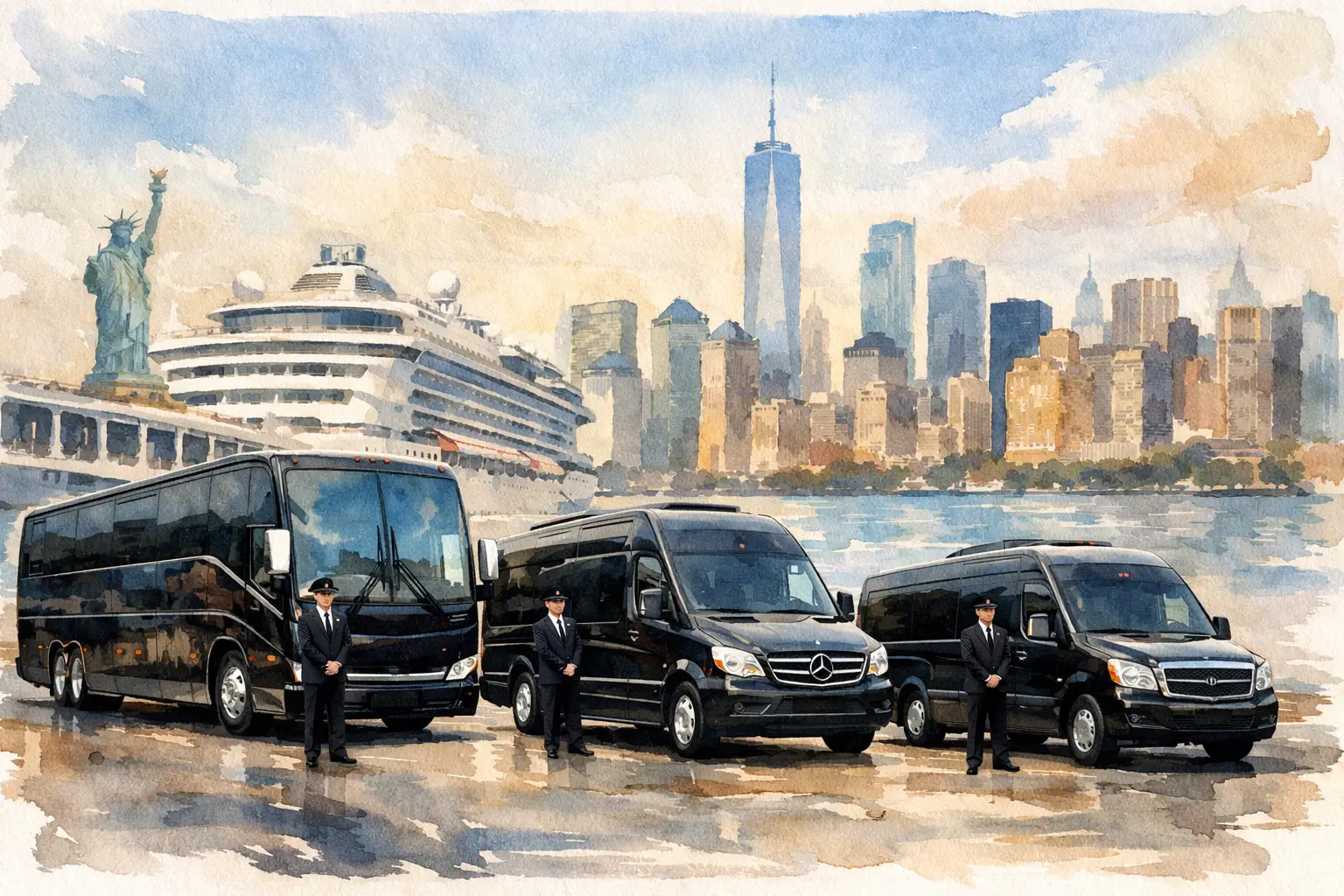
Three black passenger vans with two uniformed drivers posing in front, skyline and bridge in the background by the water.

Bus Luggage Limits for New York Group Travel

A group can fit comfortably in a vehicle and still face a baggage problem. Bus luggage limits are not determined by passenger count alone. The number, size, and shape of suitcases can affect which vehicle is appropriate, how quickly your group loads, and whether everyone has a comfortable ride.

For airport transfers, weddings, student trips, corporate travel, and Long Island excursions, luggage planning should happen before the vehicle is reserved. A simple conversation about bags can prevent crowded aisles, delayed departures, and last minute changes on the day of service.

Why Bus Luggage Limits Matter

Private group transportation offers far more flexibility than arranging separate vehicles, but every bus has a defined amount of luggage capacity. A vehicle that works well for 14 passengers traveling locally with handbags may not be suitable for the same 14 passengers arriving at JFK with large checked suitcases, carry on bags, garment bags, and equipment.

The practical question is not simply, “How many people are traveling?” It is, “How many people, how much luggage, and what type of luggage?” Those details help determine whether a Mercedes Benz Sprinter van, minibus, or full size motor coach best supports the trip.

Luggage planning also protects the schedule. Airport arrivals often involve travelers collecting bags at different times. A clear loading plan gives the driver and group organizer a better opportunity to keep the transfer organized and depart promptly once everyone is ready.

Bus Luggage Limits by Vehicle Type

There is no single industry wide rule for bus luggage limits. Storage space varies by vehicle model, seating configuration, and the amount of equipment already on board. For that reason, organizers should treat passenger capacity and luggage capacity as related but separate considerations.

Mercedes Benz Sprinter Vans

A Mercedes Benz Sprinter van can accommodate up to 14 passengers, making it a practical choice for executive groups, small families, private tours, and local event transportation. It is often best suited to travelers with light luggage, personal bags, or a limited number of standard suitcases.

For an airport transfer, a full passenger load with one large suitcase and one carry on per traveler may require a larger vehicle. Reducing the passenger count can create more room, but this should be confirmed during planning rather than assumed. Oversized items, such as golf clubs, musical instruments, or presentation materials, also need to be discussed in advance.

Minibuses

Minibuses accommodate groups that need more seating than a van while maintaining a more compact vehicle size. A 24 or 36 passenger minibus can be an effective option for corporate events, wedding guest transportation, school outings, and day trips where most passengers bring only light personal items.

Minibus luggage space differs substantially from one vehicle to another. Some trips involve backpacks and small tote bags, while others involve checked luggage for every guest. A group traveling from Manhattan to a dinner event may need little storage. A group arriving at LaGuardia for a hotel transfer may need a vehicle with greater baggage capacity, even if the number of travelers is the same.

Full Size Motor Coaches

A full size motor coach accommodates up to 56 passengers and generally offers the strongest option for larger groups with significant luggage needs. These vehicles may include underfloor baggage compartments, restrooms, and WiFi, making them well suited for airport transfers, multi day tours, sports travel, school trips, and long distance group transportation.

Even with a motor coach, luggage limits still deserve attention. Fifty six travelers carrying one standard suitcase each is a different load from fifty six travelers with multiple large bags, ski equipment, display materials, or boxed event supplies. A full description of what the group will bring allows the transportation provider to recommend the right vehicle and configuration.

How to Estimate Your Group’s Luggage Needs

The most useful estimate begins with the purpose and length of the trip. A same day corporate meeting may involve one laptop bag per passenger. A weekend wedding may mean a suitcase, garment bag, gift bag, and personal item for each guest. Airport transfers can include bags of different sizes because travelers may be returning from trips of varying lengths.

Ask travelers to identify whether they will bring a checked suitcase, carry on suitcase, backpack or personal item, and any unusual item. Count actual bags rather than relying only on a general description such as “light luggage.” One person’s light luggage may be a backpack, while another person may mean a full size suitcase and a garment bag.

Be especially precise when arranging transportation for these situations:

  • Airport arrivals and departures, where nearly every passenger may have checked baggage.
  • Weddings, where formalwear, gifts, floral items, and personal bags can add volume.
  • Sports teams, where uniforms, duffel bags, coolers, and equipment require separate space.
  • School and college trips, where students may bring luggage, backpacks, instruments, or project materials.
  • Tours and wine outings, where guests may return with purchases that were not part of the original load.

The return trip deserves the same attention as the outbound trip. Guests on a Long Island wine tour, for example, may begin with small personal bags and finish with bottles or cases that require protected storage. Similarly, an airport pickup may carry more luggage than an airport drop off, depending on the group’s plans.

Plan for More Than Suitcases

Suitcases are only part of the equation. Accessibility and safety matter as much as total storage volume. Aisles and passenger areas should remain clear so guests can enter, exit, and ride comfortably. Items should not be stacked in seating areas or placed where they could shift during travel.

Some belongings need special handling. Garment bags should be kept clean and wrinkle free. Musical instruments may need space that prevents pressure or impact. Medical equipment, mobility devices, and items needed during the ride should be identified in advance so they can be placed where passengers can access them safely.

For corporate transportation, consider materials that may be overlooked during planning. Trade show displays, meeting binders, branded gifts, audiovisual cases, and catering supplies can use a meaningful amount of space. Providing this information early helps avoid loading surprises outside a hotel, office, airport terminal, or event venue.

Booking the Right Bus for an Airport Transfer

Airport transfers require the most detailed luggage conversation because flights, terminals, and baggage claim timing add pressure to the itinerary. When requesting transportation to or from JFK, LaGuardia, Newark Liberty International Airport, or Teterboro Airport, provide the flight details, expected number of passengers, and a realistic bag count.

It also helps to share whether the group is arriving together on one flight or separately. If travelers land at different times, the organizer may need to decide whether the vehicle will wait for the entire group or whether separate pickups make more sense. The right approach depends on the itinerary, airport procedures, and the amount of baggage each arriving party will have.

Allow time for baggage claim and loading. A carefully scheduled pickup should account for the fact that travelers do not emerge from the terminal at the same moment, particularly when checked bags are involved. A professional driver can assist with an organized loading process, but accurate information from the group remains essential.

Questions to Ask Before You Reserve

Before confirming service, tell the transportation provider your passenger total, pickup and drop off locations, travel dates, and full itinerary. Then explain the luggage situation in plain terms. Include the approximate number of large suitcases, carry on bags, personal items, and any oversized or fragile belongings.

It is also wise to ask whether the recommended vehicle has dedicated luggage storage and whether your group size should be adjusted to make room for bags. A smaller group may be comfortable in a van for a local ride, while a larger vehicle could be the better choice for an airport transfer with the same passengers.

New York Bus Service helps organizers match their vehicle to the real needs of the trip, from a small executive transfer to a full size motor coach for a large group. Sharing complete details early supports a cleaner loading process, a more comfortable ride, and a transportation plan that stays on schedule.

A Better Way to Keep Group Travel Organized

Do not wait until pickup day to find out whether bags will fit. Confirm luggage needs while planning the itinerary, ask travelers for accurate bag counts, and account for items that may be added during the trip. That preparation gives every passenger more room to travel comfortably and gives your group a stronger start from the moment the doors open.

Newark Airport Group Transfer Guide for Groups

Newark Airport Group Transfer Guide for Groups

A group arriving at Newark Liberty International Airport can lose valuable time before the trip even begins. Different terminals, luggage collection, flight changes, and busy airport roadways make coordination difficult when each traveler is left to arrange transportation separately. This Newark airport group transfer guide explains how to organize a private airport transfer that keeps your passengers together, on schedule, and comfortable from arrival through the final destination.

Whether you are bringing executives to Manhattan, welcoming wedding guests from Long Island, transporting a school group, or planning a family departure, the right vehicle and a clear pickup plan make a meaningful difference. Airport transportation should support your itinerary, not create another logistical task for the person organizing it.

Start With Your Group’s Actual Travel Needs

The passenger count is the first detail to confirm, but it should not be the only one. A group of 12 travelers with large checked bags needs more room than 12 travelers carrying only personal items. A group arriving after an international flight may also need extra time for customs, baggage claim, and gathering everyone before leaving the terminal.

Ask each traveler for their flight number, arrival date, terminal, estimated luggage, and final destination. For groups arriving on multiple flights, identify whether everyone needs to leave together or whether separate scheduled pickups will better serve the itinerary. One vehicle is often the easiest choice when flights arrive within a reasonable window, but separate transfers may be more practical when arrival times are far apart.

Also consider who is traveling. Corporate guests may need a quiet, professional ride to a meeting or hotel. Families may need room for strollers and extra bags. School staff need a vehicle size that allows students and chaperones to travel together under clear supervision. Planning around the real trip, rather than only the number of seats, leads to a more comfortable transfer.

Choose the Right Vehicle for a Newark Airport Group Transfer

Private group transportation gives organizers a direct vehicle reserved for their own passengers, schedule, and destinations. The best option depends on group size, luggage volume, and the length of the ride after leaving Newark.

A Mercedes Benz Sprinter van can accommodate up to 14 passengers and works well for executive teams, families, and smaller wedding parties. It offers a practical balance of passenger space and airport access, particularly when the group has a single destination.

For medium sized groups, a 24 or 36 passenger minibus can keep colleagues, guests, or students together without requiring several separate vehicles. This is often a strong choice for hotel transfers, event transportation, and groups that need room for bags while still maintaining a manageable boarding process.

A full size motor coach can accommodate up to 56 passengers. It is well suited for larger school groups, conferences, sports teams, and events with substantial passenger counts. Depending on the coach, amenities may include a restroom and WiFi, which can be particularly useful for longer trips to Long Island, the Hamptons, or destinations beyond New York City.

Capacity is not the same as comfort. A vehicle that technically seats every passenger may not be the best selection if travelers have oversized luggage, presentation materials, sports equipment, or several days of bags. Share those details during planning so the transportation provider can recommend an appropriate vehicle.

Build Airport Timing Around the Flight, Not the Schedule on Paper

Flight arrival time is only the starting point for an airport pickup. Domestic travelers may be ready shortly after landing, while international arrivals can require considerably more time. Delays at baggage claim, customs processing, gate changes, and crowded terminal areas can all affect the point when your group is ready to board.

Provide flight details in advance so the transportation team can follow the arrival and adjust when conditions change. Travelers should also know who their onsite contact is and how to communicate once they are ready. A designated group leader is especially helpful. Rather than receiving calls from every passenger, the driver or transportation coordinator has one person confirming that the full group has collected luggage and is prepared to depart.

For outbound trips to Newark, build in time for traffic and airport procedures. The right departure time depends on the airline, terminal, day of travel, and whether the group is checking bags. Corporate groups heading to an early flight may need a different plan than a wedding party traveling on a weekend afternoon. The goal is not simply to arrive early. It is to arrive with enough time to check in calmly and keep the group together.

Account for Terminal Instructions

Newark Liberty International Airport has multiple terminals, and pickup instructions can vary based on the terminal and airport operations. Travelers should receive clear directions before landing or departing. Include the meeting location, the group leader’s contact information, and a simple instruction to remain together after baggage claim.

Large groups should avoid spreading across the terminal while waiting. When passengers separate to get food, visit restrooms, or make personal calls, boarding can take longer than expected. A brief plan sent before travel helps everyone understand when and where to regroup.

Make Luggage Planning Part of the Reservation

Airport luggage is one of the most common reasons a transfer plan needs adjustment. Passenger count alone cannot tell you how much storage is required. A group heading to a one day meeting may carry very little, while guests arriving for a wedding weekend could have multiple suitcases, garment bags, and personal items.

Give an honest estimate of the bags your group expects to bring. Mention golf clubs, instruments, sports equipment, trade show displays, mobility devices, or other oversized items as early as possible. This allows the vehicle assignment to reflect the full load, not just the number of people.

It also helps to tell travelers how luggage will be handled at pickup. They should keep passports, medications, phones, meeting materials, and other essential items with them rather than placing them in stored baggage. A simple reminder reduces the chance that someone must search through luggage after the group is already underway.

Coordinate Multiple Stops Before the Vehicle Arrives

A direct ride to one hotel is straightforward. Many groups, however, have several destinations. Executives may be going to different offices. Wedding guests may be split between hotels. A family may need to make a stop in Queens before continuing to Long Island. These details should be discussed before the day of travel.

Multiple stops can be arranged efficiently when the order, addresses, and approximate passenger count at each location are known. However, every additional stop adds time. If your group is large or has a fixed event start time, separate vehicles or a planned central drop off may be the better solution.

For corporate planners, consider the value of keeping the group together until a designated hotel or event venue. It simplifies attendance, gives guests a consistent arrival experience, and avoids unnecessary confusion after a long flight. For leisure groups, a private itinerary can be more flexible, especially when the transfer is part of a larger day of sightseeing or an excursion.

Give Passengers a Clear Day of Travel Plan

The best transportation plan only works if travelers understand it. Send the itinerary before travel in plain language. Include the flight information, terminal, meeting procedure, group leader contact, destination, and any special instructions for travelers arriving on another flight.

A short pretravel message should answer practical questions. Where should passengers go after baggage claim? Should they wait for the group leader before leaving the terminal? What happens if a flight is delayed? Is there a planned rest stop or direct ride to the hotel? Clear answers reduce calls, prevent missed connections, and help the driver begin the trip efficiently.

For school groups and youth travel, staff should establish a headcount process before boarding and after every stop. For corporate groups, an executive assistant or event coordinator can confirm attendance with the designated group leader. These small procedures protect the schedule and provide reassurance to everyone involved.

Work With a Transportation Provider That Plans Ahead

A dependable airport transfer is more than a vehicle arriving at the curb. It requires experienced professional drivers, properly maintained vehicles, accurate flight information, realistic timing, and a transportation team that understands group coordination. The provider should ask useful questions about your passengers, luggage, terminal, destination, and schedule because those details determine how well the transfer operates.

New York Bus Service provides private airport transportation for groups traveling to and from Newark Liberty International Airport, with vehicle options for small parties through larger passenger groups. Coordinated planning helps organizers replace several individual rides with one comfortable, professionally driven solution.

When your group lands at Newark, the first ride should set the right tone for the entire visit. Confirm the details early, keep passengers informed, and choose a vehicle that gives everyone room to travel comfortably. That preparation lets your group leave the airport focused on the event, meeting, celebration, or destination ahead.

Black luxury buses and two uniformed guards stand parked in a city street with a watercolor skyline in the background, suggesting a corporate shuttle scene.

NYC Convention Transportation Planning Guide

A convention agenda can be perfectly planned and still fall apart at the curb. When attendees arrive at different airports, meetings begin early, and a large venue has limited vehicle access, NYC convention transportation becomes a central part of the event experience. A professionally scheduled private vehicle gives your group a clear meeting point, a dependable arrival plan, and one less logistics issue for your team to manage.

For corporate administrators, executive assistants, event planners, exhibitors, and visiting teams, transportation should support the schedule rather than compete with it. The right plan considers where guests are arriving, when badges must be picked up, which entrances are available, and how the group will travel after the convention floor closes.

Start With the Convention Schedule, Not the Vehicle

The most effective transportation plan begins with the event itinerary. Before selecting a Sprinter van, minibus, or full size motor coach, identify the moments when your group must be together. Airport arrivals, hotel departures, exhibit setup, keynote sessions, client dinners, and return flights all affect the vehicle schedule.

Convention travel often includes more than one passenger group. Executives may arrive at one time, sales staff at another, and exhibit materials may require a separate delivery plan. A single vehicle is not always the best answer. It depends on the number of travelers, their luggage, their arrival windows, and whether the schedule requires continuous service during the day.

Build in realistic time for hotel loading, convention center traffic, security procedures, and walking from the drop off point to registration. A schedule that works on paper can become difficult if it assumes every guest is ready at the same minute. Giving the driver accurate pickup times, passenger counts, and location details helps create a practical plan that protects your most important appointments.

Identify the High Priority Trips

Most convention groups have a few trips that cannot be late. These commonly include airport transfers for speakers or executives, morning departures to the venue, transportation to an offsite reception, and final departures after the event. Reserve those times first, then determine whether additional transportation is needed for flexible trips.

If your group is attending an event at the Jacob K. Javits Convention Center, for example, arrival timing matters. Nearby streets can be active before major sessions and at the end of the day. A professional driver who has the itinerary and designated pickup instructions can help the group arrive prepared rather than searching for transportation in a crowded area.

Choose a Vehicle That Fits the Full Group

Passenger count is only one part of choosing convention transportation. Luggage, presentation materials, personal comfort, and the length of each ride matter too. A vehicle that is technically large enough may not be the most comfortable option when travelers are carrying garment bags, cases, or airport luggage.

A Mercedes Benz Sprinter van can accommodate up to 14 passengers and is a strong choice for executive teams, speakers, and small exhibitor groups. It offers a private, comfortable way to travel between an airport, hotel, venue, or dinner reservation without dividing the group between several vehicles.

For larger teams, a 24 or 36 passenger minibus provides efficient transportation for staff, attendees, and corporate guests. Minibuses work especially well for hotel to venue service, evening events, and groups that need a consistent vehicle throughout the convention schedule.

A full size motor coach can accommodate up to 56 passengers. It is often the right choice for large delegations, association meetings, employee groups, and convention attendees arriving together. Motor coaches may include a restroom and WiFi, which can add comfort during longer trips from Long Island, airport transfers, or travel to regional offsite events.

Keep the Group Together When It Matters

Splitting attendees into separate vehicles can create avoidable problems. One group may arrive before another, a key contact may be in the wrong vehicle, or people may miss instructions shared during the ride. For a scheduled convention transfer, keeping colleagues together gives the organizer more control over timing and communication.

There are situations where separate vehicles make sense. A smaller Sprinter van for senior leaders and a minibus for the wider team can fit different arrival schedules. The goal is not to use the largest vehicle available. The goal is to match each portion of the itinerary to a comfortable and efficient transportation solution.

Plan Airport Transfers Around Real Arrival Times

JFK International Airport, LaGuardia Airport, Newark Liberty International Airport, and Teterboro Airport all serve convention travelers, but each requires a different approach to timing and pickup coordination. Flight arrival time is only the beginning. Guests may need time to deplane, collect luggage, meet colleagues, and reach the designated pickup area.

For groups arriving on multiple flights, establish a clear waiting policy before the trip. In some cases, it is more efficient to schedule separate pickups for separate arrival blocks. In others, a vehicle can wait for a group arriving within a reasonable window. The right choice depends on the importance of getting to the venue quickly and the flexibility of the first day schedule.

Share a single point of contact with attendees before travel begins. Guests should know who to call if a flight is delayed, where to meet the driver, and what details to provide if their arrival changes. This small step can prevent confusion when several people are arriving from different cities.

Account for Venue Access and Daily Operations

A convention venue may have specific rules for coach access, loading zones, vehicle staging, and pickup locations. These procedures can change during large events, so transportation planning should include confirmation of the venue instructions close to the event date.

Provide your transportation provider with the hotel name, venue name, preferred entrance, event contact, and full daily schedule. If the group will be traveling to a restaurant or private event after convention hours, provide that information as early as possible. Last minute changes are sometimes unavoidable, but advance details allow for better route planning and driver preparation.

Morning departures deserve special attention. Rather than scheduling the bus for the exact time the convention begins, schedule around when your group needs to be through the entrance, checked in, and ready for the first session. The same principle applies to evening pickups. A defined pickup location and a realistic departure window make it easier for everyone to leave together.

Give Your Driver Useful Information

Professional drivers bring local experience, but they also need accurate event details. Let them know whether guests have mobility needs, whether luggage or display materials will be loaded, and whether a coordinator will be traveling with the group. If your itinerary includes multiple stops, provide the order of stops and the best contact at each location.

A transportation plan works best when one organizer has authority to confirm changes. This prevents conflicting instructions and gives the driver a reliable contact if traffic conditions or event timing require an adjustment.

Build Comfort Into the Attendee Experience

Convention days can be long. Guests may spend hours on the exhibit floor, participate in meetings, and attend evening functions before returning to the hotel. Comfortable private transportation gives attendees a chance to regroup between commitments, check messages, prepare for a presentation, or simply rest.

Vehicle cleanliness, professional service, and punctual pickup are not minor details. They shape how guests experience the entire event. This is particularly meaningful for client groups, executive visitors, and employees who are traveling on behalf of the organization.

New York Bus Service provides personalized transportation planning for convention groups throughout New York City and Long Island, with modern vehicles sized for small executive teams through large attendee groups. A properly scheduled private vehicle can simplify airport transfers, venue transportation, and evening event service while keeping your group focused on the convention itself.

Reserve Early for Major Convention Dates

New York convention calendars can create high demand for group transportation, especially when large trade shows, corporate meetings, and seasonal events overlap. Reserving early gives you more flexibility with vehicle selection and allows time to refine pickup schedules as attendee lists become final.

When requesting transportation, provide the estimated passenger count, travel dates, pickup and destination addresses, flight information when applicable, and any special itinerary needs. If details are still being finalized, start with the known trips and update the plan as the event approaches.

A well organized convention transportation plan does more than get people from one address to another. It helps your team arrive composed, stay on schedule, and leave every guest with confidence in how the event was managed.

Coach Bus Versus Vans for New York Groups

Coach Bus Versus Vans for New York Groups

A transportation choice that looks simple on paper can shape the entire day. A group headed to JFK with luggage, a wedding party traveling between venues, or a corporate team attending meetings across Manhattan needs more than enough seats. When comparing coach bus versus vans, the right answer depends on passenger count, baggage, trip length, itinerary, and how much room your group needs to stay comfortable and together.

For New York City and Long Island travel, the vehicle should support the schedule rather than create another item for the organizer to manage. A professionally driven Mercedes Benz Sprinter van may be ideal for a smaller group with a direct itinerary. A full size motor coach can be the better choice when a larger group needs coordinated transportation, generous storage, and onboard amenities for a longer day.

Coach Bus Versus Vans, Start With Group Size

Passenger count is the first practical consideration. Mercedes Benz Sprinter vans accommodate up to 14 passengers, making them a comfortable option for executive groups, family airport transfers, wedding parties, private tours, and small teams. With one vehicle and one professional driver, everyone arrives together without coordinating multiple personal cars.

A full size motor coach accommodates up to 56 passengers. That additional capacity is valuable for school trips, large corporate events, sports teams, convention transportation, major celebrations, and group sightseeing. Rather than separating attendees among several vehicles, one coach keeps the group organized from departure through final drop off.

The expected headcount should include more than confirmed travelers. Consider hosts, coordinators, chaperones, guides, or team staff who may be traveling with the group. If the number is close to a vehicle limit, selecting the next size up can provide more personal space and prevent a last minute transportation issue.

There is also a useful middle option. A minibus can accommodate 24 or 36 passengers, offering a practical solution when a Sprinter van is too small but a full size coach has more capacity than the group requires. The best vehicle is not automatically the largest one. It is the one that gives your group appropriate room while fitting the itinerary and budget.

Luggage Can Change the Vehicle Decision

A passenger seat does not tell the full story, especially for airport transportation. Fourteen passengers traveling with briefcases or small carry on bags have very different space needs than fourteen passengers arriving with large suitcases after an international flight. The same principle applies to a group heading to a cruise terminal, a golf outing, or a weekend in the Hamptons.

Sprinter vans work well when luggage is light to moderate and the group is small. For airport transfers, organizers should share the estimated number of bags and the approximate size of those bags when requesting transportation. This helps ensure that passengers and belongings can travel comfortably.

A full size motor coach is often the better fit for a larger group with substantial luggage. Its dedicated storage capacity helps keep the passenger cabin clear and makes loading more orderly. This is particularly helpful for JFK, LaGuardia, Newark Liberty, and Long Island MacArthur transfers, where a timely departure depends on having every traveler and every bag accounted for.

For a corporate event, equipment may matter just as much as luggage. Presentation materials, event signage, sample cases, athletic gear, or musical instruments all require planning. Providing these details before the trip allows the transportation provider to recommend a vehicle that supports the full load, not just the passenger count.

Comfort Matters More on Longer Trips

A short transfer from a hotel to a nearby venue may not require the same amenities as a full day wine tour or a trip from New York City to a regional destination. Sprinter vans offer a more intimate setting for smaller groups, with comfortable seating and convenient access for direct travel. They are well suited to executive airport service, dinner transportation, family events, and private tours with a limited number of stops.

Motor coaches provide more room to settle in during longer travel days. A full size charter bus may include a restroom and WiFi, features that can make a meaningful difference for groups traveling beyond the city or following a packed schedule. Passengers have more room for personal items, and organizers can reduce the need for unscheduled stops.

For school groups and adult travelers alike, comfort supports punctuality. When passengers can remain on the vehicle for longer stretches, the itinerary is easier to maintain. This is especially valuable when timing around venue reservations, game start times, flights, or scheduled activities.

Consider Streets, Stops, and Your Itinerary

New York travel has operational details that should influence vehicle selection. A Sprinter van can be an excellent choice for small groups with hotel pickups, restaurant reservations, executive meetings, or several stops where a more compact vehicle suits the plan. It gives a private group the convenience of traveling together without managing separate arrivals.

A motor coach is designed for larger groups, but it also requires thoughtful pickup and drop off planning. Venue access, curb space, permitted loading areas, and the number of passengers boarding at once all matter. An experienced transportation provider can help organizers plan practical locations and departure times that fit the group and the route.

Neither option is universally better. A 12 passenger executive group traveling between Manhattan offices may benefit from the focused service of a Sprinter van. A 45 passenger group attending a sporting event or wedding will usually benefit from a motor coach that keeps everyone together. The itinerary should guide the decision, not simply the number of available seats.

When Multiple Vehicles Make Sense

There are occasions when two smaller vehicles are more useful than one large coach. A wedding may need separate transportation for the wedding party and guests. A corporate event may require one vehicle for executives and another for employees arriving on a different schedule. Airline crew transportation may also involve staggered flight times that call for carefully timed service rather than a single large vehicle.

Multiple vehicles can add flexibility, but they also create more coordination. Each vehicle needs a clear pickup time, passenger list, loading plan, and point of contact. For groups that want the simplest possible operation, one properly sized vehicle is often easier to manage.

A professional driver and a clear itinerary are essential in either case. Organizers should provide all addresses, event times, flight details, requested stops, and any schedule restrictions before the day of service. A complete plan helps the driver anticipate the route and helps passengers know where they need to be.

Choose Based on the Trip You Are Actually Taking

A Sprinter van is often the right choice for up to 14 passengers who want private, comfortable transportation with a direct or flexible itinerary. It is particularly effective for small airport groups, executive travel, family outings, wedding parties, and private sightseeing.

A full size motor coach is generally the right choice for groups up to 56 passengers, particularly when luggage, trip duration, or the need to keep everyone together is a major factor. It brings capacity and amenities that support school trips, corporate transportation, sports travel, large celebrations, and extended tours.

New York Bus Service helps organizers match their group with a vehicle that fits the passenger count, luggage needs, pickup locations, and schedule. A detailed quote request should include your travel date, total passengers, major stops, estimated luggage, and any special timing needs. With the right vehicle planned in advance, your group can focus on the event ahead instead of the transportation behind it.

How to Manage Cruise Terminal Group Transfers

How to Manage Cruise Terminal Group Transfers

A cruise departure day has very little room for confusion. Guests may arrive with multiple suitcases, boarding windows can be fixed, and terminal curb space can fill quickly. To manage cruise terminal group transfers successfully, your transportation plan needs to account for the ship schedule, passenger count, luggage volume, terminal procedures, and the time required to reach the port.

For groups traveling from New York City, Long Island, or the surrounding area, private transportation keeps everyone on one schedule and reduces the difficulty of coordinating several personal vehicles. The right vehicle and a clear plan help your guests arrive comfortable, organized, and ready to board.

Start With the Cruise Line Schedule

The cruise line itinerary is the foundation of every transfer plan. Confirm the ship name, cruise terminal, required arrival window, boarding time, and final boarding cutoff before choosing a pickup time. These details matter because arriving at the terminal at the same time as the boarding cutoff is not the same as arriving ready to enter the terminal.

Build in time for traffic, loading luggage, terminal congestion, security screening, and check in. A group departing from Long Island may need more flexibility than a group already staying in Manhattan, especially during weekday commuter periods. If your group is gathering at a hotel, office, home, or event venue before departure, allow time for every passenger to arrive and load their belongings.

Return transfers deserve the same attention. Ask guests to provide their cruise disembarkation expectations, flight times, hotel plans, or next destination. Ships can clear passengers in stages, so a professional transportation provider should schedule pickup around the group’s likely exit time rather than simply the ship’s stated arrival time.

Confirm the Correct Cruise Terminal

New York area cruise departures may use locations such as the Manhattan Cruise Terminal or the Brooklyn Cruise Terminal. Your reservation should identify the terminal address and ship clearly. Similar sounding port information, outdated itineraries, and last minute berth assignments can create avoidable confusion if the details are not verified in advance.

Provide the transportation company with the cruise line name, vessel name, departure date, and terminal information. If a group has guests joining from different locations, designate one main pickup address whenever possible. One central departure point makes attendance easier to track and keeps the vehicle on schedule.

For a return transfer, establish a specific meeting point before the group boards the ship. Terminal pickup areas can be busy, and cell service may be inconsistent inside certain areas. Guests should know who to contact, where to wait, and what vehicle information to look for after clearing the terminal.

Choose a Vehicle Based on People and Luggage

Passenger count is only one part of vehicle selection. Cruise guests often bring larger luggage than they would for a meeting, airport transfer, or local event. A vehicle that fits the number of seated passengers may not provide enough room for suitcases, garment bags, mobility equipment, strollers, or carry on items.

A Mercedes Benz Sprinter van can accommodate up to 14 passengers and is a practical choice for smaller families, executive groups, or friends traveling together. For medium size groups, a 24 or 36 passenger minibus provides more seating and organized group travel. A full size motor coach can accommodate up to 56 passengers and may include a restroom and WiFi, which can add comfort for longer trips from Suffolk County, Nassau County, or the Hamptons.

Share an accurate luggage estimate during booking. It is useful to note whether each passenger expects one large suitcase, multiple bags, or specialty items. This lets the transportation team recommend a vehicle that offers comfortable seating and appropriate storage, instead of making assumptions on departure day.

Set a Pickup Time That Protects the Itinerary

The best pickup time is based on the terminal arrival window, not the cruise ship departure time. Work backward from the arrival window, then add time for loading, travel, expected traffic, and a reasonable cushion for the unexpected. Large groups should also allow extra time for roll call and luggage organization before the vehicle departs.

A practical plan might schedule passengers to arrive at the pickup location 15 to 20 minutes before the vehicle’s departure. The group organizer can then confirm attendance, collect last minute items, and make sure no one has left essential travel documents behind.

Avoid scheduling several separate pickup stops unless they are necessary. Each stop adds uncertainty, particularly when guests are traveling through Manhattan, Brooklyn, Queens, or Long Island during busy traffic periods. If multiple stops cannot be avoided, provide the driver with the complete sequence, contact information, and timing expectations well before the trip.

Assign One Group Contact

A single organizer gives the driver and transportation coordinator a reliable point of contact. This person should carry the reservation details, passenger count, pickup address, cruise information, and phone numbers for key travelers. They do not need to manage every suitcase or question, but they should be able to make decisions if the group needs to adjust.

Before departure, share a simple travel message with all passengers. Include the pickup time, exact address, expected travel duration, luggage guidance, terminal name, and group contact information. Ask travelers to keep identification, boarding documents, medication, and valuables with them instead of placing those items in stored luggage.

For multigenerational families, school groups, or guests with mobility considerations, identify those needs early. The transportation team can plan the loading process more effectively when they understand the group’s requirements in advance.

Plan for New York Traffic and Terminal Access

Traffic conditions around cruise terminals can change quickly due to construction, events, rush hour, and port activity. A professionally scheduled private vehicle gives your group one experienced driver focused on the route and terminal approach while travelers remain together.

Curb access is also limited at busy terminals. Drivers may need to follow terminal direction for where to unload passengers and luggage. Groups can help by preparing to exit promptly when the vehicle reaches the designated drop off area. Keep passports, boarding confirmations, and small personal items accessible so guests are not searching through bags at the curb.

On return, patience is useful. Guests may exit at different times, and terminal personnel can direct vehicle traffic based on current conditions. A clear meeting plan and an experienced driver make this stage more manageable for the whole group.

Use One Provider for Connected Travel Plans

Cruise transfers are often only one part of a larger itinerary. Your guests may need transportation from JFK International Airport, LaGuardia Airport, Newark Liberty International Airport, a Manhattan hotel, or a Long Island residence before boarding. After the cruise, they may continue to a wedding, corporate event, airport, or sightseeing plan.

Using one transportation provider for these connected trips simplifies communication and helps keep schedules consistent. New York Bus Service can coordinate private van service, minibuses, and full size motor coaches for groups with cruise terminal transportation and related travel needs. A single team can match the vehicle to each segment instead of asking guests to navigate a different arrangement every time.

Make the Final Review Two Days Before Departure

A final review helps catch the details that create delays. Confirm the passenger count, pickup time, pickup address, terminal, luggage estimate, and organizer’s phone number. Remind guests that schedules should be treated as firm, especially when a cruise ship departure is involved.

Also review the return plan before the group boards. Confirm the date, estimated pickup time, meeting instructions, and destination. Travelers will appreciate knowing that ground transportation has been arranged before they begin their vacation.

A well planned cruise terminal transfer lets your guests focus on the trip ahead, not the logistics at the curb. With the right vehicle, a realistic schedule, and clear communication, group transportation can begin and end the cruise with comfort, confidence, and dependable service.

Sustainable Charter Bus Travel for New York Groups

Sustainable Charter Bus Travel for New York Groups

A corporate team leaving Manhattan for a Long Island retreat does not need 20 separate cars filling a parking lot. A wedding party traveling from a hotel to the venue does not need guests comparing directions, arranging parking, and arriving at different times. Sustainable charter bus travel begins with a practical decision: move more people together, on one coordinated itinerary.

For group organizers, sustainability is not only about the vehicle. It is about reducing unnecessary trips, choosing the right capacity, planning a sensible route, and giving every passenger a reliable alternative to driving separately. When those details are managed well, group transportation can lower congestion, simplify logistics, and make the day more comfortable for everyone involved.

Why Group Transportation Can Be a More Sustainable Choice

A full size motor coach can accommodate up to 56 passengers, while minibuses and Mercedes Benz Sprinter vans serve smaller groups. When a vehicle is reasonably full, it can replace a significant number of private vehicles traveling to the same destination. That means fewer individual parking searches, fewer arrivals spread across a wide time window, and less traffic generated by the event itself.

The environmental benefit depends on passenger count and trip planning. A nearly full coach traveling directly from a pickup location to a destination will generally use transportation resources more efficiently per passenger than dozens of individual cars. A large bus carrying only a small group, however, may not be the most efficient choice. The responsible approach is to match the vehicle to the actual headcount, luggage needs, accessibility requirements, and itinerary.

This matters throughout New York City and Long Island, where traffic, limited parking, and event schedules can make separate vehicle travel particularly inefficient. A professionally planned group trip gives organizers greater control over when people leave, where they are picked up, and how the vehicle is used during the day.

Sustainable Charter Bus Travel Starts With the Right Vehicle

Vehicle selection has a direct effect on both comfort and efficiency. A group of eight executives traveling to JFK International Airport may be well served by a Mercedes Benz Sprinter van. A school group, wedding guest list, or company outing may require a minibus or a full size charter bus with additional seating, luggage space, and onboard amenities.

Choosing more seats than necessary is not always the best answer. A larger vehicle may still be appropriate when passengers are carrying luggage, sports equipment, presentation materials, or formal event attire. It may also be the right choice when a group needs a restroom, WiFi, or room to travel comfortably on a longer route. The goal is not simply to select the smallest option. It is to select the vehicle that supports the trip without creating avoidable extra capacity or requiring a second vehicle later.

A transportation provider should ask clear questions before recommending equipment. How many passengers are traveling? Are there multiple pickup points? Will the group have checked luggage? Does the vehicle need to wait during the event? Are there mobility needs or a strict airport arrival time? Accurate answers support a more efficient plan and help avoid last minute changes that can add unnecessary mileage.

Full Vehicles Make a Meaningful Difference

Passenger occupancy is one of the clearest factors in sustainable group travel. Encouraging attendees to use the reserved transportation, rather than drive independently, improves the value of the charter. For corporate meetings and weddings, organizers can include the pickup time and location in every event communication, then make the bus the simplest option.

For larger events with guests arriving from several areas, a few well chosen pickup locations are often more efficient than attempting door to door service for every passenger. It is a balance. Convenience matters, especially for senior guests, families, and travelers with luggage. But a route with too many stops can lengthen travel time, increase idling, and make the experience less dependable.

Plan Routes That Respect Time and Traffic

New York area travel is rarely as simple as entering an address into a map. A route to a Midtown meeting can be affected by street closures, loading restrictions, event traffic, and the time of day. A trip to the Hamptons may require careful departure timing to avoid predictable congestion. Airport transportation must account for terminal access, luggage loading, airline schedules, and the time needed for the entire group to gather.

Thoughtful planning reduces unnecessary miles and protects the schedule. A single central pickup may work well for an employee shuttle. A wedding may need a hotel pickup, venue transfer, and scheduled return service so guests can travel together safely. A school trip may require a route that includes timed admissions, meal stops, and a precise return window.

Professional drivers and dispatch planning are valuable because they bring operational awareness to the itinerary. The best plan is not always the shortest route on paper. It is the route that supports safe access, realistic travel time, legal loading locations, and an on time arrival.

Avoid Unnecessary Vehicle Waiting

Charter service can be arranged as a one way transfer, a round trip, or transportation that remains available during the event. Each option has a purpose. If a group will not need transportation for several hours, a planned return time may be more efficient than keeping a vehicle waiting nearby. If the schedule is uncertain, dedicated availability may be worth the added cost and vehicle time.

Organizers should discuss the full itinerary before booking. Include ceremony timing, meeting end times, airport flight details, restaurant reservations, and any planned stops. A complete schedule allows the transportation plan to reflect real needs instead of assumptions.

Small Travel Choices Add Up

Sustainable travel also depends on the habits of the people organizing and taking the trip. Digital itineraries can reduce printed materials. Reusable water bottles can limit single use waste on longer outings. A clear meeting point prevents passengers from circling a venue or calling for individual pickups after the group has departed.

For tours and winery outings, build an itinerary with realistic stop durations and geographic order. For airport transfers, collect flight details and luggage estimates early. For sporting events, confirm stadium access procedures and designate a clear postgame meeting location. These are operational details, but they also help prevent duplicate trips, unnecessary waiting, and avoidable confusion.

Maintenance and Professional Operation Matter

A well maintained vehicle is fundamental to dependable transportation. Regular inspections, professional drivers, clean interiors, and properly scheduled service all help reduce the risk of disruptions that can force a group to find replacement transportation at the last minute.

No transportation option is impact free. Fuel use, distance, passenger count, traffic conditions, and vehicle type all affect the overall result. Still, replacing numerous individual trips with a properly sized, professionally operated vehicle is a practical step many organizations and families can take now.

Make Sustainability Part of the Booking Conversation

When requesting a quote, explain the group size, trip purpose, locations, timing, and expected luggage. Ask which vehicle category best fits the group and whether the itinerary can be organized around fewer, more useful pickup points. If your schedule allows flexibility, ask whether an adjusted departure time could reduce time spent in heavy traffic.

New York Bus Service helps groups plan charter bus, minibus, and van transportation that fits the trip rather than forcing every event into the same format. From airport transfers to corporate meetings, school trips, weddings, and private tours, careful coordination can make group travel easier to manage and more considerate of the roads everyone shares.

The most sustainable trip is often the one planned early, sized correctly, and communicated clearly, so every passenger has one comfortable, dependable way to travel together.

Private Bus Versus Multiple Cars for Groups

Private Bus Versus Multiple Cars for Groups

A group arriving at JFK for a corporate meeting does not need another logistical problem at baggage claim. When choosing a private bus versus multiple cars, the real question is not simply how many seats you need. It is how confidently your group can arrive together, on time, comfortable, and ready for the purpose of the trip.

For a family celebration, school outing, wedding, airport transfer, or business event, separate cars can seem convenient at first. Yet every additional vehicle introduces another driver, another parking decision, another arrival time, and another opportunity for the group to become separated. A professionally driven private vehicle turns those individual decisions into one organized transportation plan.

Private Bus Versus Multiple Cars, What Changes?

Multiple cars can work for a very small group with simple plans, especially when travelers are local, flexible, and familiar with the destination. If three relatives are meeting for dinner nearby, separate vehicles may be perfectly reasonable. The equation changes when the group has a fixed schedule, luggage, guests from out of town, or more than one stop.

With a private bus, minibus, or Sprinter van, the group follows one itinerary. There is one pickup time, one professional driver, and one point of contact for transportation details. Rather than sending directions to several drivers and checking who has arrived, the organizer can focus on the event itself.

This matters throughout New York City and Long Island, where traffic patterns, curb access, parking restrictions, and event timing can affect every vehicle differently. A group traveling from Manhattan to a wedding venue on Long Island, for example, is easier to coordinate when everyone leaves and returns together.

Scheduling Is Often the Deciding Factor

A single schedule is one of the strongest reasons to reserve private group transportation. With several cars, even a modest delay can multiply. One driver may need fuel, another may take a different route, and a third may be waiting for a passenger who is not ready. By the time everyone reaches the venue, the group can be spread across several arrival windows.

A private vehicle provides a defined pickup location and a planned departure time. For an airport transfer, this helps travelers stay together from the terminal to the hotel, office, cruise terminal, or home. For a corporate event, it allows employees and guests to arrive as a group rather than filtering in during the first part of the program.

A professional driver also manages the driving responsibilities. Passengers can review meeting notes, speak with colleagues, rest after a flight, or simply enjoy the ride without navigating unfamiliar streets. That time is especially valuable for executive travel, client events, and long trips to destinations such as the Hamptons.

Parking and Navigation Add More Than Expected

Parking is easy to underestimate when planning an event. A venue may have room for one large passenger vehicle at the entrance but limited space for several personal cars. In busy areas of Manhattan, Brooklyn, Queens, or Long Island City, each car may need a separate garage, a walk from a distant lot, or a driver assigned to handle curbside drop off.

A private bus reduces the number of vehicles that need to be parked. The group can be dropped off together near the entrance when site conditions allow, then collected from a planned location at the end of the event. This is useful for theater outings, stadium events, winery visits, private tours, and wedding transportation, where guests should not have to search for their own vehicles after an evening celebration.

Navigation presents a similar concern. A route that is manageable for one experienced local driver can become difficult when several people are following directions independently. Road closures, construction, traffic, and a missed turn may leave part of the group behind. One professionally driven vehicle keeps the group on the same route and helps protect the event schedule.

Comfort Depends on the Vehicle and the Day

Comfort is not only about legroom. It is about whether passengers can sit together, store their belongings, and travel without the repeated stops that come with coordinating multiple cars. A group vehicle gives guests room to talk, helps families keep children together, and provides a more relaxed start and finish to the day.

The right size matters. A Mercedes Benz Sprinter van can accommodate up to 14 passengers and is a practical option for executive groups, airport travelers, and small private parties. A minibus accommodating 24 or 36 passengers suits many wedding groups, employee outings, and local tours. For larger groups, a full size motor coach can accommodate up to 56 passengers and may include a restroom and WiFi.

For a short local trip, individual cars may offer enough comfort. For a longer journey, the ability to sit together and avoid driving fatigue becomes more meaningful. A full day wine tour, a school trip, or a transfer between New York City and an outlying venue requires a vehicle that supports the group for the entire itinerary, not just the first few miles.

Comparing the True Cost of Multiple Cars

The vehicle price alone does not always tell the full story. When comparing a private bus versus multiple cars, organizers should account for parking fees, fuel, tolls, mileage, and the time spent coordinating drivers. There may also be costs associated with late arrivals, missed reservations, or an extra trip to collect passengers who were unable to find the venue.

A private vehicle has a clear transportation arrangement for the group. This can make budgeting easier, particularly for organizations managing an event expense or families collecting contributions for a celebration. It also eliminates the need to decide which guests will drive, who will remain available for the return trip, and whether every car has enough room for passengers and bags.

There are situations where separate cars remain the lower cost choice. If a small group is traveling locally, has no parking concerns, and has different return times, individual vehicles may offer more flexibility. A private vehicle becomes more compelling as the passenger count rises and the schedule becomes more structured.

Safety and Accountability for Group Travel

When several people drive, responsibility is divided among several individuals. Each driver has a different level of experience with city traffic, night driving, weather conditions, and the destination. For organizers, that can create unnecessary uncertainty, particularly when transporting students, wedding guests, visiting clients, or colleagues after a late event.

Private transportation provides one professional driver and one coordinated plan. The vehicle is selected for the group size, the route is planned in advance, and passengers have a designated return ride. This is especially reassuring for airport transfers involving luggage, evening celebrations, school programs, and events where guests may not know the area.

It is also easier to communicate changes. If a flight arrival time shifts or an event runs later than expected, the organizer works with one transportation provider rather than trying to reach several drivers at once. Clear communication supports a calmer experience for everyone involved.

Choose the Vehicle That Fits the Group

The best transportation choice begins with a realistic look at the trip. Count all passengers, including children, staff, and guests who may join at a later stop. Consider luggage, the length of the journey, pickup locations, accessibility needs, and whether the group must arrive at the same time.

For a small executive team or family airport transfer, a Sprinter van may be the right fit. For a medium size group attending a sporting event or private tour, a minibus can provide convenient shared transportation. For a large school group, corporate gathering, or wedding guest list, a full size charter bus creates one clear travel plan from departure through return.

New York Bus Service helps organizers match the vehicle and schedule to the occasion, whether the trip involves airport transportation, a city itinerary, a Long Island event, or a special celebration. The goal is not to put every group on the largest vehicle. It is to provide the right level of capacity, comfort, and coordination.

A well planned ride gives your guests a better beginning and a better ending to the event. Before assigning drivers and sending several sets of directions, consider whether one professionally driven vehicle would let your group spend less time coordinating and more time enjoying the reason they came together.

Airport shuttle fleet: a large black coach and two black vans with uniformed drivers on the tarmac, city skyline in the background.

How to Book Teterboro FBO Group Transport

A private flight arrival can appear simple on a schedule, yet the ground transportation details often determine whether the experience feels organized or rushed. When you need to book Teterboro FBO group transport, the right plan accounts for the specific FBO, passenger count, luggage, arrival flexibility, and the group’s next destination. For executive teams, families, event guests, and flight crews, one professionally scheduled vehicle keeps everyone together and avoids confusion at the curb.

Teterboro Airport serves private aviation travelers who often need prompt transportation into Manhattan, Brooklyn, Long Island, and other nearby destinations. A well planned group transfer begins before the aircraft lands. It gives every passenger a clear meeting plan and gives the driver the information needed to be in the right place at the right time.

Start With the FBO and Flight Details

Teterboro has multiple fixed base operator facilities, commonly called FBOs. Your transportation provider needs the exact FBO name, not simply the airport name. This detail affects vehicle access, driver staging, passenger pickup instructions, and the amount of time required to reach the correct terminal area.

Provide the flight number or tail number when available, the scheduled arrival time, and the city or address where your group is headed. Private aviation schedules can change because of weather, air traffic, passenger readiness, or a revised departure plan. Sharing updated flight information allows the transportation team to adjust timing and maintain a reliable pickup plan.

It also helps to identify one primary contact who can communicate with the driver or transportation coordinator. For a corporate group, this may be an executive assistant, travel manager, or event planner. For a family or private event, it may be the host or a designated organizer. One clear point of contact prevents multiple passengers from receiving different instructions.

Choose the Right Vehicle for Your Group

The best vehicle is determined by more than the number of seats. Passengers arriving by private aircraft may have garment bags, golf clubs, presentation materials, shopping bags, or multiple pieces of luggage. A vehicle that accommodates the group on paper can become uncomfortable if storage has not been considered.

A Mercedes Benz Sprinter van is a practical choice for up to 14 passengers traveling with a moderate amount of luggage. It offers a professional arrival experience and works well for executive groups, families, and small event parties. A 24 passenger or 36 passenger minibus gives larger groups room to travel together while maintaining a manageable airport pickup process.

For groups of up to 56 passengers, a full size charter bus is often the most efficient option. This is especially useful for corporate delegations, wedding guests, sports groups, and conference attendees traveling from Teterboro to a hotel, venue, office, or multiple scheduled stops. Full size motor coaches may include a restroom and WiFi, which can be valuable when the itinerary includes a longer trip to Long Island, the Hamptons, or another regional destination.

If your group has substantial luggage, ask about the expected storage capacity before confirming the reservation. It is better to select a vehicle with appropriate space than to make last minute changes at the airport. Comfort, luggage room, and a sensible seating plan all matter when passengers have just completed a flight.

Build Time Into the Arrival Plan

A private flight does not always mean an immediate curbside departure. Passengers may need a few minutes to deplane, collect belongings, meet colleagues, or complete FBO procedures. The driver must also follow the facility’s access and staging rules. Allowing realistic time for these steps creates a calmer pickup for everyone.

Your schedule should include the estimated landing time, the desired departure time from the FBO, and the travel time to the final destination. Traffic into Manhattan can vary significantly by time of day, day of week, weather conditions, and major events. The same is true for trips to Brooklyn, Queens, Long Island, and New Jersey. An experienced transportation provider can help build a pickup window that reflects the actual route rather than an overly optimistic travel estimate.

For meetings, dinners, cruises, sporting events, or wedding timelines, share the required arrival time at the destination. Working backward from that deadline helps establish a realistic vehicle departure time. This is particularly valuable when a group must arrive together for registration, a venue opening, a client presentation, or a scheduled event entrance.

Plan for More Than One Stop When Needed

Many Teterboro arrivals do not end with one direct transfer. An executive team may need hotel check in before an afternoon meeting. Wedding guests may need transportation from the airport to several accommodations. A family group may want to stop for lunch before continuing to a Long Island residence or event venue.

These plans are entirely workable when they are arranged in advance. Share each destination, the preferred stop order, estimated time at each location, and whether passengers will be picked up again later. A detailed itinerary helps the transportation provider assign the appropriate vehicle and schedule the driver effectively.

Multiple stops involve a tradeoff. They can make the day more convenient for passengers, but they also add travel time and can be affected by traffic. If timing is critical, keeping the initial airport transfer direct and arranging later transportation separately may be the better choice. The right approach depends on the group’s priorities, number of passengers, and commitment times.

Consider the Passenger Experience

For private aviation travelers, airport transportation is part of the overall trip experience. A clean, comfortable vehicle and a professional driver set the right tone after arrival. This matters for visiting clients, senior leadership, wedding guests, and travelers unfamiliar with the New York area.

Clear communication is equally important. Let passengers know the vehicle type, meeting point, primary contact, and planned departure time before the flight arrives. If the group includes international guests or older family members, simple instructions are especially helpful. The goal is to eliminate the need for passengers to search for a vehicle or make decisions after landing.

For corporate transfers, consider whether passengers need time to make calls, review meeting materials, or simply settle in before reaching the office. For leisure groups, consider accessibility needs, child seating requirements, and enough room for personal belongings. Good transportation planning is not just about getting from one address to another. It is about making the ride comfortable for the people on board.

Reserve Early for Important Dates

Teterboro FBO group transport should be reserved as early as possible when travel coincides with major conventions, holiday weekends, weddings, sporting events, or peak summer travel to the Hamptons. Early planning provides more vehicle options and gives your transportation provider time to review every part of the itinerary.

When requesting a quote, include the date, group size, preferred vehicle, exact FBO, flight details, luggage expectations, destination, and any additional stops. If the return transfer is known, reserve it at the same time. Keeping arrival and departure transportation with one provider simplifies communication and creates a more consistent experience for the group.

New York Bus Service helps groups coordinate private airport arrivals with Sprinter vans, minibuses, and full size charter buses based on the schedule and passenger needs. Professional planning is especially valuable when travelers are continuing to Manhattan, Long Island, or a special event with a fixed start time.

A successful Teterboro pickup is built on accurate information and realistic timing. Confirm the FBO, choose a vehicle with enough passenger and luggage capacity, and give your group one clear plan for departure. With those details in place, the ride from the airport can be the calm, comfortable start your itinerary deserves.

How to Organize Corporate Retreats Efficiently

How to Organize Corporate Retreats Efficiently

A retreat can lose momentum before the first meeting begins. A delayed airport pickup, unclear departure time, or a group split across several vehicles can leave employees distracted instead of focused. To organize corporate retreats successfully, planners need to treat transportation, timing, and attendee experience as connected parts of one itinerary.

Corporate retreats give teams room to plan, build relationships, recognize accomplishments, and step away from daily routines. Whether your group is traveling from Manhattan to Long Island, gathering executives from several airports, or planning a day of meetings and activities in the Hamptons, careful coordination helps the event feel organized from the first arrival to the final return trip.

Organize Corporate Retreats Around the Actual Experience

Start with the purpose of the retreat, not the destination. A leadership planning session has different needs than a companywide team building day. Executives may need quiet time to prepare between meetings, while a larger employee group may need a more flexible schedule for meals, activities, and social events.

Write down what attendees should accomplish by the end of the trip. It may be annual planning, department alignment, training, recognition, or relationship building. This objective shapes the length of the retreat, the type of venue, the meeting schedule, and the amount of travel your group can reasonably manage.

A one day retreat can work well when the destination is within a practical driving distance of New York City or Long Island. An overnight program may be better when the agenda includes multiple workshops, a formal dinner, or participants arriving from different cities. More time is not always better. A concise retreat with clear goals often produces better participation than a packed schedule that leaves no room to think or connect.

Build the Schedule From Arrival Through Departure

The strongest retreat schedules account for the full guest journey. That includes airport arrivals, hotel check in, meeting start times, meals, activities, and final departures. When those details are left until the last minute, small delays can create pressure throughout the day.

Ask attendees for their arrival and departure details early, especially when travelers are flying into JFK International Airport, LaGuardia Airport, Newark Liberty International Airport, or Teterboro Airport. Grouping passengers by arrival window can reduce wait time and make airport transfers easier to manage. For executives with more specific schedules, private van service may provide the right level of flexibility.

Build realistic travel time into every part of the itinerary. New York area traffic can vary significantly by time of day, borough, weather, and special events. A venue may look close on a map but require additional time for loading, parking, and city congestion. A professional transportation provider can help evaluate pickup locations and recommend departure times that support a punctual arrival.

It also helps to name one on site contact who can communicate schedule updates. This person should have the driver contact information, the final passenger count, and the authority to make simple decisions if the schedule changes. Clear communication prevents attendees from receiving conflicting instructions.

Choose Transportation That Fits the Group and Agenda

Transportation is more than a way to get people from one location to another. It sets the tone for the retreat and affects whether your team arrives prepared, relaxed, and together. Keeping the group in one professionally driven vehicle also makes attendance easier to manage and reduces the need for reimbursements, parking coordination, and separate navigation.

The right vehicle depends on passenger count, luggage, travel distance, and how often the group will travel during the retreat. A Mercedes Benz Sprinter van can accommodate up to 14 passengers and is a practical choice for executive teams, smaller departments, or airport transfers. A 24 or 36 passenger minibus suits mid size groups traveling to a meeting venue, restaurant, or activity location.

For larger employee groups, a full size motor coach can accommodate up to 56 passengers. This option can be especially valuable for longer trips because many motor coaches include a restroom and WiFi. When your itinerary includes several locations, one motor coach keeps everyone on the same schedule and provides a consistent place for the group to regroup between activities.

Do not select a vehicle based only on the headcount. Consider luggage, presentation materials, golf equipment, or personal items for an overnight stay. If the group includes senior leaders, clients, or guest speakers, comfort and space may matter as much as capacity. Sharing these details during the reservation process helps your transportation provider recommend an appropriate vehicle.

Select a Venue With Logistics in Mind

A memorable venue is valuable, but access matters just as much. Before signing a contract, confirm where a charter bus or minibus can load and unload, whether parking is available, and whether the property has any vehicle restrictions. Some urban locations have limited curb access, while some destination properties require advance coordination for larger vehicles.

Long Island and the Hamptons offer many retreat settings, from conference facilities and waterfront properties to wineries and private event spaces. These destinations can create a meaningful change of scenery for New York City teams. However, a more distant venue requires a schedule that respects travel time, meal breaks, and the pace of the day.

If the retreat includes a dinner, wine tasting, or evening reception, arranged group transportation is particularly helpful. Attendees can enjoy the event without managing parking, navigation, or individual return plans. It also gives the organizer one dependable schedule rather than dozens of separate arrivals and departures.

Leave Room for Connection, Not Confusion

A retreat should not feel like a standard office day in another building. Include structured time for the work at hand, but protect unstructured moments as well. Conversations during the ride, over lunch, or while arriving at an activity can be where teams build trust and exchange ideas that do not surface in formal meetings.

That does not mean every minute needs to be open. Too much flexibility can create confusion, especially with a larger group. Provide attendees with a simple itinerary that lists pickup times, meeting locations, meal periods, dress expectations, and a contact number for questions. Send it before departure, then provide a printed version or digital reminder on the day of travel.

Be thoughtful about the pace. A full day of presentations followed by a long drive and late dinner may leave people tired rather than engaged. If the itinerary is ambitious, choose transportation that allows the group to sit comfortably, review notes, or simply recharge between sessions.

Confirm Details Before the Retreat Begins

The final week before departure is the right time to confirm every operational detail. Verify the passenger count, pickup addresses, flight information, luggage needs, venue access instructions, and the names of your on site contacts. Let attendees know exactly where to meet and when the vehicle will depart.

A reliable transportation plan should also account for reasonable adjustments. Flights can be delayed, meetings can run long, and weather can affect travel conditions. While no planner can control every variable, working with an experienced provider gives you a clear point of contact when the schedule needs attention.

New York Bus Service helps corporate organizers coordinate private group transportation throughout New York City, Long Island, and the Hamptons. With professional drivers and vehicle options for groups from small executive teams to larger employee gatherings, the focus stays on your retreat rather than the logistics behind it.

When the schedule is clear and transportation is properly planned, attendees can arrive ready to participate. Give your team a comfortable ride, realistic timing, and one dependable plan, then let the retreat do what it is meant to do: create space for better ideas and stronger working relationships.

Can a Sprinter Fit Luggage for 14 Passengers?

Can a Sprinter Fit Luggage for 14 Passengers?

A group of 14 can fit comfortably in a Mercedes Benz Sprinter, but luggage is the detail that determines whether the ride feels organized or crowded. Can a Sprinter fit luggage for your trip? Usually, yes, when the group is carrying a reasonable amount of standard baggage. For airport transfers, however, the right answer depends on how many people are traveling, the size of each bag, and whether everyone plans to bring additional items such as garment bags, golf clubs, strollers, or equipment cases.

For New York City and Long Island groups, this question often comes up just before an airport transfer, wedding weekend, corporate outing, or cruise terminal departure. Planning luggage space before the vehicle arrives helps your driver load efficiently, keeps the passenger cabin comfortable, and avoids a last minute vehicle change.

Can a Sprinter Fit Luggage for Your Group?

A Mercedes Benz Sprinter van can accommodate up to 14 passengers, but passenger capacity and luggage capacity are not the same measurement. A van that carries 14 people may have less available room for large suitcases than a van carrying eight or ten people. The rear cargo area is designed for baggage, yet its practical capacity changes with the shape and volume of what the group brings.

For a group traveling with carry on bags, backpacks, briefcases, or a small personal bag per person, a 14 passenger Sprinter is often an excellent fit. It provides a private, professionally driven ride while keeping everyone together. It is particularly convenient for corporate teams traveling to meetings, wedding guests going between a hotel and venue, and families taking a day trip with lighter belongings.

For airport service, a group of 10 to 12 travelers with one standard suitcase and one carry on bag each may also fit well in many situations. The final recommendation should be based on the actual luggage count, not an assumption that every suitcase is the same size. A compact rolling bag uses far less room than an oversized hard case, and several small pieces can sometimes be harder to load than a few uniform suitcases.

When all 14 passengers have large checked bags, the Sprinter may not be the most comfortable choice. A larger minibus gives the group more room to ride without placing bags in passenger areas. This is especially relevant for longer trips from JFK, LaGuardia, Newark Liberty, or Teterboro, where comfort after a flight matters as much as getting everyone to the destination.

The Luggage Details That Matter Most

The most useful question is not simply how many bags your group has. It is what kind of bags they are and how the trip will operate. A group arriving for a two day business meeting may travel with compact rollers and laptop bags. A family departing on a weeklong cruise may have multiple large cases per traveler. Both groups could have the same number of passengers, but they need different vehicle plans.

Standard suitcases stack more efficiently than unusual items. Soft duffels can be flexible, while rigid oversized cases take up predictable but significant space. Garment bags, display materials, musical instruments, sports equipment, and mobility devices should always be included in the reservation details. These items can require more cargo room than their size initially suggests.

Consider where your group will be picked up and dropped off as well. A Manhattan hotel entrance, airport terminal curb, or busy event venue has limited time for loading. When the driver has an accurate baggage count in advance, the vehicle can be selected and loaded in a way that supports a prompt departure. This makes a noticeable difference for groups working around flight times, venue access windows, or a tightly scheduled itinerary.

Passenger comfort should remain part of the plan

It may be possible to fit additional bags inside the cabin, but that is not always the best experience. Passengers need clear access to seats and doors, particularly when traveling with older relatives, children, or guests in formal attire. Keeping luggage properly secured in the designated cargo area supports a cleaner, more comfortable ride and helps the group board and exit with confidence.

For short transfers, some groups are comfortable choosing a Sprinter with a fuller load. For a longer drive to the Hamptons, a Long Island wine tour, or a multi stop corporate itinerary, extra space is usually worth prioritizing. The goal is not to pack every available inch. It is to provide transportation that feels appropriately sized for the people and belongings on board.

Common Trip Types and the Right Vehicle Choice

A Sprinter is a strong option for executive airport transportation when the party is small enough to leave adequate space for luggage. Six executives with standard suitcases, for example, can travel with plenty of room. Eight to ten passengers may also be well suited to the vehicle when luggage is moderate and consistent.

For a wedding party, the answer can vary considerably. Guests traveling from a local hotel may only have personal items, which makes a Sprinter convenient for up to 14 passengers. If the group includes formalwear, gift bags, overnight luggage, floral items, or photography equipment, a larger vehicle may be a better choice. Sharing those details during the planning stage allows transportation to match the event rather than force the event to fit the vehicle.

School and college groups also benefit from looking beyond the passenger count. Students on a local field trip may have backpacks only, making a Sprinter practical for a small group. For an overnight academic trip with luggage, a minibus can offer more usable space and easier organization. The same principle applies to sports teams, where uniforms, coolers, and equipment add to the load quickly.

A 24 or 36 passenger minibus provides additional seating and cargo flexibility for groups that have significant baggage or simply prefer more room. A full size motor coach is the better option for large airport transfers, extended tours, and groups of up to 56 passengers. It may include amenities such as a restroom and WiFi, making it especially suitable for longer regional travel.

How to Plan a Sprinter Airport Transfer

Before requesting transportation, ask each traveler for a realistic bag count. Separate checked suitcases from carry on bags, backpacks, and specialty items. This does not need to be complicated. A simple total, such as 10 large suitcases, 10 carry on bags, and two golf bags, gives a transportation provider the information needed to recommend the right vehicle.

It also helps to confirm whether all passengers and bags will be in the vehicle at the same time. On some corporate trips, one or two travelers arrive on later flights. On wedding weekends, bags may be delivered to a hotel before guests use transportation to the venue. These details can reduce the amount of cargo space needed for a particular trip segment.

Give the reservation team the pickup address, destination, travel date, preferred pickup time, flight information when applicable, passenger count, and luggage estimate. If you are uncertain whether a Sprinter is large enough, it is better to ask early. An experienced transportation team can explain the options clearly and help you avoid paying for more vehicle than you need or selecting one that is too tight for the trip.

When to choose a larger vehicle

Choose a minibus rather than a Sprinter when your group has many large suitcases, several bulky specialty items, or a longer trip where open space will improve comfort. It is also a sensible choice when the passenger count is close to 14 and each person will have full size luggage. A little additional capacity can make airport arrivals and departures far easier to manage.

New York Bus Service helps groups throughout New York City and Long Island coordinate vehicle size around their actual travel needs. Professional drivers, properly maintained vehicles, and careful scheduling help keep airport transfers, events, and private group trips on track.

The best transportation plan starts with an honest luggage count. Once you know how many passengers, suitcases, and special items are traveling, you can choose a Sprinter with confidence or reserve a larger vehicle that gives everyone room to settle in and enjoy the ride.

JFK versus Newark Group Transfers Compared

JFK versus Newark Group Transfers Compared

A group arriving on the same flight should leave the airport together, not spend the first hour of the trip trying to find one another, sorting luggage, or waiting on separate vehicles. When comparing JFK versus Newark group transfers, the better airport is rarely a simple matter of distance. It depends on where your group is headed, the time of arrival, passenger count, luggage, flight schedule, and how much control you need over the day’s itinerary.

For corporate coordinators, wedding planners, school staff, and family organizers, a private vehicle with a professional driver keeps the arrival plan clear. One scheduled pickup, one point of contact, and a vehicle sized for the group can make a demanding airport day far easier to manage.

JFK versus Newark group transfers: the practical difference

JFK International Airport is in Queens, while Newark Liberty International Airport is in New Jersey. That geography matters immediately. JFK is often the more direct choice for groups staying in Queens, Brooklyn, Long Island, or eastern Manhattan. Newark can be a practical option for groups bound for Lower Manhattan, western Manhattan, New Jersey, or destinations west of the city.

However, airport-to-hotel travel in the New York metropolitan area is not determined by a map alone. Traffic patterns, bridge or tunnel routes, construction, weather, and the exact time of day can all affect the trip. A transfer that appears shorter on paper may not always be faster at a busy arrival time.

For that reason, groups should compare the full itinerary rather than only the airport name. Consider where the group will be after the transfer, too. A corporate team landing at Newark for meetings in Midtown may have a different answer than a wedding party headed to a Long Island venue. A family beginning a Hamptons vacation will usually want to weigh the airport’s location against the road time after landing.

JFK works well for many New York and Long Island itineraries

JFK is a familiar arrival point for international visitors and groups traveling to New York City or Long Island. Its Queens location can be especially convenient for itineraries involving Brooklyn, Queens, Long Island City, Nassau County, Suffolk County, and eastern destinations beyond the city.

The benefit is not that every route from JFK will be quick. New York traffic requires realistic planning. The advantage is that a professionally scheduled private transfer gives the group a direct vehicle from the airport to its assigned destination, without dividing passengers and bags among several arrangements.

JFK is also a strong choice when a group needs to make an organized stop after arrival. For example, a tour group may need to check in at a Manhattan hotel before beginning sightseeing. A corporate group may have a meeting, dinner, or conference registration scheduled later that day. Having the same driver and vehicle reserved for the planned route helps the organizer keep everyone on the same timetable.

Newark can be the better fit for west-side destinations

Newark Liberty International Airport is often worth serious consideration for groups with a New Jersey destination or an itinerary centered on Lower Manhattan and areas west of Midtown. It can also be a useful airport choice when flight availability or fares make it the more sensible option for the group.

The key is to plan for the cross-river portion of the trip when the destination is in New York City. That route may involve variable traffic, particularly around commuter periods and major events. A reliable transfer plan should allow time for airport exit procedures, passenger assembly, luggage loading, and the drive to the final drop-off location.

For groups arriving at Newark and continuing to a New York City hotel, a private minibus, Sprinter van, or motor coach provides a single organized departure. The passengers stay together, the luggage stays with the group, and the organizer does not have to manage multiple arrival updates along the way.

Choose the airport around the full group itinerary

Airport choice should support the purpose of the trip. A group transfer is not just transportation from the terminal. It is the first operational step in a business event, wedding weekend, educational trip, private tour, or family gathering.

Corporate planners should look closely at the schedule after landing. If executives have a fixed meeting time, build a practical buffer between the scheduled flight arrival and the first appointment. International arrivals, checked baggage, and a large number of passengers can extend the time required before the group is ready to depart. A driver can be scheduled around the expected arrival window, but the itinerary should account for the realities of airport travel.

For school groups, safety and supervision are central. Keeping students and chaperones in one properly sized vehicle simplifies headcounts and reduces confusion after a flight. For wedding parties and family groups, the priority may be comfort after a long trip, particularly when guests are carrying formal attire, personal bags, or event supplies.

Groups attending sporting events, concerts, conventions, or private functions should also consider the return transfer before choosing an airport. If the departure airport differs from the arrival airport, provide that information at the start of the planning process. It allows the transportation schedule to be built around the complete trip instead of a single ride.

Match the vehicle to passengers and luggage

The right vehicle depends on more than the number of seats. Luggage volume, equipment, strollers, presentation materials, and the length of the ride all matter. A vehicle that technically seats every passenger may not be the most comfortable choice if everyone is arriving with large suitcases.

A Mercedes Sprinter van can be an excellent option for smaller groups of up to 14 passengers, depending on luggage needs. It offers a professional, comfortable setting for executive airport service, families, and small tour groups. Minibuses are often a practical fit for medium-sized groups that want to travel together without reserving a full-size coach.

For larger delegations, school groups, wedding guests, or teams with substantial luggage, a full-size motor coach can accommodate up to 56 passengers. A motor coach with a bathroom and Wi-Fi can be particularly helpful for longer airport runs, Long Island destinations, or groups that need time to regroup before the next item on the schedule.

When requesting a quote, share the passenger count, approximate number of bags, flight details, destination, and any planned stops. Those details help determine whether a van, minibus, or charter bus is the appropriate solution. Accurate information at the beginning prevents last-minute changes that can complicate the arrival plan.

Plan the pickup with realistic timing

Airport pickups require more coordination than a standard point-to-point trip. Flights can arrive early or late, baggage claim times vary, and large groups do not always exit the terminal at the same moment. The most dependable plan identifies a group leader, confirms a communication method, and establishes where passengers should wait after collecting their bags.

It is also helpful to decide in advance whether the group will depart only once everyone is present or whether a small advance party has a separate plan. Most groups are best served by staying together, especially when the next stop is a hotel, meeting venue, or event site. Clear instructions reduce uncertainty for passengers who may be unfamiliar with the airport.

For early-morning departures, allow time for hotel loading, room checkouts, and traffic conditions on the route to the airport. For return flights, the transportation schedule should be based on the airline’s recommended arrival time and the group’s actual travel requirements, not on the most optimistic estimate of the drive.

A dependable transfer begins before the flight lands

The best choice between JFK and Newark is the one that supports your destination, schedule, and group size with the fewest avoidable complications. New York Bus Service can coordinate private airport transportation for groups throughout New York City, Long Island, and the surrounding area, using modern Sprinter vans, minibuses, and full-size motor coaches.

Before confirming flights, map the trip from airport arrival through the first scheduled activity. A few minutes of careful planning can give your group a more comfortable start, a clearer schedule, and a driver-ready vehicle when it is time to depart.

Two black passenger vans parked near a waterfront with a small group of people talking in the background by the water's edge.

Long Island Corporate Retreat Guide for Teams

A corporate retreat can lose momentum before the first meeting begins. Employees arriving late from separate cars, executives navigating unfamiliar roads, and a venue schedule that leaves no room for traffic can turn a valuable day away from the office into a logistical challenge. This Long Island corporate retreat guide helps planners create a well organized experience where the group can focus on goals, conversations, and team connection.

Long Island offers the right mix for corporate groups: convenient access from New York City, a range of meeting venues, waterfront settings, vineyards, golf properties, and destinations that feel distinct from a typical office day. The most successful retreats begin with a clear purpose, a realistic itinerary, and transportation planned around the full experience rather than only the first pickup.

Start Your Long Island Corporate Retreat Guide With a Clear Goal

Before selecting a venue, define what the retreat needs to accomplish. A leadership planning session requires a different setting and pace than a sales kickoff, employee appreciation outing, or cross department team building day. Your objective affects the location, duration, meal plan, room configuration, and amount of travel the group can reasonably manage.

For a strategy focused retreat, choose a venue with quiet meeting space, dependable presentation capabilities, and enough privacy for productive discussion. If the goal is recognition or team connection, a waterfront lunch, vineyard visit, golf activity, or guided Long Island excursion may be more appropriate. Many companies benefit from combining both approaches, with structured meetings in the morning and a relaxed group activity later in the day.

Keep the schedule practical. A full day does not need to be packed from morning through evening. Build in arrival time, breaks, and a buffer between activities. When people do not have to watch the clock or worry about directions, they are more likely to participate fully.

Choose a Location That Matches Your Group

Long Island is not one single retreat destination. Nassau County is generally the more convenient choice for groups starting in Manhattan, Brooklyn, Queens, or nearby business centers. Garden City, Uniondale, and Melville can work well for conference facilities, restaurants, and corporate meetings with a shorter travel time.

Suffolk County offers more space and a stronger change of scenery. Huntington, Hauppauge, and the North Fork can suit companies seeking meeting venues, dining, or winery experiences. The Hamptons, including Southampton, Bridgehampton, and East Hampton, can create a more elevated setting for executive groups, client programs, or multi day retreats. These destinations can be memorable, but they also require more detailed travel planning, especially during busy seasonal weekends.

The right choice depends on your priorities. A nearby venue may protect more time for meetings. A destination farther east can make the retreat feel more meaningful and removed from daily routines. Consider the group size, starting locations, budget, and whether employees are expected to return the same evening.

Visit the Venue With Logistics in Mind

A venue may look ideal online but create problems on arrival day. Confirm where a motor coach, minibus, or Mercedes Benz Sprinter van can enter, park, and wait between activities. Ask whether there is a designated group entrance, a covered drop off area, and sufficient time for luggage or materials if the event includes an overnight stay.

Also confirm the meeting room setup, meal timing, accessibility needs, and any restrictions on outside vendors. If your retreat includes multiple stops, identify the exact pickup location at every venue. Specific instructions reduce confusion and keep the group together.

Build an Itinerary That Respects Travel Time

A thoughtful itinerary accounts for traffic, not just mileage. Long Island routes can become busy during weekday rush periods, summer beach travel, holiday weekends, and major events. A schedule that appears easy on a map can become stressful if every activity is planned with no flexibility.

Start with one central pickup point whenever possible. For groups arriving by air, coordinate an airport transfer from JFK International Airport, LaGuardia Airport, Newark Liberty International Airport, or Long Island MacArthur Airport based on the travelers’ schedules. For teams coming from different offices, a planned pickup route can be useful, but too many stops may delay the entire group.

Set an arrival target that gives attendees time to check in, use the facilities, and settle before the first session. If a presentation begins at 10:00 a.m., plan to arrive earlier than 10:00 a.m. The same principle applies to dinners, activities, and return service. A professionally planned transportation schedule helps keep the day calm even when road conditions change.

Select Transportation Based on Passenger Count and Itinerary

Private group transportation is often the simplest way to keep a retreat organized. Rather than coordinating parking, reimbursements, and separate arrival times, the team travels together with a professional driver. This is especially valuable when the retreat includes wine tasting, a formal dinner, an evening program, or travel between several Long Island locations.

A Mercedes Benz Sprinter van can accommodate up to 14 passengers and is a strong fit for executive teams, client groups, or smaller department outings. A 24 or 36 passenger minibus provides comfortable transportation for midsize teams. For larger groups, a full size motor coach can accommodate up to 56 passengers and may include a restroom and WiFi, which can be helpful for longer trips or multi stop itineraries.

Vehicle selection should not be based on capacity alone. Consider luggage, presentation materials, golf equipment, mobility needs, and whether attendees will need time to work while traveling. A slightly larger vehicle can offer a more comfortable experience when the day includes longer distances.

Give Your Transportation Provider the Full Schedule

The most useful transportation quote is based on complete details. Share the passenger count, pickup addresses, venue locations, desired arrival times, return plans, and every planned stop. If the group may extend dinner, needs a late evening return, or will divide into smaller activities, mention that early.

New York Bus Service helps corporate organizers coordinate transportation across Long Island and the New York City area with vehicle options matched to the group and itinerary. Clear planning allows the driver and operations team to prepare for the day, manage timing, and provide dependable service from the first pickup through the final return.

Make the Retreat Feel Purposeful, Not Over Programmed

The best team activities give people a reason to interact beyond their usual work roles. That does not always mean a large scale activity. A chef led meal, winery visit, guided local tour, golf outing, or volunteer project can create a natural setting for conversation. The activity should fit the company culture and the comfort level of the group.

Be thoughtful about participation. Not every employee will be comfortable with physically demanding activities or extended outdoor time. Offering a few choices, or selecting an inclusive experience, shows consideration and improves attendance. If alcohol is part of the program, arranging private transportation supports a responsible plan for the return trip.

Meals also deserve careful attention. A seated dinner may be right for executive recognition, while a more casual lunch can encourage broader conversation. Gather dietary requirements in advance and confirm meal service timing with the venue so it supports the meeting agenda instead of interrupting it.

Plan for Details That Protect the Experience

Retreat planning is often decided by small operational details. Assign one onsite point of contact who can communicate with the venue and transportation provider. Provide attendees with a simple itinerary that includes pickup time, pickup location, dress guidance, contact information, and what to bring.

Have a weather plan for outdoor activities. Confirm whether meeting space, meals, and transportation can adjust if conditions change. For multi day programs, establish departure times clearly and allow enough time for hotel checkouts. These choices show employees that their time and comfort have been considered.

A well planned retreat should feel easy for attendees, even though it requires careful coordination behind the scenes. When the venue, agenda, meals, and transportation support one another, your team can step away from routine and return with clearer priorities, stronger relationships, and a better sense of shared direction.

Three passenger buses of different sizes parked on a plaza with city skyscrapers in the background of a sunny day.

Sprinter Van vs. Mini Bus vs. Motor Coach?

A minibus versus coach Versus Sprinter Van decision can change how smoothly your group travels through New York City, out to Long Island, or onward to the Hamptons. The right vehicle keeps everyone together, leaves room for luggage, and gives your driver a practical plan for every pickup, stop, and arrival time. The wrong fit can mean tight seating, limited storage, or paying for more vehicle than the itinerary requires.

For most planners, the answer is not about choosing the largest vehicle available. It is about matching the vehicle to the real needs of the trip: the final passenger count, the amount of luggage, the duration of travel, and the comfort expected by your guests.

Minibus Versus Coach: The Main Difference

A minibus is typically the practical choice for medium-sized groups. At New York Bus Service, minibuses can accommodate groups of approximately 24 to 36 passengers, making them well suited to corporate outings, wedding guest transportation, school events, private sightseeing, and local group transfers.

A full-size coach, also called a charter bus or motorcoach, is designed for larger groups and can carry up to 56 passengers. It offers more room for riders, greater luggage capacity, and amenities that become especially valuable on longer trips. Full-size coaches may include a restroom and Wi-Fi, depending on the vehicle and service arrangement.

Capacity is the obvious distinction, but it is not the only one that matters. A 30-person group traveling from a Manhattan office to an event venue may be perfectly comfortable in a minibus. That same 30-person group traveling with suitcases to JFK, Newark Liberty International Airport, or the Hamptons may benefit from the storage and added space of a coach.

When a Minibus Is the Better Choice

A minibus works best when your group is large enough that several personal vehicles would complicate the schedule, but not large enough to require a full-size coach. It provides one professionally driven vehicle, one coordinated arrival plan, and a comfortable way for guests to travel together.

For a corporate dinner in Manhattan, a team outing in Brooklyn, or a wedding shuttle between a Long Island hotel and reception venue, a minibus is often the efficient choice. Guests can board together, the group stays on schedule, and organizers have a clear point of contact for transportation details.

Minibuses are also a strong option for shorter airport transfers when luggage is limited and passenger counts are moderate. For example, a group of colleagues traveling with carry-on bags may find a minibus comfortable for a transfer to LaGuardia Airport. If every passenger has large checked luggage, however, that calculation changes quickly.

Minibus advantages for local group travel

The primary advantage of a minibus is right-sized transportation. You are not reserving excess seats simply because you need a professional driver and a coordinated itinerary. It is often easier to use for local routes, venue transfers, dinner reservations, and neighborhood-based itineraries where a full-size vehicle may have more limited access.

A minibus can also create a more connected atmosphere for a group. This matters for wedding parties, family celebrations, employee groups, and guided outings where passengers want to travel as one group rather than split between vehicles.

Still, capacity should never be treated as the only planning number. A 36-passenger minibus may technically fit 36 riders, but the most comfortable vehicle choice depends on whether those riders have luggage, equipment, formalwear, coolers, strollers, or other items that need space.

When a Full-Size Coach Makes More Sense

A coach is the better fit for larger groups, longer distances, and trips with substantial luggage. It is built for organized group transportation at scale, with seating for up to 56 passengers and storage that supports airport trips, multi-hour tours, athletic travel, and out-of-town events.

For a school field trip, a large wedding guest list, a company retreat, or transportation to a sporting event, one full-size coach can simplify the entire operation. Rather than coordinating staggered arrivals across multiple vehicles, the group departs together and arrives together under a single schedule.

The difference becomes especially clear on longer routes. A full-size coach offers more space to settle in, which can make a meaningful difference for a trip from New York City to eastern Long Island, a day of winery visits, or a regional tour with several planned stops. A restroom can also be a practical amenity when the itinerary involves extended travel or passengers who may need additional convenience.

Coach advantages for airports and luggage-heavy trips

Airport transportation requires more than counting seats. A group of 40 travelers heading to JFK with full-size suitcases needs a vehicle that can accommodate both passengers and baggage without crowding the cabin. A full-size coach is often the more comfortable and efficient option in this situation.

The same applies to groups traveling with sports gear, production materials, trade show displays, or school trip supplies. Planning for these items early prevents last-minute changes and helps your transportation provider assign a vehicle that supports the full trip, not just the passenger count.

For airline crews and corporate groups arriving at different terminals or traveling on a defined schedule, a coach can also provide the consistency needed for organized pickups and departures. The vehicle size supports the group, while an experienced driver manages the route, timing, and traffic conditions.

Consider the Itinerary, Not Just the Headcount

A vehicle that works well for a direct transfer may not be ideal for a full-day itinerary. This is where experienced transportation planning matters. Before reserving a minibus or coach, consider where the group begins, how many stops are planned, how long passengers will be on board, and whether the route includes dense urban areas, hotels, airports, or suburban venues.

New York City traffic, loading zones, and event schedules can affect the practical choice of vehicle. A minibus may be preferable for a smaller group with multiple Manhattan pickups. A coach may be the better choice when the group is leaving the city together for a day in the Hamptons or a Long Island corporate retreat.

Timing matters just as much. A wedding shuttle may need several precisely timed loops between a hotel, ceremony, and reception. A private tour may need flexible waiting time at each attraction. A corporate transfer may require an exact arrival window ahead of a meeting. A transportation plan should be built around these details rather than treating the vehicle as a simple seat count.

Comfort, Amenities, and Guest Expectations

Both minibuses and coaches can provide clean, professionally maintained transportation with an experienced driver. The difference is the level of space and onboard convenience available for the group.

Choose a minibus when the trip is relatively short, the passenger count is moderate, and the goal is efficient, comfortable group travel. Choose a coach when guests will be on the road for several hours, luggage is substantial, or the group would appreciate wider capacity and onboard amenities such as Wi-Fi or a restroom.

Corporate travelers may value the ability to stay connected during a longer ride. Wedding guests may appreciate avoiding parking and navigating unfamiliar roads. School organizers may prioritize keeping students and chaperones together. Families planning a private tour may simply want room to relax without managing several vehicles. The best choice reflects what will make the experience easier for the people traveling.

Questions to Answer Before You Reserve

Start with a confirmed passenger estimate, then ask each traveler about luggage and special items. Next, map the full itinerary, including every pickup, destination, and waiting period. Finally, consider the nature of the group: are they executives heading to a meeting, guests in formal attire, students on a field trip, or travelers arriving after a flight?

It is wise to leave a small margin for last-minute additions when possible. Reserving a vehicle at absolute maximum capacity can limit comfort and leave no room for bags or changes to the guest list. A transportation provider can help assess whether a larger minibus, a full-size coach, or a Mercedes Sprinter van for a smaller group is the most sensible match.

New York Bus Service plans transportation around the full picture, including group size, route, timing, luggage, and vehicle requirements. A brief conversation before booking can turn a complicated itinerary into a clear, professionally managed ride that lets your group focus on the event ahead.

Are Buses Suitable for Children? A Parent Guide

Are Buses Suitable for Children? A Parent Guide

A field trip group waiting at a Manhattan museum, a youth team heading to an early game, or several families traveling together to a Long Island celebration all face the same practical question: are buses suitable for children? When the vehicle, driver, itinerary, and adult supervision are planned correctly, private bus transportation can be one of the most organized and comfortable ways to travel with young passengers.

The key is not simply choosing a large vehicle. It is choosing transportation that matches the children’s ages, group size, trip length, luggage needs, and the policies of the school, camp, team, or family group. A professionally driven bus keeps the group together, reduces the need for multiple cars, and gives organizers one clear schedule to manage.

Are Buses Suitable for Children on Group Trips?

Yes, buses are well suited to many children’s group trips, particularly when a responsible adult plans the trip with the transportation provider in advance. For school outings, campus visits, youth sports events, birthday celebrations, sightseeing, and airport transfers, a private vehicle provides a designated place for the entire group to board, ride, and arrive together.

For organizers, keeping the group in one vehicle is a major operational benefit. There are fewer arrival times to track, fewer parking concerns at busy destinations, and less risk of a child being separated from the main group during transit. This can be especially valuable in New York City, where traffic, curb access, and parking can make a multi-car plan difficult to coordinate.

Comfort also matters. A full-size motor coach can accommodate up to 56 passengers and may include a restroom and Wi-Fi, which can make longer regional trips more manageable. For smaller groups, a minibus or Mercedes Sprinter van may be a better fit. The right choice depends on the final passenger count, the number of adults traveling, and whether the group has equipment, strollers, backpacks, or overnight bags.

What Makes a Bus Trip Safer for Young Passengers?

Safe group transportation begins before anyone boards. A reputable provider should use properly maintained vehicles and professional drivers who understand how to operate in busy city streets, highways, school loading areas, venues, and airports. The organizer’s role is equally important: provide accurate details, establish clear supervision, and make sure families understand the trip plan.

Match the Vehicle to the Group

An oversized vehicle is not automatically the best choice, and neither is the smallest available option. A group of 12 children plus adults may travel comfortably in a Sprinter van, while a class, sports team, or large extended family may need a minibus or motor coach. Build the reservation around the actual headcount, not an estimate that leaves no room for chaperones or belongings.

Young children may require more space per passenger because of bags, booster seats, or personal comfort. Longer rides also call for more consideration than a short local transfer. If the group will be traveling from Long Island to a sporting venue, airport, or regional attraction, extra capacity can make the ride calmer and easier to supervise.

Confirm Child Restraint Needs Early

Child passenger requirements can vary by age, size, vehicle type, and trip circumstances. Families and organizers should confirm applicable requirements with the appropriate authorities and communicate their needs before reserving transportation. Do not assume that the rules for a personal passenger vehicle apply in exactly the same way to every bus or van.

If children need car seats, booster seats, or a vehicle with specific seating features, raise that requirement at the beginning of the planning process. The transportation provider can then help determine the most appropriate vehicle arrangement and whether families need to supply and install approved restraints. This is one area where last-minute planning creates unnecessary pressure.

Use a Clear Adult-to-Child Supervision Plan

A professional driver is responsible for safely operating the vehicle. Chaperones, teachers, coaches, or designated parents are responsible for supervising children. Defining those roles helps everyone travel more safely and comfortably.

Before departure, decide who will conduct headcounts, who will sit near younger riders, who will communicate with the driver, and who will check the vehicle after each stop. On a school trip, it is wise to assign children to small groups under specific adults rather than relying on one person to monitor everyone at once.

Plan the Route and Stops Around Children

Children generally handle travel better when the itinerary is realistic. A rushed schedule with no restroom breaks, no meal plan, and no buffer for traffic can turn an otherwise well-planned outing into a difficult day. Share the pickup location, destination, timing, planned stops, and special requests before the trip.

For longer outings, ask about practical details such as luggage storage, restroom availability, pickup access, and the time needed for loading and unloading. New York City destinations often have restricted curb space, so a planned meeting point can prevent confusion and keep children away from congested street activity.

When a Private Bus Is a Strong Choice

Private bus transportation is particularly useful when the group needs to stay on a defined schedule. A school class visiting several locations, a youth team traveling with uniforms and equipment, or families flying from JFK or LaGuardia all benefit from a single, professionally coordinated itinerary.

It also gives organizers more control over the travel experience. The group is not split among separate vehicles, and the departure does not depend on individual drivers finding parking or navigating unfamiliar streets. For children, traveling with their classmates, teammates, or family members can make the trip feel more predictable and enjoyable.

There are trade-offs. Very small groups may find a larger vehicle unnecessary, while a full-day itinerary with many stops may require careful planning around vehicle access and driver hours. The answer is not one vehicle for every occasion. It is a transportation plan built around the actual trip.

Questions to Ask Before Booking Children’s Transportation

A brief planning conversation can prevent most avoidable issues. Be ready to discuss the children’s approximate ages, total number of passengers, number of supervising adults, pickup and drop-off locations, trip duration, luggage, mobility needs, and any restraint requirements.

It also helps to ask how early the group should arrive for boarding, where the vehicle can safely load, and how itinerary changes should be communicated on the day of travel. If the trip includes a game, performance, airport departure, or timed admission, provide those fixed times so transportation can be scheduled with a reasonable buffer.

For a school or youth organization, confirm internal approval requirements before finalizing the vehicle. Some organizations have their own rules on chaperone ratios, permission forms, emergency contacts, and transportation documentation. A bus reservation should support those procedures, not replace them.

A Simple Day-of-Trip Routine

The smoothest children’s trips usually follow a routine. Arrive early enough to board without rushing, complete a headcount before departure, and remind children of basic onboard expectations. Keep aisles clear, remain seated when the vehicle is in motion, use appropriate volume levels, and follow the chaperones’ instructions at every stop.

Bring a printed passenger list and emergency contact information, even if information is also stored on a phone. For younger groups, a second count after every stop is essential. Coaches and teachers should also check under seats and in overhead areas before leaving the vehicle behind.

New York Bus Service helps organizers select a vehicle that fits the group and itinerary, from Mercedes Sprinter vans for smaller parties to minibuses and full-size motor coaches for larger outings. Clear scheduling and early communication allow the transportation plan to support the children, their families, and the adults responsible for the day.

A bus trip with children should feel organized before the engine starts. Choose the right vehicle, put supervision procedures in place, confirm the details that apply to your group, and give young passengers a comfortable way to travel together.

How to Coordinate a Multi Stop Group Itinerary

How to Coordinate a Multi Stop Group Itinerary

A group itinerary can look manageable on paper until the first delayed flight, crowded hotel loading zone, or last-minute attendee change puts pressure on the schedule. To coordinate a multi stop group itinerary successfully, planners need more than a list of addresses. They need realistic travel times, a vehicle that fits the group and its luggage, and one clear plan for every pickup, stop, and return trip.

For corporate teams, wedding parties, school groups, private tours, and airport arrivals, professionally scheduled transportation turns a complicated day into an organized experience. The goal is simple: keep the group together, on time, and comfortable while allowing room for the normal variables of New York City and Long Island travel.

Start With the Purpose of Each Stop

Every stop should have a job. A corporate itinerary may include hotel pickups, a breakfast meeting, an office visit, dinner, and a return to the hotel. A wedding schedule may require separate transportation for the wedding party, guests, ceremony, photos, reception, and late-night departures. A sightseeing group may want to cover several neighborhoods without spending the day trying to locate parking or regroup on crowded sidewalks.

Before setting times, identify whether each stop is a pickup, drop-off, timed appointment, meal break, photo stop, or extended wait. That distinction affects how long the vehicle needs to remain available and whether the driver can stage nearby. A 15-minute drop-off at a Manhattan restaurant is very different from a two-hour wait during a meeting in Garden City.

Keep the itinerary focused. Adding a stop because it is geographically nearby does not always make it practical. Group boarding takes time, and popular areas may have limited space for a larger vehicle to pull over safely. A thoughtful route with fewer, well-planned stops is often more reliable than an ambitious schedule with no margin.

Build a Schedule Around Real Travel Conditions

The biggest mistake in multi-stop planning is treating map travel estimates as guaranteed arrival times. Traffic patterns, bridge and tunnel approaches, road work, event congestion, weather, airport conditions, and loading restrictions can all change a route. A schedule that works at 10:30 a.m. may not work at 5:00 p.m.

Plan the day in blocks rather than minute-by-minute promises. Include the drive time, boarding time, unloading time, and a reasonable buffer before any time-sensitive commitment. For a group of 30 or 50 passengers, loading is not instant. Attendees may be finishing conversations, retrieving bags, using restrooms, or arriving from different parts of a venue.

Airport transportation deserves additional flexibility. Groups arriving at JFK, LaGuardia, Newark Liberty International Airport, or Teterboro should account for flight variability, baggage collection, and the time needed to assemble everyone at the designated pickup area. If travelers arrive on separate flights, establish a clear rule in advance: will the vehicle depart after the final scheduled arrival, after a set waiting period, or in separate waves?

Give Every Stop a Time Window

A practical itinerary states more than an arrival time. It provides a target arrival, a planned departure, and a contact person responsible for confirming that the group is ready. For example, a team may be scheduled to arrive at a venue by 9:15 a.m., board at 11:40 a.m., and depart no later than 11:50 a.m. That ten-minute boarding window gives the driver and organizer a workable operating plan.

When a stop has a fixed start time, work backward. If a meeting begins at noon, determine when the entire group must be inside the building, then allow time for vehicle unloading, security, elevator access, and check-in. The bus arrival time should come before the event arrival time.

Choose the Vehicle Based on People, Luggage, and Day Length

Passenger count is the starting point, not the entire decision. A Mercedes Sprinter van may be an excellent fit for up to 14 passengers, especially for executive airport transfers or a small family outing. A minibus can serve a medium-sized group efficiently, while a full-size motor coach can accommodate up to 56 passengers and provides added comfort for longer trips, including a bathroom and WiFi on applicable coaches.

Luggage changes the equation. Ten passengers with carry-on bags have different needs than ten passengers returning from an international flight with large suitcases. The same is true for school trips with equipment, wedding parties with garment bags, and sporting groups carrying gear. Share these details when requesting transportation so the vehicle recommendation reflects the full load, not only the headcount.

Consider how long guests will be on board. A short hotel-to-venue transfer may call for one type of vehicle, while a full-day Long Island wine tour or Hamptons itinerary may justify additional interior space and amenities. Comfort supports punctuality too. Passengers who have a clear place for their belongings and a comfortable seat are easier to keep on schedule.

Create One Source of Truth for the Day

A multi-stop itinerary needs one current version that everyone can follow. Avoid relying on separate text threads, calendar invitations, and handwritten notes that may contain conflicting times. The organizer, venue contacts, and transportation provider should work from the same core details.

The most useful itinerary includes the date, full pickup and drop-off addresses, scheduled times, number of passengers, luggage or equipment notes, and the name and mobile number of the on-site group contact. Add access information when it matters, such as a hotel entrance, event dock, cruise terminal area, school gate, or venue loading instructions.

For larger events, designate one person who can make decisions during the trip. Drivers should not need to collect route changes from several attendees. A single point of contact can confirm when the group is ready, communicate delays, and approve approved itinerary adjustments if the event schedule changes.

Plan for the Stops That Need Extra Coordination

Some locations require more detail than others. Manhattan hotels and restaurants may have tight curb access. Stadium transportation needs clear arrival and departure instructions because post-game traffic can be substantial. Schools and corporate campuses may require advance driver information or a specific entrance. Airport and cruise terminal transfers often involve designated commercial pickup procedures.

Tell the transportation provider about these factors before the service date. It allows the route, arrival strategy, and vehicle staging plan to be prepared in advance. If the group will split after an event, specify exactly who is traveling to each destination and at what time. A single return trip is simpler, but separate departures can work well when they are planned clearly.

Keep the Group Informed Without Overloading Them

Passengers do not need every operational detail, but they do need instructions they can act on. Send a short message before the trip with the pickup location, boarding time, expected return time, and the organizer’s contact information. Let them know that departure times are based on the full group being ready to board.

For multi-day corporate programs or tours, provide the next day’s pickup details the evening before. This is particularly helpful when guests are unfamiliar with New York City, staying at different hotels, or attending events across Manhattan, Brooklyn, Queens, and Long Island.

A simple communication plan prevents the most common delay: people searching for the vehicle after the group is already scheduled to leave. Use a recognizable meeting point, not a vague instruction such as “outside the hotel.” The correct entrance, side of the street, and meeting time matter.

Work With a Transportation Partner Early

The earlier a transportation provider understands the itinerary, the better they can help identify pressure points. New York Bus Service works with organizers to match the right vehicle, schedule realistic pickup windows, and support multi-stop transportation throughout New York City, Long Island, and the Hamptons.

Early planning is especially valuable for airport arrivals, weddings, large corporate events, school trips, and peak travel dates. Provide the preliminary itinerary even if some details are still being finalized. It is easier to refine a planned route than to solve for capacity, timing, and availability shortly before service.

Changes are sometimes unavoidable, so ask how itinerary updates should be communicated and who is authorized to make them. A professional driver can help the day stay organized, but the best results come from a schedule that anticipates real travel conditions from the start.

A well-coordinated multi-stop trip gives your guests something valuable: they can focus on the meeting, celebration, tour, or event ahead instead of worrying about where the group needs to be next.

Plan Accessible Group Bus Travel With Confidence

Plan Accessible Group Bus Travel With Confidence

A group trip can fall apart at the curb if accessibility is treated as a detail to address later. To plan accessible group bus travel successfully, begin with the people riding, their specific needs, and the real conditions at every stop. A vehicle that works well for one passenger may not be the right fit for a group with mobility devices, limited walking tolerance, sensory needs, or a tightly timed airport schedule.

For corporate administrators, school staff, wedding planners, and family organizers, the goal is straightforward: every passenger should be able to board, ride, and arrive comfortably while the itinerary remains on time. That takes early communication, the appropriate vehicle, and a transportation partner that understands New York City and Long Island pickup logistics.

Start With Individual Access Needs

Accessibility is not a single request. One traveler may use a wheelchair, another may need a handrail and extra time on the steps, and another may be recovering from surgery or have difficulty standing for long periods. Ask passengers privately about their transportation needs as soon as the trip is being organized. Avoid assumptions based on age or appearance.

The most useful information is practical. Find out whether anyone will remain in a wheelchair while riding, whether a mobility device folds, its approximate dimensions and weight, and whether the passenger can transfer to a vehicle seat. Also ask if travelers need assistance with boarding, a seat near the entrance, room for a service animal, or a quieter and less crowded boarding process.

This information helps the transportation provider match the vehicle and equipment to the actual trip. It also prevents an uncomfortable situation where a group arrives for pickup and discovers that a mobility device cannot be safely accommodated as expected.

Confirm the Right Vehicle Before Booking

Vehicle size and vehicle accessibility are separate decisions. A group of 14 may fit in a Mercedes Sprinter van, while a larger group may require a minibus or full-size motor coach. But the best capacity match is not automatically the best accessibility match. Confirm the accessibility features available on the specific vehicle proposed for your reservation.

Ask direct questions about lift or ramp availability, wheelchair securement positions, aisle width, entrance steps, handrails, and luggage storage. If a passenger will remain seated in a wheelchair during travel, confirm the number of securement locations rather than assuming every seat can serve that purpose. A full-size motor coach may offer more passenger space, a restroom, Wi-Fi, and substantial luggage capacity, but the arrangement still needs to suit the riders who will be aboard.

For groups with travelers who can walk short distances but find stairs difficult, the boarding height and number of steps matter as much as a lift. For others, a smaller vehicle with a simpler entry may be more practical for a short Manhattan transfer. The right answer depends on the group, route, trip duration, and required equipment.

Share Accurate Passenger and Equipment Counts

Do not estimate when mobility equipment is involved. Provide the final passenger count, number of wheelchairs or walkers, and luggage needs before the trip is confirmed. Wheelchairs, especially powered models, can require significant floor space and securement planning. Luggage for an airport transfer can also affect available interior room.

If plans change, notify your transportation provider promptly. Adding one passenger, one wheelchair, or several large bags can change the vehicle recommendation and may require a revised operating plan.

Build an Accessible Pickup and Drop-Off Plan

New York area curb space is often the hardest part of an accessible trip. A hotel entrance, office tower, school, venue, airport terminal, or restaurant may look convenient on a map but have limited room for a bus to stop safely. Construction, delivery activity, traffic restrictions, and event congestion can make a preferred entrance impractical.

Share exact pickup and drop-off addresses, including the correct entrance or terminal whenever possible. Let the transportation team know whether there are curb cuts, a level waiting area, stairs, narrow driveways, parking restrictions, or security procedures at the location. For a wheelchair lift or ramp to operate safely, the driver needs suitable clearance and a stable boarding area.

At airports such as JFK, LaGuardia, and Newark Liberty International, build additional time into the itinerary. Terminal access rules, traffic, baggage collection, and flight delays can affect pickup timing. Designate a group contact who can communicate with the driver once the travelers are ready at the approved pickup point.

Give the Schedule Room to Work

Accessible boarding takes time, and that time should be planned rather than treated as a delay. Schedule an earlier pickup when riders need a lift, securement, assistance with luggage, or a more measured boarding process. This is particularly important for weddings, sporting events, theater outings, corporate meetings, and flights with fixed arrival times.

A well-planned schedule also includes realistic travel time between stops. A coach cannot always use the same route, loading zone, or curbside space as a passenger car. In busy neighborhoods, a few extra minutes can protect the group from rushing through boarding or leaving a passenger behind while others wait.

For longer trips, discuss rest stops and passenger comfort in advance. Consider how far travelers may need to walk from the vehicle to the entrance, whether accessible restrooms are available at planned stops, and how long the group can comfortably remain seated. These details are especially valuable for Long Island excursions, winery outings, and full-day private tours.

Plan Seating, Luggage, and Onboard Comfort

Accessible transportation continues after the door closes. Reserve suitable seating for passengers who need extra legroom, a seat close to the entrance, or a position where they can board and exit without navigating a crowded aisle. Keep essential items such as medication, mobility aids, communication devices, and light outerwear within easy reach instead of placing them beneath luggage.

When traveling with a wheelchair user who transfers to a seat, clarify how the wheelchair will be stored and whether it can be safely secured during the ride. For groups carrying walkers, canes, or medical equipment, decide what stays with each passenger and what will be placed in storage.

Comfort also includes temperature, lighting, and noise. Some riders are sensitive to cold air, bright lights, or crowded conditions. While not every preference can be guaranteed, sharing needs before departure gives the driver and transportation coordinator the opportunity to prepare appropriately.

Assign One Informed Trip Coordinator

A single point of contact keeps communication clear. That person should have the driver’s trip details, the final passenger list, pickup instructions, emergency contacts, and a concise record of agreed accessibility arrangements. They do not need to share private medical information with the entire group. They simply need enough information to help boarding proceed respectfully and safely.

Before departure, the coordinator should remind passengers of the pickup time and location, advise them to arrive early, and explain where the vehicle will stop. For a large group, it is helpful to board passengers with additional access needs first, followed by the rest of the group. This reduces crowding near the entrance and allows the driver to complete securement procedures without pressure.

Use a Practical Pre-Trip Checklist

Before the travel date, confirm these five items with your transportation provider:

  • The assigned vehicle and its confirmed accessibility features
  • Passenger count, mobility devices, service animals, and luggage volume
  • Exact pickup and drop-off points, including accessible entrance details
  • Boarding time, travel buffer, scheduled stops, and return instructions
  • The day-of contact person for the group and the driver

A written confirmation is useful because it gives everyone the same operating plan. It also provides an opportunity to correct details before the vehicle arrives.

Choose Experience Over Assumptions

Accessible group transportation requires more than a vehicle reservation. It requires thoughtful scheduling, accurate information, and professional coordination from the first call through the final drop-off. New York Bus Service works with organizers to identify the right vehicle, account for group needs, and create a dependable travel plan for trips across New York City, Long Island, and the Hamptons.

The best time to raise an accessibility question is before the itinerary is final. Share what your passengers need, allow enough time for proper planning, and give every traveler the confidence that their place on the trip has been considered.

Cruise Terminal Transfers for New York Groups

Cruise Terminal Transfers for New York Groups

A cruise departure day has very little room for confusion. Luggage must be loaded, every traveler needs to arrive at the correct terminal, and boarding windows can be unforgiving. For families, corporate incentive groups, wedding parties, school groups, and tour organizers, professionally planned cruise terminal transfers replace a complicated collection of arrivals with one coordinated transportation plan.

The right vehicle does more than bring passengers to the port. It gives the organizer a clear pickup time, enough room for people and bags, a professional driver who understands the itinerary, and a dependable way to begin or end a trip. That matters whether your group is sailing from Manhattan, Brooklyn, or another New York-area cruise departure point.

Why Cruise Terminal Transfers Need Advance Planning

Cruise terminals operate differently from a standard hotel or event venue. Passenger drop-off areas can be busy, security procedures affect timing, and terminal access may change based on the ship, sailing date, or port operations. Groups arriving in several personal vehicles can end up separated by traffic, parking decisions, and last-minute communication problems.

A private group transfer keeps the plan together. Your driver follows a scheduled pickup route, travels with the group, and drops passengers at the appropriate terminal area based on the confirmed sailing details. Instead of asking guests to manage directions and luggage on their own, the organizer has one transportation point of contact.

Return trips deserve the same attention. Disembarkation times are estimates, and customs clearance, luggage collection, and terminal congestion can affect when passengers are ready to leave. A well-planned return transfer includes clear instructions for the group and a pickup plan built around the cruise line’s disembarkation process.

Start With the Details That Affect the Trip

The best transportation plan begins with accurate information, not just a passenger count. Provide the ship name, terminal, sailing date, requested arrival time, pickup address or addresses, and the number of bags your group expects to bring. If passengers are flying into JFK, LaGuardia, Newark Liberty, or another regional airport before the cruise, include flight details and enough time for luggage retrieval and airport traffic.

It is also helpful to identify passengers with mobility needs, young children who require car seats, or travelers arriving from different locations. These details influence the vehicle recommendation and may determine whether one central pickup location is more practical than a multi-stop itinerary.

Choose the Right Vehicle for Your Group and Luggage

Passenger capacity is only part of the decision. Cruise travelers often carry larger suitcases, garment bags, strollers, mobility equipment, and extra bags for an extended vacation. A vehicle that fits every passenger may not be the right choice if luggage space is limited.

For smaller groups of up to 14 passengers, a Mercedes Sprinter van can provide a comfortable, private option with professional driver service. It works especially well for families traveling together, executive groups, and small parties departing from one or two locations.

A minibus is a practical choice for medium-size groups that want everyone on the same schedule without reserving a full-size coach. For larger parties, a full-size motor coach can accommodate up to 56 passengers and provides the room and onboard features that can make a longer trip more comfortable, including a bathroom and WiFi on applicable vehicles.

The vehicle choice depends on the distance, number of travelers, luggage volume, pickup locations, and whether your group needs transportation only to the terminal or throughout a larger itinerary. A group staying in Manhattan before sailing may only need a direct hotel-to-port transfer. A Long Island group may need several pickups, airport coordination, and a return ride after the cruise.

When One Vehicle Is Better Than Several

One vehicle is not automatically the best answer for every group. A small group staying in separate neighborhoods may be more efficient with separate scheduled vehicles than a lengthy pickup route that causes everyone to leave far too early. On the other hand, one minibus or motor coach is often the strongest choice for a corporate group, wedding party, school group, or large family departing from a central location.

The advantage is accountability. Everyone travels together, the organizer can confirm attendance before departure, and there is no need to coordinate parking, reimbursable mileage, or multiple arrival updates. One professionally driven vehicle also gives the group a consistent luggage plan from the first pickup through terminal drop-off.

Build a Schedule Around the Cruise, Not the Clock Alone

A sailing time is not the same as the time your group should arrive. Cruise lines publish boarding and final check-in requirements, and travelers should follow those instructions carefully. Your transfer should be scheduled to place the group at the terminal with a reasonable cushion for traffic, luggage handling, security, and boarding.

New York traffic can vary sharply by day, time, weather, construction, and special events. A departure from Long Island or an airport transfer through city traffic requires a different time allowance than a short transfer from a Manhattan hotel. When planning a cruise terminal transfer, it is better to agree on a realistic departure time than to rely on the fastest route shown on a map.

For early sailings, confirm the group’s meeting point and loading process in advance. Ask travelers to be ready before the vehicle arrives, with luggage clearly identified and essential documents kept with them rather than packed away. A few minutes saved at each pickup can make a meaningful difference at the terminal.

Plan the Return Pickup With Flexibility

Cruise return days can be unpredictable. Passengers may leave the ship in assigned groups, wait for luggage, or encounter delays during customs processing. Rather than telling travelers to scatter once they leave the terminal, establish a simple meeting instruction before the cruise begins.

For groups continuing to an airport, hotel, event venue, or Long Island destination, allow time between the anticipated terminal pickup and any fixed reservation. Flight schedules are especially important. While a professionally scheduled transfer helps keep the group organized, no transportation plan can eliminate delays caused by ship operations or terminal clearance procedures.

Make the Port Transfer Easier for Every Traveler

The group organizer does not need to carry every logistical detail alone. Before departure, send passengers a short itinerary with the pickup address, meeting time, recommended arrival time, luggage guidance, and the name or phone number of the designated group contact. Tell travelers to keep passports, boarding documents, medications, and valuables with them.

If your group includes elderly guests, children, or travelers unfamiliar with New York, assign a few adults to help with head counts and luggage checks. For corporate and tour groups, a lead traveler can confirm the final passenger count with the driver before leaving the pickup location. These small steps keep the transfer orderly without making the day feel over-managed.

New York Bus Service plans private transportation for groups throughout New York City, Long Island, and the Hamptons, with vehicle options ranging from Mercedes Sprinter vans to minibuses and full-size motor coaches. The goal is straightforward: match the vehicle, driver, route, and schedule to the actual needs of your group.

A cruise should begin with anticipation, not a string of messages asking who has arrived at the terminal. When transportation is planned around your ship, luggage, group size, and full itinerary, the first day of the trip starts with everyone in the right place and ready to board.

New York Van Services for Stress-Free Group Travel

New York Van Services for Stress-Free Group Travel

A group arriving at JFK does not need another logistical problem. Flight times change, luggage takes time to collect, and getting everyone from the terminal to Manhattan, Long Island, or a hotel can become disorganized quickly when each traveler is arranging transportation separately. New York van services give groups one clear pickup plan, one professionally driven vehicle, and one point of coordination from arrival through drop-off.

For corporate administrators, wedding planners, families, school staff, and tour organizers, the value is not simply having a vehicle. It is knowing the right vehicle will be scheduled for the group size, baggage requirements, timing, and destination. A well-planned van reservation keeps the day on schedule while allowing passengers to travel together in a clean, comfortable setting.

When New York Van Services Are the Right Fit

A Mercedes Sprinter van is often the practical choice for smaller groups that want more space and coordination than separate personal vehicles can provide. With seating for up to 14 passengers, a Sprinter can work especially well for airport transfers, executive teams, family celebrations, private city tours, and small wedding parties.

The best vehicle depends on more than the number of passengers. A group of 12 people traveling with large suitcases may need a different arrangement than 12 passengers attending a local dinner or traveling between offices. Pickup locations, luggage volume, the number of stops, and the length of the trip all affect the right recommendation. Giving those details at the start helps avoid a vehicle that feels too tight or a schedule that does not allow enough loading time.

For groups larger than a van can comfortably accommodate, a minibus or full-size motor coach may be a better fit. Minibuses are useful for medium-sized groups, while full-size coaches can carry up to 56 passengers and provide added features such as onboard restrooms and WiFi. The objective is straightforward: keep the group together in a vehicle suited to the actual itinerary, rather than splitting passengers across several cars and hoping everyone arrives at the same time.

Airport Transfers Need More Than a Pickup Time

Airport transportation is one of the most common reasons groups book a van, but it requires careful planning. At JFK, LaGuardia, Newark Liberty, Long Island MacArthur, and Teterboro, terminal procedures, traffic patterns, and flight schedules can affect the pickup process. A reservation should account for the airline, flight number, arrival time, passenger count, checked baggage, and final destination.

For departing passengers, build in enough time for the trip to the airport, terminal access, bag check, security, and any expected traffic. For arriving groups, it helps to establish a clear communication plan for when passengers have collected their luggage and are ready to proceed to the designated pickup area. These small details are what make airport coordination feel organized rather than rushed.

Airport service is also useful for airline crews, executive guests, conference attendees, and families traveling for a cruise. Groups headed to New York City cruise terminals or regional seaports can travel together with their luggage instead of coordinating multiple arrival times at the port.

New York Van Services for Events and Local Travel

Every event has a different rhythm. A corporate meeting may require precise transfers between a Manhattan hotel, office, and dinner reservation. A wedding may need transportation from a hotel block to the ceremony, reception, and late-night return. A sightseeing group may prefer a flexible route through New York City, with time for photos, meals, and planned attractions. The vehicle may be the same, but the schedule should not be.

For corporate transportation, consistency matters. Executive assistants and event planners need a provider that understands the importance of arriving before the meeting begins, accommodating multiple pickup points when necessary, and maintaining a professional experience for employees and clients. A private van is a strong option for executive airport transportation, off-site meetings, team dinners, and small group travel throughout New York City and Long Island.

Weddings and private celebrations benefit from the same level of planning. Guests are less likely to be delayed, confused about parking, or separated from the group when transportation is arranged in advance. A van can be ideal for the wedding party, immediate family, or guests traveling between a hotel and venue. For larger guest counts, combining vans with minibuses or motor coaches can keep the transportation plan aligned with the event schedule.

School trips and academic outings require special attention to timing, group supervision, and vehicle capacity. A professionally planned itinerary can include school pickup, scheduled stops, meal breaks, and a reliable return time. Sports teams and fan groups also benefit from traveling together to stadiums and events, particularly when parking and post-game traffic are concerns.

Private Tours and Long Island Outings

New York City sightseeing is more enjoyable when the group can focus on the day rather than navigation and parking. A private van allows families, visiting executives, and small tour groups to follow a custom schedule that reflects their interests. That may mean a full day in Manhattan, a Brooklyn itinerary, a museum-focused route, or travel between city landmarks and Long Island destinations.

Long Island wine tours require a particularly thoughtful schedule. Guests may have several planned winery visits, a meal stop, and a return trip to Nassau County, Suffolk County, or New York City. A professional driver gives everyone the freedom to enjoy the outing while the transportation remains organized. The same approach works for Hamptons visits, beach gatherings, milestone birthdays, and weekend family events in Southampton, East Hampton, Bridgehampton, Sag Harbor, or nearby communities.

Details to Confirm Before You Reserve

The strongest transportation plans begin with a complete itinerary. Before requesting a quote, identify the date, passenger count, pickup address, destination, desired departure time, and expected return time. If there are multiple stops, list them in the order they will occur. This gives the transportation provider the information needed to recommend the appropriate vehicle and schedule realistic travel time.

It is also helpful to mention luggage, mobility needs, child passengers, equipment, or special event timing. A group heading to the airport with 10 large suitcases has different space needs than a group attending a local corporate dinner. A wedding schedule may need a vehicle available between the ceremony and reception, while a tour may require flexible waiting time at each stop.

For airport and cruise transfers, provide travel details as early as possible. Flight information allows the driver and dispatch team to prepare for the scheduled arrival or departure, while cruise terminal information helps ensure passengers are brought to the correct location. If plans change, communicate the update promptly so the transportation schedule can be adjusted when possible.

What Reliable Group Transportation Looks Like

Reliability is built before the vehicle reaches the curb. It comes from accurate reservations, realistic routing, maintained vehicles, experienced professional drivers, and attentive communication. A clean, properly sized van is important, but so is the planning behind it: confirming the route, understanding the event timeline, and allowing for the realities of New York area traffic.

New York Bus Service helps groups travel throughout New York City, Long Island, and the Hamptons with transportation options ranging from Mercedes Sprinter vans to minibuses and full-size motor coaches. The right choice depends on your group, not a one-size-fits-all package. A small executive team may need a quiet airport transfer, while a large school or wedding group may need a coach with room for every passenger.

When you are responsible for a group itinerary, a clear transportation plan gives everyone a better start and finish to the day. Share the details early, choose a vehicle that fits the trip, and leave the road coordination to a professional driver who is prepared for the schedule ahead.

Employee Shuttle Service NYC for Reliable Commutes

Employee Shuttle Service NYC for Reliable Commutes

A late arrival at a client meeting, an overcrowded parking area, or a missed connection from the airport can affect far more than one person’s morning. An employee shuttle service NYC businesses can rely on gives teams a predictable way to reach offices, campuses, meetings, and regional work sites together. For the organizer, it also replaces a long list of individual travel questions with one planned route, one professional driver, and one clear schedule.

For companies operating across Manhattan, Brooklyn, Queens, Long Island, and nearby destinations, the value is not simply transportation. It is better control over timing, a more comfortable commute, and a dependable plan for the days when everyone needs to arrive prepared.

When an Employee Shuttle Service NYC Makes Sense

A scheduled employee shuttle is especially useful when a workplace is difficult to reach by public transportation, parking is limited, or teams regularly travel between locations. It may serve a recurring route from a transit hub or park-and-ride location to an office, or provide transportation for a one-time corporate event, training session, conference, or off-site meeting.

Airport transportation is another common need. When executives, visiting colleagues, or teams are arriving through JFK, LaGuardia, Newark Liberty International Airport, or Teterboro, a professionally scheduled vehicle helps keep arrivals organized. Rather than asking each traveler to manage a separate ground transportation plan, the group can depart together with luggage accommodated and a driver assigned to the itinerary.

The right arrangement depends on how frequently your team travels and how fixed the schedule must be. A daily weekday route requires consistent pickup points and enough time for normal traffic variation. An event shuttle may need more flexibility, particularly when attendees arrive in waves or a program runs later than expected. Both work best when the transportation provider understands the full schedule before the first vehicle is dispatched.

Start With the Route, Not the Vehicle

Selecting a vehicle is important, but route planning should come first. A vehicle that looks right on paper can still be the wrong choice if pickup locations are inconvenient, loading space has not been considered, or travel times leave no margin for traffic.

Begin by identifying where riders start, where they need to go, and when they must be there. For a recurring commuter route, that may mean choosing one or two pickup points that are easy to access and practical for the majority of the team. For a corporate event, it may mean coordinating service between the office, hotel, venue, airport, or dinner location.

A useful transportation plan accounts for more than the distance between two addresses. In New York City, curb access, building entrances, peak travel periods, street closures, and group loading time all influence the schedule. A realistic plan includes a reasonable buffer rather than assuming every trip will follow best-case travel conditions.

Before requesting a quote, prepare these details:

  • Expected passenger count, including whether it may change by day or shift
  • Pickup and drop-off addresses, preferred entrances, and target arrival times
  • Dates and operating hours, including return service or multiple runs
  • Luggage, presentation materials, mobility needs, or other items requiring space
  • A primary on-site contact who can communicate schedule changes

This information allows a transportation partner to recommend a route and vehicle category based on the actual operation, not a rough estimate.

Choose a Vehicle That Fits the Group

The best vehicle is the one that gives passengers enough room without creating unnecessary cost or complexity. For executive groups, small teams, or airport transfers, a Mercedes Sprinter van can accommodate up to 14 passengers in a comfortable, professional setting. It is often a practical option for point-to-point service where a full-size bus would be more capacity than the group needs.

For medium-size teams, a 24- or 36-passenger minibus provides room for coordinated commuting, meetings, and venue transfers. It can be a strong choice for organizations that need a single vehicle for a department or a defined route but do not need motor coach capacity.

A 56-passenger full-size motor coach is well suited for larger employee groups, company-wide meetings, conferences, and longer regional trips. With a bathroom facility and WiFi, it can also improve comfort when passengers will be on the road for an extended period. That said, a motor coach needs appropriate access and loading space, so it is not automatically the best fit for every Midtown or neighborhood pickup.

Passenger count is only the starting point. Consider whether every seat will be occupied, whether riders are carrying luggage, and whether the group needs room to board efficiently. A vehicle at its maximum capacity may be appropriate for a short local route, while a trip to Long Island or a multi-stop corporate itinerary may call for additional space.

Build a Schedule People Can Trust

A shuttle only becomes valuable when employees know they can plan around it. Clear pickup times, defined boarding locations, and timely updates make the service easier to use and easier to manage. For recurring service, publish the schedule in advance and establish a simple process for communicating changes to riders.

Avoid building a route that depends on every rider arriving at the curb at the exact same second. Group boarding takes time, particularly at large offices, hotels, and event venues. Allow time for passengers to gather, for the driver to load items, and for the vehicle to depart safely.

It also helps to decide in advance what happens when the schedule changes. A meeting that ends late, a flight delay, or a weather issue may require a revised departure time. The transportation provider should have current contact information for the person authorized to make decisions, while employees should know where to wait and whom to contact if they are delayed.

For a high-attendance event, consider staggered return departures instead of expecting every guest to leave at once. This approach can reduce curb congestion and give attendees flexibility without losing control of the overall transportation plan.

Safety, Professionalism, and the Rider Experience

Employees notice the details. A clean vehicle, a courteous professional driver, and a properly organized pickup set the tone before the workday or event begins. Those details also matter to clients, speakers, and visiting executives who may be forming an impression of your organization from the moment they arrive.

Safety should be part of the planning conversation, not an assumption made after booking. Ask about vehicle maintenance, driver qualifications, insurance, and the provider’s experience operating group transportation in the areas on your itinerary. An experienced driver brings practical knowledge of urban traffic patterns, airport procedures, and group loading requirements that cannot be replaced by a map alone.

There is also a comfort consideration. A regular commuter service may benefit from a quieter, direct route with minimal stops. A longer corporate trip may require onboard features such as WiFi, a restroom, and sufficient luggage storage. Matching the service level to the purpose of the trip helps avoid paying for features that do not matter while ensuring passengers have what they need.

Work With One Transportation Partner From Plan to Return

The strongest shuttle plans have a single point of accountability. When the route, vehicle, timing, and contacts are coordinated by one transportation provider, there are fewer handoffs and fewer opportunities for information to be missed.

New York Bus Service helps corporate organizers plan transportation around group size, workplace schedules, airport arrivals, and event requirements. From Mercedes Sprinter vans and minibuses to 56-passenger motor coaches, the goal is to provide a professionally driven vehicle that fits the trip and keeps the group moving on schedule.

A dependable employee transportation plan should make the workday easier before anyone reaches the office. Start with the real needs of your riders, allow time for New York travel conditions, and choose a service designed to support the schedule your team has to keep.

New York Van Service for Stress-Free Group Travel

New York Van Service for Stress-Free Group Travel

A group can leave a Manhattan hotel on time and still lose its schedule before reaching JFK if luggage, pickup instructions, and vehicle size were not planned correctly. A professional New York van service gives organizers one vehicle, one experienced driver, and one coordinated plan for getting everyone where they need to be – without asking guests, employees, or family members to sort out transportation on their own.

For groups that do not need a full-size motor coach, a Mercedes Sprinter van can be an efficient, comfortable choice. The key is matching the vehicle and the itinerary to the actual trip, not simply the passenger count.

When a New York Van Service Is the Right Fit

A van is often the best option for groups of up to 14 passengers traveling together for a defined purpose. It works particularly well when the schedule involves airport arrivals, a corporate meeting, a wedding venue, a private city tour, a stadium event, or a Long Island outing. Rather than splitting the group into separate vehicles, everyone arrives together and the organizer has a single point of coordination.

This can make a meaningful difference in New York City. Hotel entrances, office buildings, airports, and event venues all have their own pickup procedures and curbside limitations. A professionally scheduled van service accounts for the pickup location, timing, passenger count, and luggage requirements in advance. That preparation helps prevent the last-minute confusion that can affect the beginning of an otherwise well-planned day.

A van is not automatically the right choice for every group. If you have more than 14 travelers, substantial equipment, or a large amount of checked luggage, a minibus or full-size charter bus may offer a better fit. New York Bus Service can coordinate transportation from Sprinter vans to 24- and 36-passenger minibuses and 56-passenger motor coaches, allowing organizers to choose based on the full travel plan rather than guesswork.

Start With the Itinerary, Not Just the Passenger Count

The number of seats matters, but it is only one part of a transportation decision. A group of ten passengers with ten large suitcases needs a different setup than ten colleagues traveling from a Midtown office to a dinner reservation. The same is true for a wedding party carrying garment bags, a school group with backpacks, or a golf outing with clubs.

When requesting a quote, provide the trip details that affect service most directly:

  • The date, pickup time, and preferred arrival time
  • Every pickup and drop-off address, including additional stops
  • The number of passengers and expected luggage or equipment
  • The purpose of the trip, such as an airport transfer, corporate event, or tour
  • Any timing details, including flight information, venue access, or return schedule

Clear information allows the transportation provider to assign the appropriate vehicle and build a schedule with realistic travel time. It also gives the driver the context needed to deliver professional service from the first pickup through the final drop-off.

Build in Time for New York Conditions

New York travel times can change quickly because of traffic, construction, event activity, weather, and street access restrictions. A reliable plan does not depend on a best-case travel estimate. It includes a reasonable time buffer, especially for airport departures, major events, and time-sensitive corporate appointments.

For airport transportation, groups should also consider the time required to gather passengers, load luggage, and reach the correct terminal. Arriving at the airport with the full group together is easier than coordinating multiple arrivals, particularly when travelers have different levels of familiarity with the city or airport layout.

Airport Transfers Need More Than a Pickup Time

JFK, LaGuardia, Newark Liberty International Airport, and Teterboro Airport all require careful coordination. Flight schedules can change, travelers may arrive at different times, and airport pickup areas may shift based on terminal procedures. A professional airport transfer plan begins with accurate flight details and a clear meeting or pickup process.

For arriving groups, determine whether everyone will travel together after collecting baggage or whether separate arrivals require separate vehicle times. For departing groups, confirm how much luggage will be traveling and whether the pickup location has a practical loading area. These details are particularly valuable for executive teams, airline crews, families traveling for a cruise, and groups beginning a tour immediately after landing.

A van service also simplifies transfers to New York City cruise terminals and nearby seaports. The right schedule accounts for embarkation windows, luggage volume, and the time needed to access the terminal area. The goal is not merely transportation from point A to point B. It is a calm, organized start to the trip.

Comfort and Professionalism Matter for Every Type of Group

The benefit of a professionally driven van is not limited to the destination. It is the ability for passengers to travel together, prepare for the day, or simply relax without the responsibility of navigation and parking.

For corporate transportation, that may mean executives reviewing an agenda before a meeting or employees arriving together for a retreat. For wedding transportation, it may mean keeping the bridal party on schedule between the hotel, ceremony, reception, and photo locations. For families and visitors, it means spending more time enjoying New York City or Long Island and less time coordinating directions.

Vehicle condition is equally important. A clean, well-maintained Mercedes Sprinter van provides a more comfortable experience for airport guests, clients, and special-event attendees. Experienced professional drivers bring local operational knowledge, but their role also includes punctuality, courteous service, and attention to the agreed itinerary.

Tours and Long Island Outings Benefit From One Plan

Private sightseeing tours are more enjoyable when the group can adjust the day around its interests while keeping transportation organized. A van can support a flexible itinerary that includes Manhattan landmarks, Brooklyn neighborhoods, Queens attractions, or a longer trip into Nassau County, Suffolk County, or the Hamptons.

Long Island wine tours are another situation where professional group transportation makes practical sense. Guests can enjoy the experience together while a designated professional driver handles the route and schedule. The itinerary should account for tasting reservations, meal stops, travel distances, and the desired pace of the day. A rushed schedule can take away from an outing that is meant to be relaxed.

Choose a Provider That Plans, Not Just Drives

The quality of group transportation is often decided before the vehicle arrives. Look for a provider that asks practical questions about passenger count, luggage, pickup logistics, return timing, and special requirements. Those questions are a sign that the company is planning the trip rather than treating every reservation the same way.

It is also wise to confirm what vehicle category is being reserved, how the itinerary will be communicated, and what changes can be accommodated if an event schedule shifts. For complex trips with multiple stops, provide the final itinerary as early as possible. This is especially helpful for corporate roadshows, wedding weekends, school activities, and airport transfers involving several flight times.

A dependable transportation partner should make the process straightforward: identify the group’s needs, recommend the proper vehicle, confirm the schedule, and provide a professional driver prepared for the assignment. That level of planning reduces pressure on the person responsible for the trip.

Book Early for Important Dates

For major events, holiday weekends, wedding season, graduation periods, and peak summer travel to the Hamptons, early planning provides more vehicle options and more time to refine the itinerary. Waiting until the final days can limit availability, particularly when a group needs a specific vehicle size or has several scheduled stops.

Early booking does not mean every detail must be final immediately. It means securing transportation while there is time to confirm addresses, passenger totals, flight information, and venue instructions. A good transportation plan can then adapt to reasonable changes without losing sight of the group’s main schedule.

The best New York van service feels simple because the details have been handled before passengers step aboard. When the vehicle fits the group, the driver understands the itinerary, and everyone has a clear pickup plan, transportation becomes one less thing to manage and more time to focus on the occasion ahead.

Airport Transfer Checklist for Group Travel

Airport Transfer Checklist for Group Travel

An airport transfer checklist is most valuable before the flight is booked, not while your group is standing at baggage claim with changing arrival times and too many bags. For corporate teams, wedding parties, school groups, families, and tour organizers, the right planning turns airport transportation into one confirmed part of the itinerary rather than a last-minute coordination problem.

A professionally scheduled group vehicle gives everyone a clear meeting plan, enough room for passengers and luggage, and one point of contact for the transfer. The details below help you prepare a dependable arrival or departure transfer for JFK, LaGuardia, Newark Liberty, Teterboro, or another regional airport.

Airport Transfer Checklist: Start With the Flight Details

Your transfer schedule should be built around the actual flight itinerary, not only a general arrival window. Provide the airline, flight number, travel date, scheduled landing or departure time, and the airport terminal when it is available. These details allow your transportation provider to plan pickup timing accurately and monitor the trip as needed.

For airport arrivals, clarify whether the group is traveling on one flight or several. A team arriving from different cities may need separate pickup times, even when everyone is headed to the same Manhattan hotel or Long Island meeting location. If the group is arriving together, confirm whether passengers will travel with checked luggage. Baggage claim can add significant time, particularly for a large group or an international itinerary.

For departures, work backward from the airline’s recommended arrival time, then account for traffic, the pickup location, the number of travelers, and the time needed to load luggage. A 6:00 a.m. flight from JFK has a different traffic pattern than a weekday afternoon departure from Midtown, but early flights also leave less room to correct a delay. Your pickup time should reflect the full journey, not just estimated driving time.

Confirm the Passenger Count and Luggage Plan

The passenger count is only half the vehicle decision. Ask every traveler to confirm the bags they expect to bring, including large suitcases, garment bags, equipment cases, strollers, golf clubs, or presentation materials. A group of 12 travelers with carry-ons has very different space requirements from 12 travelers returning from a week-long event with checked luggage.

It is also helpful to identify mobility needs in advance. Let the transportation coordinator know if anyone needs additional boarding assistance or if extra time should be built into the schedule. Clear information early allows the vehicle and pickup plan to match the group rather than forcing the group to adapt at the curb.

For smaller executive groups, a Mercedes Sprinter van can provide comfortable transportation for up to 14 passengers, depending on luggage volume. A minibus may be the better choice for medium-sized groups that need more seating or storage. For larger delegations, school trips, wedding guests, or event attendees, a full-size motor coach can accommodate up to 56 passengers and offers features such as an onboard bathroom and WiFi. The best choice depends on both people and property.

Set One Clear Pickup Location

Airport terminals are busy, and a vague instruction such as “meet outside” is rarely enough for a group. Before travel day, share a simple, written meeting plan with every passenger. It should state the terminal, the designated pickup area, the group contact, and what passengers should do after collecting their bags.

A curbside pickup may work well for a small domestic group that is ready to leave together. For a larger party, a coordinator may need to collect the group first, confirm that all luggage is accounted for, and then direct passengers to the vehicle. The right approach depends on airport procedures, terminal conditions, and the size of the group.

Name one on-site group leader and one backup contact. Both should have the transportation provider’s dispatch information and the confirmed reservation details. This avoids the common problem of several travelers calling with partial information while the group leader is still in the terminal. The person responsible for the transfer should keep their phone charged and accessible after landing.

Build in Time for Real Airport Conditions

Airport schedules can change quickly. Flights arrive early, hold at the gate, change terminals, or face a longer wait for checked bags. Road conditions around New York City airports can also vary by time of day, weather, construction, and special events.

A practical plan includes a reasonable buffer without asking travelers to wait unnecessarily. For arrivals, allow time for deplaning, walking through the terminal, and baggage claim. For departures, allow enough time for loading the vehicle, traffic, airport access roads, and the airline’s check-in requirements. Groups traveling during holiday weekends, convention periods, or severe weather should allow additional flexibility.

If your itinerary includes a stop before or after the airport, provide the complete route in advance. A group may need to go from Newark Liberty to a conference venue, from LaGuardia to a dinner reservation, or from a Long Island hotel to JFK with a stop to collect additional guests. A professionally planned route is more reliable when every stop and timing requirement is known before dispatch.

Verify Your Reservation Before Travel Day

Three to five days before the transfer, review the reservation with the full itinerary in front of you. Confirm the date, pickup time, airport, terminal, passenger total, luggage estimate, pickup address, destination, and the primary contact number. If flight details have changed, report the update immediately.

This is also the right time to confirm the vehicle type. Do not assume that a vehicle selected when the trip was first planned will still suit the group after guest lists and luggage needs change. A few added passengers, several large bags, or a revised route can affect the appropriate vehicle category.

Give travelers a concise departure message. Include when they should be ready, where to meet, who to call with an urgent issue, and a reminder not to leave personal items behind. For corporate travel, the message can also include the event coordinator’s contact information. For school or youth groups, establish the headcount process before boarding so staff members can confirm every passenger is present.

Prepare for the Return Transfer Too

Many organizers plan the airport arrival carefully but leave the return trip until the last day of the event. That can create unnecessary pressure, especially when travelers are staying in multiple locations or leaving on different flights. Reserve the return transfer with the same care as the first pickup.

Confirm which travelers are departing together and whether anyone has an earlier flight. If one group has different departure times, separate vehicles or staggered pickup schedules may be more practical than asking everyone to leave at once. The goal is not simply to fill seats. It is to get each traveler to the correct terminal with an appropriate time cushion.

Before leaving the hotel, venue, cruise terminal, or private residence, conduct a final luggage check. This small step is especially useful after multi-day meetings, weddings, tours, and sporting events, when personal items may be stored in several rooms or carried by different members of the group.

Choose a Transportation Partner Built for Group Logistics

Airport transportation is more than a ride between two addresses. It requires vehicle capacity, route planning, professionally managed scheduling, experienced drivers, and clear communication when conditions change. A provider that regularly coordinates group travel can anticipate the details that are easy to miss when arranging transportation on your own.

New York Bus Service plans airport transfers for groups traveling throughout New York City, Long Island, and the Hamptons, with vehicle options for small parties through full-size groups. Clean, well-maintained vehicles and professional drivers help keep your itinerary comfortable and on schedule.

Keep the final checklist simple: confirm the flight, count the people and bags, establish the meeting point, name a group contact, and review the reservation before travel day. When those details are handled in advance, your group can step off the plane or leave the venue knowing the next part of the trip is already organized.

Best Buses for Wedding Guests for Every Guest List

Best Buses for Wedding Guests for Every Guest List

A wedding day can run beautifully until 40 guests are circling a Long Island venue looking for parking, a few relatives arrive late, and the ceremony start time begins to slip. The best buses for wedding guests prevent that chain reaction. With a professionally driven vehicle and a clear transportation plan, guests arrive together, on time, and ready to celebrate rather than navigate unfamiliar roads.

For weddings in New York City, Long Island, and the Hamptons, the right vehicle is not always the largest one. It is the one that matches your guest count, travel distance, venue access, and schedule. A thoughtful plan also gives guests a comfortable way to enjoy the reception without worrying about driving afterward.

Best Buses for Wedding Guests by Group Size

Start with the number of passengers who genuinely need transportation, not the total number on the invitation list. Guests staying at a hotel, traveling from a designated pickup point, or attending an after-party may all have different needs. A transportation provider can help turn those details into a practical vehicle plan.

Mercedes Sprinter vans for intimate wedding groups

A Mercedes Sprinter van is a strong choice for up to 14 passengers. It works especially well for the wedding party, immediate family, or VIP guests who need a direct ride from a hotel to the ceremony, photo location, and reception venue.

Sprinter vans are also useful when an estate, restaurant, or waterfront venue has limited space for larger vehicles. For a smaller group, they offer a more personal experience while keeping the day organized. They can be scheduled separately from guest transportation, allowing the wedding party to leave earlier for photographs or arrive at a different entrance.

Minibuses for medium-sized guest groups

Minibuses are often the most practical option for wedding groups that are too large for a van but do not require a full motor coach. With configurations that serve approximately 24 to 36 passengers, they are well suited for guests traveling from one hotel, a nearby train station, or a central meeting point.

This option is a good fit for couples who want to provide transportation without reserving more seats than needed. It can also work well for two pickup locations, with one vehicle assigned to each hotel. The key is to avoid building a schedule around a perfectly full bus. Allowing a few open seats makes room for last-minute family changes and keeps boarding comfortable.

Full-size motor coaches for larger weddings

For larger guest lists, a full-size motor coach can accommodate up to 56 passengers. This is often the best choice when many guests are staying at the same hotel or when the route includes a longer trip between New York City and a Long Island or Hamptons venue.

A full-size coach provides the capacity to keep a large portion of the guest list together. On longer routes, features such as onboard WiFi and a bathroom can make the trip more comfortable. These details matter when guests include grandparents, families with children, or visitors unfamiliar with the area.

For a wedding with 90 or 120 guests needing transportation, multiple vehicles may be more effective than trying to manage several separate departure waves with one coach. The right approach depends on the venue’s arrival area, the timing of the ceremony, and how many guests are expected to use the service.

Match the Vehicle to the Wedding Schedule

Capacity is only part of the decision. Wedding transportation succeeds when the vehicle schedule supports the rhythm of the day. A direct 20-minute route may require a much larger time window once guest boarding, Manhattan traffic, venue access, and photo stops are considered.

For most weddings, guests benefit from a clear outbound plan and a clearly announced return plan. The outbound trip should get everyone to the venue with enough time to be seated before the ceremony. It is better for guests to have time for a welcome drink than to step off the bus feeling rushed.

The return plan depends on your reception. One departure at the end of the evening works for a shorter celebration or a group that is likely to leave together. Two return departures are often better for longer receptions, especially when some guests may want to depart earlier. A professional transportation coordinator can build those times around your actual timeline rather than relying on broad estimates.

Comfort Details That Matter to Wedding Guests

Wedding transportation should feel dependable and well planned, not like an afterthought. Clean, maintained vehicles, professional drivers, and easy boarding are essential. Comfort matters even more for guests in formal attire, older relatives, and anyone traveling from out of town.

Consider the route before selecting a vehicle. A short transfer from a Garden City hotel to a nearby reception may call for a simple, efficient minibus. A longer trip to Southampton, East Hampton, or another Hamptons destination may make a motor coach with a bathroom a more comfortable choice.

There is also a practical question of what guests will bring. Overnight bags, garment bags, welcome boxes, and umbrellas can take up more space than expected. Mention these items during planning so the transportation arrangement accounts for passenger comfort as well as seating.

Plan Pickup Points That Guests Can Actually Find

A transportation plan can be perfectly timed and still create confusion if guests do not know where to board. Hotel main entrances, clearly identified lobby areas, and designated curbside locations are usually easier to manage than vague instructions such as “meet outside.”

Your wedding website, welcome card, or event message should identify the pickup location, boarding time, departure time, and a reminder that the vehicle must leave on schedule. Boarding time and departure time should be different. Asking guests to board 15 minutes before departure creates a buffer without making anyone guess when the vehicle will arrive.

If your group is coming from several hotels, do not automatically assume every stop can be included on one route. Each additional stop adds travel time and creates another opportunity for delays. In many cases, separate vehicles or a single centralized pickup point is the more reliable choice.

Questions to Settle Before Reserving Wedding Transportation

Before confirming a vehicle, gather the details that affect service most directly. A transportation provider will need more than a passenger count to create a dependable plan. Have these points ready:

  • Estimated passenger count for each trip, including the wedding party and family members
  • Pickup and drop-off addresses, plus any hotel, venue, or property access instructions
  • Ceremony, reception, and final return times
  • Number of return departures desired
  • Luggage, mobility, or special seating considerations

These details help determine whether one vehicle, multiple vehicles, or a combination of a Sprinter van, minibus, and motor coach makes the most sense. They also allow the driver and dispatch team to prepare for the actual route and timing.

When One Bus Is Better Than Multiple Smaller Vehicles

One larger coach can simplify communication and ensure guests arrive as a group. It is often ideal for a hotel block traveling to a venue outside the city, particularly when parking is limited. It can also create a more relaxed beginning to the celebration, since guests can talk and travel together.

Multiple smaller vehicles can be the better choice when guest pickups are spread across different locations, roads are narrow, or the venue has limited turnaround space. They also provide flexibility when the wedding party and guests need different schedules. There is no universal answer, which is why route planning should happen before the vehicle is selected.

For couples planning a wedding in New York City, Long Island, or the Hamptons, New York Bus Service can coordinate professionally driven Sprinter vans, minibuses, and full-size motor coaches around the schedule that matters most: yours. Give your guests clear instructions, allow time for boarding, and choose a vehicle plan that lets everyone focus on the wedding instead of the logistics.

Executive Transportation That Keeps Teams On Time

Executive Transportation That Keeps Teams On Time

A delayed airport pickup or a missed meeting arrival can affect far more than one person’s schedule. For executive assistants, corporate administrators, and event planners, executive transportation is part of the day’s operational plan. The vehicle must arrive on time, fit the group comfortably, follow the correct route, and remain coordinated as schedules change.

For business travel in New York City and Long Island, dependable group transportation replaces fragmented travel arrangements with one professionally driven vehicle and one clear point of coordination. Whether the itinerary includes an airport transfer, an off-site meeting, a client dinner, a conference, or a multi-stop corporate event, the right transportation plan helps the group arrive prepared and focused.

What Executive Transportation Should Deliver

Executive transportation is not simply a ride between two addresses. It is a scheduled service designed around professional expectations: punctual arrivals, clean vehicles, experienced drivers, appropriate passenger capacity, and communication that respects a busy itinerary.

The best option depends on the group, luggage needs, destination, and timing. A leadership team traveling from Manhattan to a Long Island strategy session has different requirements than a group of visiting executives arriving at JFK with presentation materials and checked bags. The goal is the same in both cases: remove unnecessary coordination from the day.

A properly planned service should account for pickup windows, building access, airport procedures, traffic patterns, and the time required for each stop. In the New York metropolitan area, a route that looks simple on a map can be affected by congestion, construction, event traffic, and limited curb access. Planning ahead gives the driver and transportation coordinator the information needed to keep the itinerary organized.

Choose the Right Vehicle for the Group

Vehicle selection has a direct impact on comfort and efficiency. Choosing a vehicle that is too small creates a crowded experience and can leave little room for luggage. Reserving a full-size coach for a small leadership group may not be the most practical use of the budget. Right-sizing the vehicle is one of the most useful decisions in executive transportation.

Mercedes Sprinter Vans for Small Executive Groups

A Mercedes Sprinter van is often an excellent choice for executive groups of up to 14 passengers. It offers a professional appearance, comfortable seating, and space for airport luggage or business materials. Sprinter vans work well for airport arrivals, board meetings, client visits, private dinners, and small team outings.

They are also a practical option when an itinerary includes multiple locations. A group can remain together from the first pickup through the final drop-off instead of dividing into separate vehicles and coordinating arrival times at each stop.

Minibuses for Department Travel and Events

For medium-sized groups, a minibus can provide the needed capacity without placing attendees across multiple vehicles. This is useful for corporate teams attending conferences, employee recognition events, training sessions, and regional meetings.

A minibus is especially valuable when the group has a firm schedule. Keeping attendees in one vehicle reduces late arrivals caused by individuals taking different routes or encountering separate delays. It also gives organizers a more accurate headcount before departure.

Motor Coaches for Large Corporate Groups

A full-size motor coach can accommodate up to 56 passengers and is a strong choice for large meetings, conventions, corporate outings, employee transportation, and executive events. For longer trips, features such as onboard bathroom facilities and WiFi can make the travel time more comfortable and productive.

A motor coach is not always necessary, but it becomes the most efficient solution when a large group needs to travel together. Rather than organizing several vehicles, a company can manage one departure time, one driver, and one coordinated itinerary.

Airport Transportation Requires More Than a Pickup Time

Airport travel is where planning matters most. Flights can arrive early or late, travelers may have luggage to collect, and airport pickup procedures differ by terminal. Executive airport transportation should include clear flight details, passenger counts, luggage expectations, and confirmed pickup instructions.

New York Bus Service coordinates transportation to and from JFK International Airport, LaGuardia Airport, Newark Liberty International Airport, Long Island MacArthur Airport, and Teterboro Airport. For corporate groups, this can include one-way arrivals, return departures, or a vehicle scheduled to remain available between appointments.

When booking an airport transfer, provide the flight number, arrival time, terminal when available, total passengers, and number of bags. It is also helpful to identify whether the group will travel directly to a hotel, office, event venue, or another airport. These details allow the vehicle type and schedule to match the actual trip rather than a rough estimate.

For early morning departures, build in realistic time for loading and airport arrival. For evening arrivals, consider whether the group needs separate hotel drop-offs or one central destination. A transportation plan works best when the final steps of the trip are considered as carefully as the airport pickup itself.

Build the Itinerary Around the Real Day

Corporate transportation often involves more than a single transfer. An executive team may need hotel pickup, transport to a morning meeting, service to a lunch reservation, an afternoon site visit, and evening return service. Providing the complete itinerary early helps prevent last-minute confusion.

Include every planned stop, the expected arrival and departure times, the primary contact, and any special instructions for entrances or loading zones. If the schedule is likely to change, communicate that during planning. Some trips are best arranged as a point-to-point service, while others benefit from a vehicle and driver scheduled for several hours.

There is a trade-off to consider. Point-to-point service can be efficient for a straightforward airport or hotel transfer. Dedicated hourly service can offer more flexibility for a meeting day with uncertain end times, multiple stops, or changes directed by a client. The right approach depends on how fixed the itinerary truly is.

Professional Drivers Support a Better Experience

For executive travel, the driver is a central part of the service experience. Professional drivers must be prepared, courteous, safety-focused, and familiar with the operational demands of group travel. They should arrive with a clear understanding of the itinerary and handle the route with attention to timing and passenger comfort.

This matters particularly for visiting clients and senior leadership. The transportation experience begins before the meeting room or event venue. A clean, well-maintained vehicle and a professional driver help set the right tone from the first pickup.

Safety is equally essential. Corporate organizers should look for a transportation provider that prioritizes properly maintained vehicles, qualified drivers, and careful scheduling. These standards are not extras. They are the foundation of dependable group travel.

Use Executive Transportation for More Than Meetings

Executive transportation can support a wide range of business needs across New York City, Nassau County, Suffolk County, and the Hamptons. Corporate retreats, team-building activities, trade shows, client entertainment, holiday events, and stadium outings all benefit from a coordinated group vehicle.

It is also a practical choice for private tours and Long Island wine outings connected to company events. In these settings, transportation allows the group to stay together and enjoy the occasion without placing travel logistics on attendees. For event planners, that means fewer separate arrival questions and a more controlled schedule.

For recurring needs such as employee routes, airport transfers for visiting teams, or transportation between offices and event venues, consistency becomes especially valuable. A provider that understands the company’s typical passenger counts, preferred pickup locations, and scheduling standards can make future reservations easier to organize.

Details That Make Booking Easier

A clear request produces a better transportation plan. Start with the trip date, pickup time, pickup location, destination, passenger count, luggage needs, and complete itinerary. Then identify the best on-site contact and a backup contact if possible.

Also consider the experience you want passengers to have. A small executive group may prefer the privacy and comfort of a Sprinter van. A larger department may need a minibus. A convention group or employee outing may require a full-size motor coach with room for everyone to travel together.

The most effective executive transportation plan is the one that fits the schedule, group size, and purpose of the trip without adding complexity. When every detail is coordinated before the vehicle arrives, your team can step onboard, settle in, and give its attention to the business ahead.

Sprinter Versus Minibus for New York Groups

Sprinter Versus Minibus for New York Groups

A group of 12 heading to JFK with luggage has very different transportation needs than 25 colleagues traveling from Manhattan to a Long Island meeting. That is why the Sprinter versus minibus decision should start with the actual trip, not just the number of seats. The right vehicle keeps everyone together, protects the schedule, and gives passengers room to travel comfortably.

For many New York groups, a Mercedes Sprinter van is the practical choice for smaller parties. A minibus becomes the better fit when passenger count, luggage volume, or the need for more interior space increases. Both provide professionally driven group transportation, but they serve different types of itineraries.

Sprinter Versus Minibus: The Main Difference

A Mercedes Sprinter van is designed for small groups that want a private, comfortable ride without the footprint of a larger vehicle. New York Bus Service uses Sprinter vans for groups of up to 14 passengers. They are well suited to executive airport transportation, family trips, small wedding parties, private city tours, and guests traveling between venues.

A minibus is intended for medium-size groups that have outgrown a van but do not need a full-size motor coach. Depending on the vehicle selected, minibuses can accommodate approximately 24 to 36 passengers. That added capacity makes a meaningful difference for corporate outings, school groups, wedding guest transportation, sporting events, and sightseeing programs with a larger headcount.

The comparison is not only about seats. It is about balancing passenger space, bags, access to pickup locations, trip duration, and the amount of coordination your group needs.

When a Mercedes Sprinter Van Makes Sense

A Sprinter is often the strongest option when your group is close-knit and your itinerary includes locations where a smaller vehicle is easier to position. In Manhattan, Brooklyn, Queens, and many Long Island business districts, vehicle size can affect where a driver can safely load passengers and how easily the group can move between stops.

For airport service, passenger count should be considered alongside baggage. A group of eight executives with carry-on bags may fit comfortably in a Sprinter. A group of eight travelers returning from an extended vacation with multiple large suitcases may need additional room, even though the headcount is the same. Sharing luggage details at the time of booking helps ensure the vehicle matches the full load.

Sprinters also work particularly well for executive transportation. Passengers can arrive together, avoid the confusion of separate cars, and maintain a more controlled schedule between an airport, hotel, meeting, dinner reservation, or event venue. For a small group visiting New York City, a professionally driven Sprinter provides the convenience of door-to-door transportation without asking guests to navigate unfamiliar streets or coordinate multiple arrivals.

A smaller vehicle is not automatically the lower-cost choice if it requires splitting the group into multiple vehicles. If everyone needs to arrive at the same time, one appropriately sized vehicle is usually easier to manage than a plan built around separate departures.

Best uses for a Sprinter

Sprinter service is a natural fit for airport transfers with small parties, executive teams, families, bridal parties, private tours, and airport-to-hotel transportation. It is also a sensible choice for small groups traveling to a concert, stadium event, or dinner where punctual pickup and return service matter more than maximum seating capacity.

When a Minibus Is the Better Choice

A minibus is the better answer when the group is too large for a 14-passenger van or when comfort would be compromised by filling every available seat. It gives organizers more breathing room for passengers, personal belongings, and itinerary changes while keeping the entire party in one vehicle.

This matters for corporate transportation. A team traveling to an off-site meeting, conference, client event, or holiday gathering benefits from arriving as one group. A minibus reduces the likelihood of late arrivals caused by separate travel arrangements and gives the organizer one clear pickup plan, one driver, and one schedule to manage.

For weddings, a minibus can transport guests from a hotel to the ceremony, reception, or after-party without requiring relatives to drive unfamiliar routes. It is equally useful for wine tours, Hamptons outings, and private excursions where the day includes several stops and guests should be able to relax between destinations.

School and youth group travel are other situations where a minibus may be preferable. When students, chaperones, and event materials need to travel together, organizers gain more control over attendance and timing. A professionally driven vehicle also allows teachers and coordinators to focus on the group rather than directions, parking, or staggered arrivals.

Plan for the real passenger count

When selecting a minibus, do not base capacity solely on the number of invitations sent or people expected to attend. Confirm the number of passengers who need transportation for each trip segment. A wedding, for example, may need a larger vehicle after the reception than before it. An airport itinerary may require different capacity for outbound and return trips if travelers are arriving on separate flights.

It is wise to leave room for realistic changes. A vehicle that technically fits every passenger may not feel comfortable for a longer ride, especially when coats, bags, presentation materials, or personal items need to be stored onboard.

Capacity and Luggage Should Be Decided Together

The most common planning error is treating seating and luggage as separate questions. They are connected. The right vehicle for a short ride from a Manhattan hotel to a nearby venue may not be the right vehicle for a transfer to JFK, LaGuardia, Newark Liberty International Airport, or a Long Island destination.

Before requesting transportation, count passengers, estimate the number of large and carry-on bags, and consider specialty items. Golf bags, strollers, event displays, musical equipment, or boxed supplies can change the vehicle recommendation. If your group includes mobility needs, share those details early as well so the transportation plan can be arranged thoughtfully.

Trip duration also affects the decision. For a brief local transfer, a fully occupied vehicle may be acceptable. For an all-day tour or a ride from New York City to the Hamptons, added room can improve the experience considerably. Comfort supports punctuality too: passengers who can board easily and store belongings efficiently help the trip begin on time.

New York Streets and Pickup Logistics Matter

New York transportation is rarely just a route from point A to point B. Hotel entrances, office buildings, airport terminals, venue loading zones, traffic patterns, and local restrictions all influence the plan. A Sprinter may be advantageous for a small group with several tight urban stops, while a minibus may be the clear choice for a larger group departing from one central location.

Give your transportation provider complete pickup information, including the address, preferred entrance, pickup time, flight details when applicable, and all scheduled stops. For corporate events, include the onsite contact. For weddings and private celebrations, designate one person who can confirm passenger readiness and communicate last-minute changes.

A professional driver and a well-planned itinerary help keep the day organized, but the best results come from matching the vehicle to the trip before the schedule is finalized.

How to Make the Right Choice

Choose a Sprinter when you have up to 14 passengers, moderate luggage, and a smaller-group itinerary where vehicle agility and private comfort are priorities. Choose a minibus when you need to transport roughly 24 to 36 passengers, keep a medium-size group together, or allow more room for bags and longer travel.

There are situations between those two options. A group of 14 with heavy luggage might benefit from a different arrangement than a group of 18 traveling light for a short transfer. That is not a problem to solve by guessing. A transportation specialist can recommend a vehicle based on the group size, pickup points, destination, luggage, and timeline.

The goal is not to choose the smallest vehicle that can fit everyone. It is to choose the vehicle that lets your group board confidently, travel comfortably, and arrive together on schedule. Provide the full itinerary early, and the right Sprinter or minibus can turn a complicated group movement into a well-organized trip.

Planning JFK Group Airport Transfers Without Delays

Planning JFK Group Airport Transfers Without Delays

A JFK arrival can unravel quickly when 20 employees, wedding guests, students, or family members leave different terminals at different times. Planning JFK group airport transfers begins with one practical goal: keep the group together, account for luggage, and set a pickup plan that works even when flights or airport conditions change.

For a group organizer, the challenge is rarely just reserving a vehicle. It is coordinating flight details, passenger counts, terminal instructions, traffic, and the final destination in Manhattan, Brooklyn, Long Island, or beyond. A professionally scheduled private vehicle gives the group one point of coordination and removes the burden of arranging multiple cars after a long flight.

Start With the Actual Travel Schedule

Build the airport transfer around the flight itinerary, not the event start time. For arrivals, the pickup window should reflect the difference between a plane touching down and passengers being ready to depart. Domestic travelers may need time to deplane, collect checked bags, and reach the designated pickup area. International arrivals usually need additional time for passport control, baggage claim, and customs processing.

A realistic arrival plan is more valuable than an overly tight one. Flights can arrive early, wait for a gate, or face a lengthy baggage delay. Providing complete flight information allows the transportation team to schedule appropriately and monitor changes when possible. Organizers should also identify whether everyone is on one flight or arriving in waves. If the group is split across several flights, one vehicle may still be the best fit, but the schedule needs to allow for the last arriving passengers.

For departures, work backward from the airline’s recommended airport arrival time. Add travel time from the hotel, office, venue, or residence, then include a reasonable buffer for New York traffic, road work, and terminal congestion. Early-morning transfers, weekday rush periods, and major events in the city can all affect the departure schedule.

Match the Vehicle to People and Luggage

Passenger count alone does not determine the right airport vehicle. Ten travelers with carry-on bags have different space needs than ten travelers returning from a two-week international trip with large suitcases. The destination also matters. A direct transfer to a Manhattan hotel is straightforward, while multiple drop-offs across Long Island require more time and careful routing.

A Mercedes Sprinter van can be an excellent choice for groups of up to 14 passengers when luggage requirements are reasonable. For medium-size groups, a minibus provides additional seating and baggage capacity. Larger delegations, school groups, wedding parties, and conference attendees may benefit from a full-size motor coach accommodating up to 56 passengers. Full-size charter buses can also provide added onboard comfort for longer trips, including available restroom facilities and Wi-Fi.

Be specific when requesting a quote. An accurate vehicle recommendation depends on the details you provide, including:

  • Total passenger count, including children and trip leaders
  • Number of checked bags, carry-ons, oversized items, and equipment cases
  • Flight numbers, airlines, arrival terminals, and scheduled times
  • Pickup and drop-off addresses, plus any planned stops
  • Accessibility needs, special instructions, and the name of the onsite contact

This information helps prevent a common airport-transfer problem: selecting a vehicle that technically seats the group but does not comfortably handle its luggage.

Confirm a Clear JFK Pickup Plan

JFK is a busy airport with multiple terminals, changing curbside conditions, and limited waiting options. A reliable pickup plan should identify the terminal, the passenger meeting procedure, and the communication method to use once travelers are ready.

Groups should appoint one lead traveler who can communicate with the driver or transportation coordinator. That person should keep their phone charged, have the reservation details available, and alert the group if the flight schedule changes. When a group has several families, departments, or chaperones, a single lead contact prevents conflicting instructions and repeated calls.

Passengers should also understand that airport pickup procedures are designed around active traffic flow. The driver may not be able to wait at the curb while the group searches for bags or gathers everyone from different gates. A designated meeting point and a simple “everyone is ready” confirmation keep the process organized.

For large groups, it may be necessary to stage the transfer in more than one pickup cycle. This is not a setback when it is planned in advance. It can be the most practical way to accommodate terminal access, baggage volume, or a group arriving on separate flights.

Plan for Delays Without Overcomplicating the Trip

Airport travel involves variables that no organizer controls. Weather in another city can delay an inbound flight. A gate change can add walking time. A bag may arrive late, or a traveler may need assistance after landing. The best response is not to create an overly complicated schedule. It is to create a communication plan that accounts for likely changes.

Share the flight information and lead passenger contact before the trip. Let travelers know who will receive driver instructions. If the group is landing at JFK after an event, meeting, or cruise itinerary, confirm the final passenger count again a day or two before travel. Small changes can affect the vehicle type or the amount of luggage space required.

Corporate organizers should also consider whether executives, clients, and staff need separate arrival arrangements. A single motor coach is efficient for a large team traveling together, but a smaller executive vehicle may be appropriate for a different schedule or destination. The right solution depends on the itinerary, not simply the number of people traveling.

Coordinate the Destination, Not Just the Airport

An airport transfer is only successful when the group reaches the correct destination on time. Hotels may have restricted loading zones. Office buildings may require advance notice for a group arrival. Wedding venues and private residences can have narrow driveways, limited parking, or timing restrictions. Share these details before the vehicle is dispatched.

For groups heading to Manhattan, it is helpful to provide the exact hotel entrance or building address rather than a neighborhood name. For Long Island destinations, include any gate, campus, estate, or venue access instructions. If the transfer includes a stop for refreshments, a meeting, or a luggage drop, build that into the itinerary from the start.

Return transfers deserve the same attention. Confirm the pickup time, address, passenger count, airline, and terminal before the group departs for its event or stay. A return reservation should not depend on a traveler remembering details at the end of a busy trip.

Choose a Transportation Partner Built for Group Logistics

Group airport transportation requires more than a driver and a vehicle. It requires scheduling discipline, clean and maintained vehicles, experienced professional drivers, and a team that understands the pace of New York-area travel. The provider should be able to recommend a vehicle based on actual group needs, clarify pickup procedures, and keep the itinerary straightforward.

New York Bus Service supports group transfers to and from JFK with Mercedes Sprinter vans, minibuses, and full-size charter buses for a range of group sizes. Whether the trip involves a corporate team, wedding guests, students, or a family gathering, proper planning helps each traveler leave the airport with clear instructions and a comfortable place to sit.

Before confirming your reservation, take five minutes to verify the flight details, baggage count, lead contact, and destination instructions. That small amount of preparation can turn a crowded JFK arrival into a calm, coordinated start to the trip.

Group Transportation for New York Events

Group Transportation for New York Events

A group arriving in Manhattan for a 9:00 a.m. meeting cannot afford to have guests scattered across separate vehicles, delayed at different terminals, or searching for the correct entrance. Reliable group transportation puts everyone on one schedule, with one professional driver and a vehicle selected for the actual needs of the trip.

For corporate planners, families, school staff, wedding coordinators, and tour organizers, transportation is more than the ride between two addresses. It affects arrival times, guest comfort, luggage handling, event flow, and the confidence people have in the day ahead. The best plan starts by matching the vehicle, route, and timing to the group rather than treating every trip alike.

Start With the Group’s Real Travel Requirements

Passenger count is the first question, but it should not be the only one. A group of 12 traveling light from Midtown to a dinner reservation has different needs from 12 travelers arriving at JFK with checked bags, carry-ons, and a fixed hotel check-in time. The same is true for a wedding party traveling between venues versus a corporate team attending meetings at several locations.

Before requesting transportation, confirm the number of passengers, pickup and drop-off addresses, date, desired arrival time, and whether the trip is one-way, round-trip, or requires multiple stops. Include luggage, equipment, golf bags, strollers, or presentation materials in the planning conversation. These details help determine the appropriate vehicle and prevent last-minute adjustments.

It also helps to identify one point of contact for the group. The organizer can confirm passenger counts, communicate schedule changes, and coordinate boarding instructions. For a large event, one clear communication channel often saves more time than any shortcut in the itinerary.

Choose the Right Vehicle for Group Transportation

The right vehicle should give passengers room to travel comfortably without paying for capacity that the group does not need. For smaller groups of up to 14 passengers, a Mercedes Sprinter van is often a practical choice for airport transportation, executive travel, private outings, and local transfers. It offers a professional setting while keeping the group together.

For medium-sized groups, minibuses provide added passenger capacity and are well suited to corporate events, wedding guest transportation, school activities, city tours, and sporting events. They are a strong option when several families, colleagues, or guests need to travel on the same schedule.

A full-size motor coach can accommodate up to 56 passengers and is often the most efficient solution for larger groups. For longer travel days, a coach with a bathroom facility and WiFi can make a meaningful difference in passenger comfort. This option is particularly useful for regional travel, campus visits, large employee groups, athletic teams, and events where a coordinated arrival matters.

There is a trade-off to consider. Choosing a vehicle solely by the number of seats can create a tight fit when travelers bring substantial luggage. On the other hand, reserving a much larger vehicle than necessary may not be the most efficient use of the transportation budget. A detailed trip review helps balance comfort, capacity, and cost.

Match the Vehicle to the Itinerary

A vehicle that works well for a direct airport transfer may not be the best fit for a full-day itinerary. If the group will visit several New York City locations, the schedule should account for loading time, traffic patterns, venue access, and the driver’s staging instructions. For Long Island wine tours, Hamptons outings, or multi-stop private tours, the vehicle needs to remain available according to the planned schedule.

Ask whether passengers will need time to board at each stop, whether the group will split up at any point, and where the driver can safely meet the group. In dense areas of Manhattan, Brooklyn, and Queens, a specific pickup instruction is far more useful than simply naming a building address.

Plan Around Time, Not Just Distance

New York-area travel is shaped by more than mileage. Traffic congestion, airport terminal activity, road restrictions, event releases, weather, and curbside access can all affect the schedule. A route that appears short on a map may require additional time during weekday rush periods or after a major concert, game, or convention.

For airport transfers, build the itinerary around the flight schedule and terminal details. Groups flying into JFK, LaGuardia, Newark Liberty, or Teterboro should provide flight information, anticipated arrival times, and the number of bags. International arrivals may need more time for processing, while an outbound group should allow enough time for check-in and security procedures.

For weddings and private celebrations, the transportation schedule should include a buffer before the ceremony, reception, or photo session begins. Guests may arrive early, and late arrivals can disrupt the event. A properly planned pickup window gives the group time to board without creating unnecessary stress.

Corporate transportation requires the same discipline. If executives are attending a meeting, investor event, or off-site program, plan for an early arrival rather than a last-minute entrance. A few extra minutes at the destination create room for security procedures, elevator travel, registration, and a composed arrival.

Keep Communication Clear Before the Trip

The most successful group trips are usually the ones where passengers know exactly what to expect. Send a concise itinerary before departure with the pickup location, pickup time, contact number, estimated return time, and any instructions for luggage or meeting the driver. For airport arrivals, tell passengers whether they should proceed to a designated meeting point after collecting their belongings.

For a large group, avoid asking every passenger to contact the transportation provider individually. Designate an organizer who can handle questions and notify the provider of relevant changes. This keeps communication accurate and allows the driver to focus on safe, punctual service.

It is also wise to reconfirm the itinerary shortly before the trip. Check the final passenger count, flight updates, venue changes, and contact information. An event planner may have adjusted a ceremony time, a corporate organizer may have added a hotel stop, or a family may have changed its departure preference. Confirming these details early is much easier than adapting once the vehicle is already en route.

Use One Provider for a Coordinated Experience

Coordinating several separate vehicles can create unnecessary uncertainty. One party may arrive early, another may be delayed, and the organizer is left answering calls instead of managing the event. A professionally driven van, minibus, or motor coach keeps the group together and gives the schedule a single point of accountability.

This approach is especially valuable for airport transfers, cruise terminal transportation, wedding guest shuttles, school trips, stadium events, and corporate programs. Passengers can talk, prepare, or relax during the ride rather than worrying about directions, parking, or whether everyone has reached the destination.

New York Bus Service provides personalized planning for groups traveling throughout New York City, Long Island, and the Hamptons. With modern Sprinter vans, minibuses, and full-size motor coaches, the vehicle can be selected around your passenger count, itinerary, and comfort expectations.

Questions to Ask Before You Reserve

A clear conversation before reserving transportation can prevent most day-of surprises. Ask how much luggage the group will bring, whether the vehicle will remain with the group between stops, what time passengers must arrive at the destination, and whether the itinerary includes locations with limited curb access. If the trip runs late into the evening, confirm the return schedule rather than assuming it will be easy to extend service at the last minute.

For school and youth groups, organizers should also confirm the number of chaperones, student count, pickup procedures, and venue contact information. For corporate groups, identify any executive timing requirements or confidential event locations that need careful coordination. For wedding parties, share the venue timeline and the names of the people who can approve changes on the event day.

A dependable transportation plan should feel simple to passengers because the details have been handled before they board. When the group, vehicle, route, and timing are aligned, everyone can focus on the meeting, celebration, flight, or experience ahead. Start with a detailed itinerary, allow practical time buffers, and reserve a vehicle that gives your group the space and professional service it deserves.

New York Charter Bus Service for Group Travel

New York Charter Bus Service for Group Travel

A group can lose an hour before the event even begins when guests are split between rideshares, personal vehicles, and unfamiliar routes. A professionally scheduled New York charter bus service keeps everyone on one itinerary, with one pickup plan, one trained driver, and a vehicle selected for the size of the group. Whether the destination is a Midtown meeting, JFK Airport, a Long Island wedding venue, or a day in the Hamptons, organized transportation gives the person in charge fewer moving parts to manage.

For corporate administrators, school staff, wedding coordinators, and family organizers, the value is not simply having enough seats. It is knowing the vehicle will arrive as scheduled, the driver understands the route, and the group can travel together without parking concerns or last-minute coordination calls.

Why a New York Charter Bus Service Simplifies Group Travel

New York travel requires more planning than many organizers expect. Traffic conditions can change quickly, airport terminals have specific pickup procedures, and a route that looks short on a map may take considerably longer during rush hour or around a major event. A private charter creates a central transportation plan instead of asking each passenger to solve those challenges independently.

This is particularly useful when timing matters. A corporate group headed to a conference needs to arrive ready for the day, not scattered across several cars. Wedding guests need a clear departure time between the hotel and venue. Students on a field trip need reliable supervision and a defined return plan. A single charter vehicle helps the entire group operate on the same schedule.

There is also a practical comfort benefit. Passengers can settle in, speak with colleagues, prepare for an event, or simply enjoy the ride while a professional driver handles the road. For longer trips to Long Island, New Jersey, the Hamptons, or regional destinations, that shared travel time can make the day feel more organized from the start.

Choose the Right Vehicle for Your Group

The right vehicle depends on passenger count, luggage, trip length, and the nature of the itinerary. Reserving more space than needed may not be the most economical choice, while selecting a vehicle that is too small can make airport transfers and long rides uncomfortable. A quote-based charter plan should account for the entire group, not just the number of seats.

Sprinter vans for smaller groups

Mercedes Sprinter vans are a practical choice for groups of up to 14 passengers. They work well for executive airport transfers, family travel, small wedding parties, private city tours, and teams traveling between meetings. Their smaller footprint can also be helpful when the itinerary includes tighter pickup areas or several stops in New York City.

Minibuses for mid-sized travel needs

For groups that have outgrown a van but do not need a full motor coach, 24- and 36-passenger minibuses provide an efficient middle option. They are often a strong fit for employee shuttles, campus visits, wedding guest transportation, sightseeing groups, and airport transfers with moderate luggage requirements.

Motor coaches for larger groups

A 56-passenger motor coach is designed for larger groups that need to stay together. Schools, corporate departments, tour groups, athletic teams, and major event attendees often benefit from one full-size vehicle rather than coordinating multiple smaller units. For an extended trip, the additional space can also improve passenger comfort.

When choosing a vehicle, share the expected passenger count and include children, staff, chaperones, and coordinators. It also helps to mention luggage, mobility needs, equipment, or special stops upfront. Those details allow the transportation plan to match the actual trip rather than a rough estimate.

Build an Itinerary That Works in New York

A successful charter reservation starts with a complete itinerary. Pickup address, desired arrival time, destination, return schedule, and all planned stops should be clearly outlined before the trip. For airport service, include the flight number, terminal, airline, number of travelers, and amount of luggage. These details help coordinate a pickup plan that reflects real airport procedures rather than a generic meeting point.

Timing should include a reasonable buffer. A group traveling to a wedding should not plan to arrive at the ceremony at the exact time it begins. A team headed to a flight should consider traffic, terminal access, security lines, and the possibility that passengers may need additional time to gather. The best departure time depends on the day, route, group size, and destination.

Multi-stop transportation also benefits from clear communication. If guests will be picked up at a hotel, taken to a ceremony, transferred to a reception, and returned later that evening, list every address and expected departure window. If the schedule is flexible, say so. A flexible itinerary may need a different reservation structure than a point-to-point transfer with fixed times.

Charter Transportation for the Trips That Cannot Run Late

Corporate transportation often involves high expectations and little room for delays. Employee shuttles, executive meetings, client events, trade shows, and off-site retreats all require professional coordination. A private bus allows the group to arrive together and reduces the administrative burden of tracking separate arrivals, reimbursements, and parking arrangements.

Airport transportation is another common reason to charter a bus. Service to JFK, LaGuardia, Newark, and Long Island MacArthur can be arranged for groups traveling on the same flight or arriving within a planned window. The appropriate vehicle depends heavily on luggage. A group of 12 with carry-on bags has different needs than 12 passengers returning from an international trip with large suitcases.

For weddings and private events, charter transportation gives guests a dependable way to move between hotels, venues, and after-party locations. It can be especially useful when parking is limited, the venue is outside the city, or guests are unfamiliar with the area. Clear pickup instructions and a scheduled return service let guests focus on the celebration rather than the drive home.

Educational travel needs the same level of advance planning. Field trips, campus tours, academic competitions, and cultural outings require a properly sized vehicle, experienced driver, and schedule that works for students and chaperones. Passenger counts and departure procedures should be confirmed early so the day begins with a clear plan.

What to Provide When Requesting a Charter Quote

A detailed request leads to a more accurate transportation recommendation. Start with the date, pickup location, destination, passenger count, and the times the group needs to be on the road. Then add the full itinerary, including any stops, expected waiting time, luggage needs, and return arrangements.

It is helpful to identify the purpose of the trip as well. An executive transfer, school outing, wedding shuttle, and private sightseeing tour may involve the same route but require different timing and vehicle considerations. If the group has a strict arrival deadline, communicate it directly.

At New York Bus Service, customized planning is built around the trip rather than a one-size-fits-all route. The goal is to provide a professionally driven vehicle that fits the group, supports the schedule, and removes the need to coordinate multiple cars.

What Reliable Charter Service Should Include

A dependable provider should make the planning process clear before the day of travel. That means confirming the itinerary, assigning an appropriate vehicle, and providing a licensed, trained driver who is prepared for the route. Fleet condition matters as well. Safety-inspected, well-maintained vehicles support a more comfortable and confident travel experience for every passenger.

Availability can matter when plans change. Flight adjustments, extended events, and unexpected traffic do not always follow a standard business schedule, which is why access to support and clear communication are valuable. Still, flexibility has limits. Last-minute changes may affect timing, vehicle availability, or pricing, so organizers should share updates as early as possible.

A well-planned charter is not just transportation between two addresses. It is the part of the event that keeps the group together, on time, and ready for what comes next. When your itinerary is set, request a quote with the full trip details and give your passengers one clear plan to follow.

Corporate Event Transportation NYC That Stays on Time

Corporate Event Transportation NYC That Stays on Time

A Manhattan meeting can begin at 9:00 a.m., while attendees are still arriving through JFK, LaGuardia, Newark, or a nearby hotel. Corporate event transportation NYC planners need more than a vehicle with enough seats. They need a schedule that accounts for airport arrivals, building access, traffic patterns, luggage, executive expectations, and the simple fact that a late arrival can affect an entire program.

For conferences, client meetings, employee events, board retreats, and off-site programs, professionally coordinated group transportation gives organizers one clear point of control. Instead of tracking several individual arrivals and separate vehicles, your group travels on a planned itinerary with a professional driver and a vehicle selected for the actual needs of the event.

Why Corporate Transportation Requires More Planning in NYC

New York City rewards preparation. A short distance on a map can take very different amounts of time depending on the hour, borough, street closures, weather, venue loading rules, and the number of passengers boarding. Corporate transportation should be planned around the full event timeline, not only the time printed on the invitation.

That starts with knowing where passengers are coming from and where they must be at each stage. An executive arriving at Teterboro Airport may need direct transportation to a Midtown meeting. A team flying into JFK may need a coordinated airport transfer to a Long Island hotel. A conference group may require a morning hotel pickup, an afternoon transfer to a dinner venue, and return transportation after the program ends.

Each situation calls for a different plan. A single airport transfer may be straightforward, while a multi-stop event requires detailed timing, passenger counts, pickup instructions, and driver communication. The best approach is to build the transportation schedule early, alongside venue and catering plans, rather than treating it as a last-minute item.

Choose the Right Vehicle for Your Corporate Group

Vehicle size affects more than comfort. It affects luggage capacity, boarding time, pickup logistics, and how easily your group can stay together. Selecting a vehicle that is too small creates unnecessary coordination issues. Reserving far more capacity than the group needs can add cost without improving the experience.

A Mercedes Sprinter van is often a practical choice for executive teams and smaller groups of up to 14 passengers. It offers a professional setting for airport transfers, client dinners, site visits, and small-group meetings. For medium-sized groups, a minibus can provide efficient transportation while keeping colleagues together rather than splitting them into multiple vehicles.

For larger conferences, employee events, and regional programs, a full-size motor coach can accommodate up to 56 passengers. A motor coach with a restroom and WiFi is particularly valuable when the itinerary includes longer travel to Long Island, the Hamptons, or other regional destinations. Passengers can use travel time to review an agenda, prepare for a presentation, or simply arrive more relaxed.

The right choice depends on the final passenger count, not the number of people originally invited. Ask attendees to confirm transportation needs before finalizing the reservation, especially when airport arrivals or optional evening events are involved. It is also wise to allow for bags, presentation materials, signage, and equipment when calculating space.

Build a Transportation Schedule Around the Event, Not the Clock

A dependable corporate transportation plan includes buffer time, but it should be purposeful. Too little time can put the event behind schedule. Too much can leave guests waiting in a hotel lobby or outside a venue. The goal is a schedule that feels organized and comfortable for passengers while protecting the most important event milestones.

Consider the full passenger experience. How long will it take attendees to leave a meeting room? Is there a designated pickup location that can accommodate a bus? Does the venue require advance notice for vehicle access? Will guests need time to collect luggage before an airport departure? These details should be addressed before the day of service.

For programs with multiple transfers, provide a clear transportation itinerary to attendees. Include pickup locations, departure times, the name of the event or group, and a reminder to be ready several minutes before departure. A concise message reduces confusion and helps the driver maintain the planned schedule.

Details Your Transportation Provider Should Receive

Clear information helps a transportation provider prepare the correct vehicle, route, and service schedule. For a corporate event, share:

  • The date, passenger count, and primary contact for the program
  • Every pickup and drop-off location, including hotel entrances or venue loading instructions
  • Requested arrival times and the time guests must depart each location
  • Flight details for airport transfers, plus the expected amount of luggage
  • Special requirements such as executive travel, accessibility needs, multiple stops, or onboard WiFi

If plans change, communicate them as soon as possible. A revised attendee count, shifted dinner reservation, or delayed flight can affect vehicle timing. Early updates create more options for adjusting the service plan.

Airport Transfers Set the Tone for the Entire Event

Airport transportation is often the first in-person touchpoint for visiting employees, speakers, clients, and leadership teams. When arrivals are organized, guests begin the event with confidence. When they are left to sort out transportation individually after a long flight, the day can start with frustration.

Corporate airport transfers work best when travelers are grouped by arrival window and destination. One vehicle may be appropriate for a leadership team arriving at Newark Liberty International Airport, while another is scheduled for a larger group landing at JFK. For attendees traveling through LaGuardia, a direct transfer to a Manhattan office, conference hotel, or event venue can keep the agenda on track.

Flight monitoring and realistic pickup instructions matter. Passengers need time to exit the aircraft, collect checked bags, and reach the designated meeting point. International arrivals usually require additional flexibility. For departures, plan for airport traffic, terminal access, luggage loading, and the airline’s recommended arrival window.

Professional Drivers and Maintained Vehicles Matter

Corporate guests notice the details. A clean vehicle, a courteous professional driver, organized boarding, and punctual arrival reflect well on the company hosting the event. Transportation may be one part of the agenda, but it is often the part every guest experiences.

A professional driver also brings local operating knowledge that is useful when navigating busy commercial districts, hotels, airports, and event venues. Drivers should follow the agreed itinerary while adapting responsibly to conditions on the road. That combination of preparation and judgment is especially valuable when an event includes executives, clients, or a tightly timed schedule.

New York Bus Service provides charter buses, minibuses, and Mercedes Sprinter vans for corporate groups throughout New York City, Long Island, and surrounding areas. With professionally driven, maintained vehicles and transportation plans built around your itinerary, the focus stays where it belongs: on your event and your guests.

When One Vehicle Is Better Than Several

Keeping a group together is not always necessary. Senior leaders may need a separate executive transfer, and attendees arriving on different flights may require staggered service. Still, one appropriately sized vehicle is often the most practical choice for a group traveling to the same destination.

Group transportation gives the organizer a single departure time, a single point of contact, and a clearer headcount. It also helps colleagues arrive together for registration, meals, presentations, and off-site activities. For team events, the travel time can create useful space for conversation before the formal program begins.

The trade-off is that one group departure requires participants to be ready at the same time. If your attendees have highly varied schedules, separate scheduled transfers may be the better solution. A transportation plan should fit the event’s priorities, whether that means keeping everyone together or giving key travelers more flexibility.

Make Transportation Part of the Event Plan

Corporate transportation works best when it is treated as an operational element of the event, not just a trip between locations. Confirm passenger numbers, select the correct vehicle, share a complete itinerary, and establish one event contact who can make decisions if timing changes.

When guests step onto a clean, comfortable vehicle and know exactly where they are going, they can focus on the meeting, the client relationship, or the celebration ahead. That level of preparation turns transportation from a possible disruption into a dependable part of a well-run corporate event.

Plan a Long Island Winery Bus Tour With Ease

Plan a Long Island Winery Bus Tour With Ease

A well-planned Long Island winery bus tour should feel like a day away, not a transportation project. Your group should be able to meet at one pickup point, settle into a clean, comfortable vehicle, enjoy each tasting, and return together without anyone monitoring directions, parking, or the clock.

For corporate outings, birthday celebrations, wedding parties, family gatherings, and private groups, professionally driven transportation gives the day a clear structure while still leaving room to enjoy the vineyards, tasting rooms, and scenic roads of Long Island.

Why a Long Island winery bus tour is easier for groups

Long Island wine country can involve more driving than guests expect. Vineyards in Suffolk County and the North Fork are spread out, tasting appointments may be scheduled at different times, and weekend traffic can affect the pace of the day. When several guests travel in separate vehicles, even a simple itinerary can become difficult to coordinate.

A private bus, minibus, or Mercedes Sprinter van keeps the group together from the first pickup through the final return. Everyone arrives at the same time, guests can relax between stops, and the organizer has one transportation plan instead of several vehicles to track. That matters when a reservation runs on a firm schedule or when the group is celebrating a special occasion.

The right vehicle also supports a more responsible wine tour. After tastings, guests have a professional driver handling the road while the group can focus on conversation and the experience ahead.

Start with the group size and trip style

Vehicle selection should be based on more than the number of seats. Consider the length of the day, where passengers will be picked up, the amount of space guests need, and whether the trip includes luggage, coolers, gifts, or purchases from the vineyards.

A Mercedes Sprinter van is a practical choice for smaller groups of up to 14 passengers. It offers a polished, comfortable setting for executive teams, close friends, and family outings. A minibus can be a better fit for medium-sized groups that want everyone traveling together without reserving a full-size coach.

For larger celebrations, company events, and extended winery itineraries, a full-size motor coach can accommodate up to 56 passengers. A coach with a restroom and WiFi can be especially helpful when the route includes a longer ride from New York City, Nassau County, or western Suffolk County to the East End. The best choice depends on your actual passenger count and how your group plans to use the vehicle throughout the day.

Plan for a few extra seats when possible

Booking to the exact seat count can work, but it leaves little flexibility for bags, personal items, or a guest who confirms late. If comfort is a priority, selecting a slightly larger vehicle may be worthwhile. This is particularly true for all-day outings, when room to spread out can make the return trip much more pleasant.

Build an itinerary that respects tasting times

The strongest wine tour itineraries are not packed with as many stops as possible. They are paced around confirmed tasting reservations, travel time, meal plans, and the group’s preferred experience. A rushed schedule can make even excellent wineries feel like quick check-ins.

For many private groups, three winery visits plus a lunch stop create a comfortable full-day format. Two wineries may be a better choice for a shorter outing or a group that prefers more time at each location. Four stops can work when vineyards are close together and the visits are brief, but it requires precise timing and a realistic understanding of travel conditions.

Before confirming transportation, gather the details that shape the route: pickup location, passenger count, winery names, reservation times, lunch plans, final drop-off, and any requested stops along the way. If the group is departing from Manhattan, Brooklyn, Queens, or Nassau County, allow additional time for getting out to Long Island and returning after the final tasting.

A private transportation provider can schedule service around your planned itinerary, but vineyard reservations should be confirmed directly with each location. Availability, group limits, food options, and outside food policies vary. Checking those details early helps prevent last-minute changes that affect the entire day.

Choose the right pickup and return plan

One central pickup location is usually the simplest arrangement. It reduces waiting time, makes headcounts easier, and helps the trip begin on schedule. For corporate groups, that might be an office. For a wedding party or family gathering, it could be a hotel, event venue, or a convenient location near the group’s home base.

Multiple pickups can be arranged in some cases, but every added stop affects the day’s timing. If guests are coming from different areas, consider asking them to meet at a central point rather than building a route around individual addresses. It is a small planning decision that can preserve valuable time at the wineries.

The return plan deserves equal attention. Decide whether all guests will be dropped at the original pickup point or whether the group needs a final stop at a restaurant, hotel, or celebration venue. Communicating this in advance gives passengers clear expectations and allows the transportation schedule to be built correctly.

What to confirm before booking winery transportation

A dependable wine tour begins with complete information. The transportation team should know the date, approximate service hours, number of guests, pickup and drop-off locations, and each confirmed winery stop. It also helps to identify a primary contact who can communicate with the driver or transportation coordinator on the day of travel.

Provide the itinerary in the order you expect to visit each location, including tasting reservation times and the name of any restaurant. If your group has mobility needs, requires extra storage, or is bringing event supplies, mention that before the vehicle is assigned. These details affect vehicle recommendations and help avoid preventable delays.

Ask about the vehicle amenities that matter to your group. For a longer ride, guests may value WiFi, comfortable seating, climate control, a restroom on a full-size coach, and storage space. Clean, well-maintained vehicles and experienced professional drivers should be standard expectations, not afterthoughts.

Keep the day enjoyable without losing the schedule

Wine country is more enjoyable when the group has a plan but does not feel managed minute by minute. The organizer can help by sharing a simple itinerary before departure: where to meet, departure time, winery order, lunch plan, and expected return time. Guests do not need every operational detail, but they should know when the vehicle will depart each stop.

Encourage everyone to arrive a little early for the initial pickup. A late start can affect tasting reservations later in the day, especially during busy weekends. At each winery, designate a reasonable meeting time for returning to the vehicle and make sure the group knows who to contact if they need assistance.

It is also wise to leave a modest buffer between stops. Traffic, longer tasting experiences, restroom breaks, and group photos happen. A schedule with breathing room is more dependable than one that assumes every transition will take only a few minutes.

Transportation for celebrations, teams, and private groups

A Long Island winery outing can serve many purposes. Executive teams may use it as a relaxed off-site gathering. Families may plan it around a milestone birthday or reunion. Wedding groups may schedule a pre-wedding day out, while friends may simply want a comfortable way to enjoy the North Fork together.

The transportation needs change by occasion. A corporate group may require punctual pickup from an office and a vehicle that supports conversation during the ride. A celebration may need more flexibility around dining and a late afternoon return. Large groups may need a full-size coach so every guest can participate instead of splitting into separate vehicles.

New York Bus Service provides private transportation options for winery groups throughout Long Island, with Sprinter vans, minibuses, and full-size motor coaches selected around the group’s size and itinerary. The goal is straightforward: one professionally driven vehicle, a clear schedule, and a more comfortable day for everyone on board.

Make the reservation early for peak dates

Spring, summer, and fall weekends are popular for Long Island winery visits, and availability can tighten around holidays, wedding season, and harvest events. Booking transportation and tasting reservations early gives your group more choices and more time to build a route that works.

Once your itinerary is confirmed, send guests the pickup details, dress guidance based on the weather, and a reminder to bring identification required by the wineries. Then let the transportation plan do its job. With the route, vehicle, and timing organized in advance, your group can spend the day enjoying Long Island’s wineries together rather than trying to coordinate the trip from behind the scenes.

Long Island Beach Group Transportation Plans

Long Island Beach Group Transportation Plans

A beach day can go off schedule before anyone reaches the water. One car is waiting on passengers, another is searching for parking, and the person responsible for coolers, chairs, and beach permits is answering calls from three different vehicles. Long Island beach group transportation gives organizers one coordinated plan for getting everyone to the shore, staying on schedule, and returning comfortably at the end of the day.

For corporate outings, wedding weekends, family celebrations, school programs, and private tours, the goal is not simply to get a group from one address to another. It is to build transportation around the group size, beach destination, baggage, equipment, pickup points, and the realities of summer traffic. A professionally driven private vehicle helps the day begin and end with far less coordination for the organizer.

Start With the Beach Day Schedule

Beach transportation works best when the itinerary is planned from the beach backward. Start with the requested arrival time, then account for the distance, expected traffic, loading time, and the walk from the designated drop-off area to the sand. A group traveling to the Hamptons on a Saturday morning may need a notably earlier departure than a group heading to a Nassau County beach on a weekday.

The return trip deserves the same attention. Beach groups rarely leave at the exact same moment. Some guests need time to change, collect personal items, or make a final stop for food. Establish a clear meeting point and pickup time before the group exits the vehicle. This prevents guests from spreading across a crowded parking area and helps the driver position the vehicle where it can be accessed safely and efficiently.

For a multi-stop day, share every stop in advance. A morning pickup in Manhattan, a hotel pickup in Garden City, lunch in Southampton, and an evening return are manageable when the schedule is documented clearly. Last-minute changes can sometimes be accommodated, but a detailed itinerary gives the transportation provider the best opportunity to plan the route and vehicle timing properly.

Choose the Right Vehicle for Your Group

The right vehicle should fit the people and the day they have planned. Passenger capacity is only one part of the decision. Beach bags, folding chairs, umbrellas, sports equipment, strollers, and luggage for an overnight Hamptons stay all take up room. A vehicle that technically holds every passenger may not be the most comfortable choice when the group is bringing substantial gear.

A Mercedes Sprinter van is often a practical option for smaller groups of up to 14 passengers. It works well for executive groups, families, wedding parties, and friends traveling with a defined amount of beach equipment. For medium-sized groups, a minibus provides additional seating and helps keep everyone together without requiring multiple personal vehicles.

A full-size motor coach can accommodate up to 56 passengers and is a strong choice for large corporate outings, school groups, reunion events, and organized tours. It also provides the added convenience of an onboard bathroom and WiFi, which can be especially useful on longer trips from New York City to eastern Long Island. The best choice depends on the passenger count, equipment volume, travel distance, and comfort expectations.

Think Beyond the Seat Count

When requesting a quote, provide an honest estimate of what guests will bring. Ten passengers with weekend bags and beach equipment may need a different setup than ten passengers traveling with only small personal items. Mention coolers, golf bags, surfboards, event supplies, or large photography equipment early in the planning process.

It is also helpful to consider the makeup of the group. Young children may require more loading time. Older guests may benefit from a route that minimizes unnecessary stops. A corporate team may need an early arrival for a planned activity, while a wedding group may need more flexibility around photographs and reception timing. Transportation should support the event rather than force the event to conform to a generic route.

Plan for Beach Access, Parking, and Traffic

Long Island beaches each have their own access patterns. Some use designated entrances, limited parking areas, seasonal restrictions, or beach passes. Others have nearby drop-off points but do not allow large vehicles to wait at the entrance. Confirm the exact destination, not just the town name, before finalizing transportation.

A driver can follow the planned route and arrive at the agreed location, but organizers should verify event-specific details with the venue, beach authority, hotel, or host property. If guests are attending a private beach club, a wedding at a waterfront venue, or an organized beach event, ask whether there is a preferred vehicle entrance and a designated group drop-off area.

Traffic is another reason to avoid tight schedules. Friday afternoons, holiday weekends, and peak summer Saturdays can add substantial time to eastbound or westbound travel. Building in a reasonable buffer is not wasted time. It gives the group breathing room if traffic slows, a pickup takes longer than expected, or a beach access point is congested.

Make the Ride Part of the Experience

A private group vehicle does more than reduce the number of cars on the road. It gives guests time together before the event begins. Colleagues can review the day’s agenda, families can travel without splitting up, and wedding guests can arrive at the same time rather than filtering in over an hour.

For corporate beach outings, consider using the travel time to communicate the schedule, meeting instructions, and return departure time. For family and social trips, designate one organizer to hold the final itinerary and ensure everyone knows where to meet after the beach. Clear communication is simple, but it prevents the most common end-of-day problem: guests assuming someone else knows the plan.

New York Bus Service can coordinate private transportation for groups traveling from New York City, Nassau County, Suffolk County, and the Hamptons. The focus is on a vehicle and schedule that match the trip, with a professional driver handling the road while the group stays together.

Useful Details to Confirm Before You Reserve

A complete transportation request helps avoid surprises and makes vehicle recommendations more accurate. Before reserving Long Island beach group transportation, confirm these details:

  • The total passenger count, including children and event staff
  • Every pickup and drop-off address, with preferred arrival times
  • The final beach, venue, or waterfront destination
  • The amount and type of luggage, beach gear, or event equipment
  • Whether the group needs round-trip service, multiple stops, or a vehicle on standby
  • A day-of contact who can communicate schedule changes

These details matter because a beach outing is rarely a simple point-to-point trip. The group may need an airport pickup from JFK International Airport before heading east, a hotel transfer after the beach, or transportation between a ceremony, reception, and waterfront photo location. Providing the full picture from the beginning allows for more reliable scheduling.

Safety and Comfort Remain the Priority

A beach trip should feel relaxed, but the transportation plan still requires professional standards. Groups should expect a clean, well-maintained vehicle, an experienced driver, and a schedule that does not depend on rushed connections. Allowing enough time for loading, travel, and pickup is one of the most practical ways to improve both safety and comfort.

For school and youth groups, organizers should also establish attendance procedures at each stop. A simple headcount before departure and at the return pickup point helps ensure the entire group remains accounted for. For adult groups, a designated lead contact can perform the same role and communicate directly with the driver if the itinerary needs attention.

Reserve Early for Summer Dates

Beach travel demand increases quickly during warm-weather weekends, holiday periods, wedding season, and major events across Long Island. Reserving early gives organizers more options on vehicle type and departure timing. It also gives everyone involved time to confirm the beach destination, guest count, baggage needs, and special instructions.

The most effective plan is the one that leaves room for real conditions. Confirm the essentials, choose a vehicle with appropriate space, and build a little flexibility into the schedule. Then your group can spend less energy coordinating the drive and more time enjoying the reason they came to Long Island in the first place.

Family Reunion Bus Rental for Easier Group Travel

Family Reunion Bus Rental for Easier Group Travel

When relatives are arriving from different airports, staying at different hotels, and trying to reach the same dinner reservation, a family reunion bus rental can turn a complicated day into a coordinated one. Instead of assigning drivers, tracking parking, and waiting for late arrivals in separate vehicles, your family travels together with a professional driver and a schedule built around the reunion.

For New York City and Long Island families, transportation is often the detail that determines whether the gathering feels relaxed or rushed. Traffic, bridge crossings, airport timing, venue access, and large-group parking can create avoidable pressure. A private bus gives the organizer one point of coordination while giving relatives more time to reconnect.

Why a Family Reunion Bus Rental Makes Sense

A reunion has a different rhythm than a typical outing. Grandparents may need easy, comfortable boarding. Adult children may be coming in on different flights. Cousins may want to spend the ride catching up rather than navigating unfamiliar roads. A professionally driven vehicle keeps the group together without requiring one family member to manage transportation all day.

The benefit is especially clear when the schedule includes more than one stop. Your group might begin with pickups at JFK, LaGuardia, or Newark Liberty International Airport, continue to a hotel, visit a family home or restaurant, and finish at a waterfront venue, museum, ballgame, or Long Island winery. With one itinerary and one designated driver, each stop is planned in advance and the group does not have to reorganize itself at every location.

It also creates a more inclusive experience. Relatives who do not drive, are unfamiliar with the area, or simply prefer not to handle city traffic can participate fully. Everyone arrives at the same time, and no one misses the opening toast because they were still searching for a parking garage.

Choose the Right Vehicle for Your Family

The best vehicle depends on the number of passengers, luggage, mobility needs, and how long the group will be on the road. It is better to match the vehicle to the actual itinerary than to choose only by headcount.

Mercedes Sprinter vans for smaller gatherings

A Mercedes Sprinter van is a practical option for groups of up to 14 passengers. It works well for an airport pickup group, a small family dinner, a day trip from Manhattan to Long Island, or transportation for older relatives who would appreciate traveling together. For a reunion split between several locations, a Sprinter can also be useful for a smaller branch of the family with its own schedule.

Minibuses for medium-sized groups

For a larger reunion, a minibus provides more room while keeping the group consolidated. Vehicles accommodating 24 or 36 passengers are often a good fit for a restaurant celebration, a family photo session in Central Park, a graduation weekend, or transportation between a hotel and an event venue. A minibus can be the right choice when the group is too large for vans but does not need a full motor coach.

Full-size motor coaches for major reunions

A full-size motor coach can accommodate up to 56 passengers and is designed for longer trips and larger groups. This option is especially useful for a full-day reunion itinerary, a Hamptons gathering, a trip to a sporting event, or transportation for relatives arriving from several hotels. Motor coaches include a bathroom facility and WiFi, which can make a long ride more comfortable for guests of different ages.

There is a trade-off to consider. A larger bus offers more capacity and amenities, but some residential streets, smaller driveways, and compact venue entrances may not be suitable for it. Sharing the exact pickup and drop-off locations during planning helps determine whether a motor coach, minibus, or van is the most practical choice.

Build an Itinerary That Leaves Room for Family Time

The strongest reunion plans do not schedule every minute. They account for flights, luggage collection, photo stops, restroom breaks, and the fact that family members may want a few extra minutes to talk. A transportation schedule should support the occasion, not make it feel like a race.

Start by identifying the non-negotiable times: flight arrivals, venue reservations, ceremony times, stadium entry, or a dinner seating. Then work backward to establish pickup windows. If multiple relatives are arriving by air, it may make sense to schedule separate airport transfers rather than asking early arrivals to wait for several hours. For a group already together at a hotel, one departure time and one return time keep the day simple.

Be clear about the full route. A driver needs more than the name of a venue. Provide the pickup address, loading entrance if known, expected number of passengers at each stop, luggage needs, and the desired end time. If the plan includes a surprise stop at a childhood neighborhood, cemetery, park, or family landmark, include it before the trip rather than adding it during the ride.

For events in Manhattan, consider traffic patterns and loading restrictions. For Long Island or Hamptons reunions, allow realistic travel time, especially for summer weekends or holiday periods. A schedule with a little flexibility is usually more valuable than one built around the shortest possible drive time.

Details That Help Every Generation Travel Comfortably

A family reunion may include toddlers, teenagers, parents, and grandparents in the same group. That variety is part of the occasion, but it should shape transportation planning. Ask relatives in advance whether anyone needs assistance with boarding, has a folding mobility device, or will be traveling with a child seat. Early communication allows the vehicle plan and boarding process to reflect your family’s needs.

Comfort also comes from simple organization. Designate one or two family contacts who can communicate schedule changes, rather than asking the driver to field questions from many passengers. Collect mobile numbers for key organizers, confirm where the group will gather at each pickup, and remind guests to be ready a few minutes before departure. These small steps prevent the familiar problem of 30 people waiting for one person who thought everyone was meeting somewhere else.

If the reunion includes airport transportation, label bags clearly and keep essential items with each passenger. For a day-long outing, encourage guests to bring water, medications, phone chargers, and weather-appropriate layers. The goal is not to overmanage relatives. It is to make sure the ride remains comfortable and the itinerary stays on track.

When Private Group Transportation Is Most Valuable

A family reunion bus rental is particularly useful when the day involves airport arrivals, a formal celebration, or a destination outside the city. It can also simplify transportation for anniversary parties, memorial gatherings, holiday meals, family tours, and multi-day reunions where guests are staying in more than one hotel.

It is not always necessary to place every relative on the same vehicle. A small local group may prefer to meet at the venue, while out-of-town guests use the bus from the hotel. Some families use a motor coach for the main celebration and a Sprinter van for airport transfers or a smaller evening outing. The right arrangement depends on who needs transportation, where they are starting, and whether the schedule requires everyone to travel together.

New York Bus Service can help families plan private transportation throughout New York City, Long Island, and the Hamptons with modern vehicles, experienced professional drivers, and service tailored to the day’s schedule. Sharing your date, passenger count, route, and timing early makes it easier to reserve a vehicle that fits the reunion rather than forcing the reunion around transportation.

A family reunion is one of the few occasions when people make real effort to be in the same place at the same time. Give that time back to them. With a clearly planned ride, relatives can spend less energy on directions and parking and more of it on the stories, photos, and conversations they came to share.

How to Rent a Charter Bus NYC Without Delays

How to Rent a Charter Bus NYC Without Delays

A group arriving at JFK, heading to a Manhattan conference, or planning a Long Island wedding does not have room for transportation guesswork. Knowing how to rent a charter bus NYC starts with one practical goal: match the right professionally driven vehicle to your passenger count, itinerary, luggage, and timing. When those details are clear from the beginning, your group can travel together comfortably and stay focused on the event ahead.

Start With the Trip Details

Before requesting a quote, organize the information a transportation provider needs to plan the trip correctly. This prevents last-minute changes and helps ensure the vehicle, driver schedule, and pickup plan fit the day.

Have your travel date, pickup time, pickup address, destination, and expected return time ready. Include every stop, even if it seems brief. A corporate group may need hotel pickup, a meeting venue, dinner, and a return transfer. A wedding may involve separate hotel, ceremony, reception, and late-evening departures. For airport service, provide flight numbers, airline, terminal when available, and the number of bags or large items traveling with the group.

Passenger count matters just as much as the route. Ask attendees to confirm early, then allow a reasonable margin if the final count is still changing. A bus that technically has enough seats may not be the best choice if every traveler has luggage, presentation materials, sports equipment, or formalwear that needs space.

Choose the Right Vehicle for Your Group

The best vehicle depends on more than the number of people. Consider trip duration, luggage, onboard comfort, and whether the group needs amenities for a longer ride.

A Mercedes Sprinter van is often a practical option for up to 14 passengers, especially for executive transportation, airport transfers, family outings, and smaller private groups. It offers a comfortable, professional setting without reserving more capacity than the trip requires.

For medium-sized groups, a minibus can provide an efficient option for employee transportation, wedding guests, local tours, and sporting events. A 24- or 36-passenger vehicle may be appropriate when one group needs to stay together but does not require a full motor coach.

For larger groups, extended regional travel, school trips, or events where passenger comfort is a priority, a full-size charter bus can accommodate up to 56 passengers. Full-size motor coaches can include a bathroom and WiFi, which can make a meaningful difference on longer itineraries or when riders need to remain connected between stops.

Do not select solely by the lowest capacity that fits your headcount. If a group is traveling from Long Island to a New York City venue with luggage or spending several hours on the road, additional room can improve the experience considerably.

Build a Realistic NYC Itinerary

New York City schedules need breathing room. Traffic patterns, venue access rules, airport conditions, bridge and tunnel congestion, and group loading time can affect the day. A transportation plan should account for the actual experience of gathering people and entering or exiting busy areas, not just the distance shown on a map.

Set a pickup time that gives the group time to board, settle in, and depart as planned. For corporate events, ask attendees to arrive before the scheduled departure rather than at it. For weddings and private celebrations, designate a single on-site contact who can communicate with the driver if the timeline changes.

If the itinerary includes Manhattan, provide exact addresses and note any loading instructions from the hotel, restaurant, theater, or event venue. Some locations have designated areas for bus arrivals and departures. Confirming these details in advance helps avoid confusion when the group is ready to board.

Airport travel requires the same care. Groups flying through JFK, LaGuardia, Newark Liberty International Airport, or Teterboro benefit from a plan that includes flight monitoring expectations, terminal instructions, and a clear meeting point. Arrival transfers may need flexibility for baggage claim and changing flight schedules, while departure transfers should leave ample time for airport check-in and security.

Ask What Is Included in the Quote

A clear quote should reflect the full scope of your trip, not just a starting rate. Share all known details before booking so the transportation provider can account for the vehicle type, route, total time, required stops, parking arrangements, tolls, and any waiting time.

When reviewing a quote, ask how the schedule is structured and what happens if your event runs longer than planned. It is also useful to confirm the vehicle capacity, luggage considerations, amenities requested, and the process for communicating day-of changes. These questions are not about creating extra paperwork. They protect the schedule and give the organizer a better understanding of what to expect.

Price can vary based on date, vehicle availability, trip length, destination, time of day, and the complexity of the itinerary. A simple point-to-point airport transfer will be planned differently from a full-day sightseeing tour, a Hamptons wine outing, or transportation for a multi-location corporate program. The most useful quote is one built around the actual trip rather than an incomplete estimate.

Confirm Safety, Professionalism, and Vehicle Condition

A charter bus reservation is a transportation decision, but it is also a responsibility to your passengers. Choose a provider that emphasizes experienced professional drivers, properly maintained vehicles, and dependable scheduling.

Ask whether the vehicle is inspected and prepared before service, particularly for a trip with a fixed event start time. For school staff, executive assistants, and event planners, reliability is often the deciding factor. The group may have reservations, tickets, flights, or a program that cannot wait if transportation arrives late.

Cleanliness matters, too. A well-kept bus or van creates the right first impression for executives, wedding guests, clients, and visiting family. For longer rides, confirm that requested features such as WiFi or an onboard bathroom are available on the specific full-size motor coach assigned to your trip.

Reserve Early for High-Demand Dates

Early planning gives you better options, especially for spring weddings, graduation events, holiday gatherings, summer Hamptons trips, major sporting events, and busy corporate seasons. Once you know the date and approximate passenger count, begin the reservation process. You can refine small details later, but reserving the appropriate vehicle early is often easier than finding capacity close to the event date.

After reserving, provide the final itinerary and passenger count as soon as they are confirmed. Keep one person responsible for updates so the transportation provider receives consistent information. If a venue changes, a flight is adjusted, or a second pickup is added, communicate it promptly. Small itinerary changes can affect routing and driver timing in a busy metro area.

Day-of Coordination Makes the Difference

On the day of service, share the lead organizer’s phone number and make sure that person is reachable. Give passengers the meeting time, exact pickup location, and a reminder to be ready before departure. For groups with multiple stops, explain the return boarding location at each venue so no one is left searching for the vehicle.

For airport arrivals, let travelers know the planned meeting instructions before they land. For weddings, designate someone other than the couple to manage transportation questions. For corporate programs, circulate the transportation schedule alongside the event agenda. A few clear instructions prevent avoidable delays and keep the group comfortable.

New York Bus Service plans transportation around the details that matter: group size, vehicle needs, event timing, airport requirements, and the realities of travel throughout New York City and Long Island. A professionally coordinated charter bus gives your guests, colleagues, students, or family one reliable plan instead of several separate travel arrangements.

The right reservation is not simply a vehicle on a date. It is a carefully scheduled group travel plan that lets everyone arrive together, on time, and ready for what they came to do.

What Size Bus for 50 Passengers? Your Best Fit

What Size Bus for 50 Passengers? Your Best Fit

A headcount of 50 is where transportation planning becomes much simpler when you choose one properly sized vehicle. If you are asking what size bus for 50 passengers, the practical answer is a full-size motor coach that seats up to 56 passengers. It gives your group assigned seating, room to travel together, and the capacity needed for luggage on longer trips.

For a corporate program, wedding, school outing, airport transfer, stadium event, or Long Island excursion, selecting the right vehicle is about more than matching a number on a seating chart. Your route, luggage volume, trip length, and onboard expectations all affect the best choice.

What Size Bus for 50 Passengers Is Best?

A 56-passenger full-size motor coach is generally the best fit for a group of 50. With six seats remaining beyond your confirmed count, your group has a modest capacity cushion for last-minute additions, trip coordinators, or attendees whose plans change.

This is not excess space for the sake of it. It is a practical decision that protects comfort and keeps the trip organized. A full-size coach allows every passenger to remain seated together rather than splitting the group between multiple vehicles. That matters when arriving at a conference, ceremony, airport terminal, sporting venue, or tour stop on a defined schedule.

At New York Bus Service, full-size motor coaches accommodate up to 56 passengers and include a restroom and Wi-Fi. These amenities are particularly valuable for longer trips, early airport departures, full-day tours, and travel between New York City, Long Island, and the Hamptons.

Why a Smaller Bus Usually Will Not Work

A 36-passenger minibus is an excellent option for medium-size groups, but it does not provide enough seating for 50 travelers. Booking two smaller vehicles may appear to solve the capacity issue, yet it creates additional coordination: two drivers, two arrival points, two parking considerations, and the possibility that one group arrives before the other.

For groups traveling on a tight itinerary, one motor coach is usually the more dependable arrangement. Your attendees board in one location, remain together throughout the route, and arrive as one group. That is especially useful for wedding guests traveling between hotel, ceremony, and reception venues, as well as corporate teams attending off-site meetings.

A Mercedes Sprinter van is also not the right category for 50 passengers. These vehicles serve groups of up to 14 and are a strong choice for executive airport transportation, small family groups, and private travel. At a 50-passenger count, however, a full-size coach is the clear operational fit.

Count People, Then Plan for the Trip

The passenger total is the starting point, not the only factor. Before reserving a motor coach, confirm whether the number 50 includes organizers, chaperones, presenters, children, and any guests who may join the group later. A final count of 50 on paper can become 52 or 54 quickly when event staff and last-minute attendees are included.

Luggage is the next consideration. Airport groups may carry checked bags, carry-ons, garment bags, presentation materials, golf equipment, or event supplies. A full-size motor coach is designed for larger group travel and offers the storage capacity that a smaller vehicle may not. It is a sensible choice for transfers to and from JFK, LaGuardia, Newark Liberty International Airport, or Long Island MacArthur Airport when travelers are bringing standard trip luggage.

Trip duration also changes the equation. For a brief local transfer, your group may focus mainly on seating and punctual pickup. For a full day of sightseeing, a wine tour, a college visit, or a trip to the Hamptons, comfort becomes more significant. A restroom, Wi-Fi, climate-controlled cabin, and professional driver help passengers stay comfortable between stops.

When a 56-Passenger Motor Coach Makes the Most Sense

A full-size motor coach is a dependable match for many 50-person itineraries. It works particularly well when the group needs to travel on one schedule, carry luggage, or spend more than a short period on the road.

Corporate administrators often select a motor coach for employee transportation to meetings, conferences, team events, and airport transfers. Keeping colleagues together helps the day begin on time and reduces the burden of managing individual arrivals. For executive programs, a professionally driven coach also provides a calm place for passengers to review an agenda or prepare for the event ahead.

Wedding coordinators use this vehicle size to transport guests without asking them to navigate unfamiliar routes, search for parking, or coordinate separate arrivals. The same approach supports school groups, where chaperones benefit from having students on one vehicle with a clear pickup and return plan.

For private tours, a 56-passenger coach gives larger families, reunion groups, and visitors a comfortable way to see New York City and Long Island together. Everyone can hear the same trip instructions, make the same stops, and return to the same vehicle without the confusion of a multi-vehicle caravan.

The Six Extra Seats Are Helpful, But They Are Not a Lounge

A coach with 56 seats is appropriate for 50 passengers, but it is helpful to understand what the remaining seats mean. They provide flexibility, not necessarily a guarantee of open personal space throughout the cabin. Passengers should still expect standard coach seating, with each traveler assigned a seat.

Those extra seats can be useful when a group has a coordinator, additional chaperones, or an itinerary that may change. They can also offer a margin of comfort if a few attendees confirm closer to departure. If your group expects to bring unusually large equipment, accessibility devices, or extensive event materials, discuss those details when planning transportation. Passenger capacity and cargo needs should be considered together.

Questions to Confirm Before You Reserve

A well-planned reservation begins with a few clear details: your exact passenger count, pickup location, destination, pickup time, return schedule, and number of stops. Add flight information for airport transportation and provide a realistic estimate of luggage. If the group is traveling for a wedding, corporate event, school trip, or stadium game, share the event start time so the transportation schedule can account for traffic, loading, and arrival procedures.

New York City travel requires careful timing. Midtown congestion, airport terminal access, venue restrictions, bridge and tunnel traffic, and loading zones can all affect the route. An experienced transportation provider can help organize the schedule around those conditions rather than leaving passengers to manage the details on the day of travel.

It is also wise to ask about amenities that matter to your group. For a longer itinerary, restroom access and Wi-Fi can make a meaningful difference. For a formal event, vehicle cleanliness and a professional driver presentation may be central to the experience. For school and corporate travel, maintained vehicles, safety-focused operations, and reliable communication are often the top priorities.

Plan for Comfort, Not Just Capacity

The best vehicle for 50 passengers is not simply the smallest bus that can physically transport the group. It is the coach that supports the entire itinerary with enough seats, appropriate luggage capacity, and the amenities needed for the distance and occasion.

For most groups of 50, a 56-passenger full-size motor coach provides that balance. It keeps everyone together, supports organized arrivals, and offers the comfort needed for travel throughout New York City, Long Island, and nearby destinations. Confirm your final count early, share the details of your itinerary, and choose transportation that lets your group focus on the event rather than the logistics.

Mercedes Sprinter Van Rental NYC for Groups

Mercedes Sprinter Van Rental NYC for Groups

A Mercedes Sprinter van rental NYC is often the right answer when a group needs more room than a standard passenger vehicle but does not need a full-size motor coach. For airport arrivals, executive meetings, wedding parties, private sightseeing, and Long Island outings, a professionally driven Sprinter keeps everyone together, on schedule, and comfortable from the first pickup to the final stop.

For groups of up to 14 passengers, the value is not simply the vehicle itself. It is the ability to work from one itinerary, load luggage in one place, and rely on an experienced driver who understands the timing and traffic patterns that shape travel in the New York metropolitan area.

When a Mercedes Sprinter Van Is the Best Fit

A Sprinter van is designed for small groups that want a more private, polished travel experience. It provides a practical middle ground between arranging several separate vehicles and reserving a larger minibus or motor coach with more seats than the group requires.

This option works particularly well for corporate teams traveling between offices, hotels, meeting venues, and dinner reservations. Executive assistants and corporate administrators can coordinate one pickup time and one point of contact instead of managing multiple arrivals. The same advantage applies to families traveling for celebrations, guest groups attending a wedding, and visitors who want to see New York City without splitting into separate vehicles.

Airport transportation is another common use. A group arriving at JFK, LaGuardia, Newark Liberty, Teterboro, Westchester County, or Long Island MacArthur Airport can meet their driver and travel together to Manhattan, Brooklyn, Queens, Long Island, or another destination in the region. For travelers with checked bags, equipment, or event materials, discussing luggage needs in advance is essential. Passenger capacity and luggage capacity are related, but they are not identical.

What to Expect From a Mercedes Sprinter Van Rental NYC

The right transportation plan begins with the details of the trip: group size, pickup location, destination, flight information when applicable, luggage, timing, and any planned stops. A Mercedes Sprinter van accommodates up to 14 passengers, making it a strong choice for a group that wants comfortable seating without the scale of a larger vehicle.

A professional driver is central to the experience. In a city where street access, hotel loading areas, venue schedules, and traffic conditions can change quickly, experienced service matters. Your driver manages the route and vehicle logistics so your group can focus on the purpose of the trip, whether that is preparing for a presentation, welcoming out-of-town guests, or enjoying a special occasion.

Clean, well-maintained vehicles also make a difference when transportation is part of the impression an event creates. For executive travel, client visits, and wedding-day transportation, the vehicle should support the standard of the occasion. For families and tour groups, comfort and dependable scheduling help the day remain organized even when the itinerary includes several destinations.

Plan Around Your Itinerary, Not Just Passenger Count

Selecting transportation by seat count alone can create avoidable complications. A group of 12 may fit in a Sprinter van, for example, but a group of 12 traveling with large suitcases, golf bags, trade-show materials, or musical equipment may need additional space or a different vehicle category. Sharing those details early allows the transportation provider to recommend the proper fit.

Timing deserves the same attention. Airport service may involve flight monitoring, while a wedding itinerary may include multiple pickup locations, ceremony transportation, photographs, and a late-evening return. A corporate itinerary might require precise transfers between a hotel, office, conference venue, and restaurant. These trips benefit from a schedule built around actual event timing rather than a simple point-to-point estimate.

For multi-stop service, provide the full itinerary before the trip. Include addresses, preferred pickup times, contact names, and any locations with limited access. Manhattan hotels, private venues, stadium areas, cruise terminals, and busy event spaces can have specific loading procedures. Good advance planning helps the driver arrive prepared and helps the group avoid last-minute confusion.

Common Trips for Sprinter Van Service

A Mercedes Sprinter van is flexible enough for many types of local and regional group travel. It is frequently selected for airport transfers, corporate roadshows, executive transportation, weddings, private New York City tours, campus visits, sporting events, and family celebrations.

It is also well suited to Long Island day trips, including winery itineraries, beach outings, and Hamptons visits. For these longer days, having one vehicle and one professional driver gives the group a consistent meeting point between stops. It also allows organizers to build an itinerary that feels relaxed without asking guests to navigate unfamiliar roads or coordinate parking.

School and youth groups may require a vehicle with more capacity depending on the number of students, chaperones, and equipment involved. In those cases, a minibus or full-size motor coach may be the better choice. Matching the vehicle to the trip is more useful than forcing every group into the same category.

Sprinter Van, Minibus, or Motor Coach?

A Sprinter van is ideal for up to 14 passengers when privacy, easy coordination, and a premium small-group setting are priorities. It can be especially practical for executive groups, airport arrivals, wedding parties, and private tours where the schedule calls for direct, efficient service.

For medium-size groups, a 24- or 36-passenger minibus provides more seating while still offering a manageable option for local transportation and events. A 56-passenger full-size motor coach is the appropriate choice for larger groups, extended trips, school travel, and major events. Full-size coaches can include amenities such as a bathroom and Wi-Fi, which can be valuable when travel time is longer or the group needs space to work en route.

There is no single best vehicle for every occasion. The best choice depends on the number of travelers, amount of luggage, length of the trip, accessibility of the pickup locations, and how much flexibility the itinerary requires. A transportation provider should ask questions before recommending a vehicle, not simply offer the next available option.

Details That Help Your Trip Run Smoothly

When requesting a quote, accurate information helps create a reliable plan. Confirm the date, pickup window, passenger total, pickup and drop-off addresses, and whether the trip is one way, round trip, or hourly service. If the reservation involves air travel, provide airline and flight details. If it involves an event, explain the schedule, expected end time, and whether the group may depart in waves.

It is also helpful to identify the primary on-site contact. That person should have the driver’s dispatch information and understand where the group is expected to meet. For corporate groups, this may be an executive assistant or event manager. For weddings, it may be the planner, venue coordinator, or a designated member of the wedding party.

New York Bus Service plans transportation around the realities of each group, from a single airport transfer to a full day of meetings, tours, or celebrations. Clear communication before the service date makes it easier to accommodate the schedule and deliver the punctual, professional experience your guests expect.

A well-planned Sprinter van reservation gives your group more than a ride. It gives everyone a dependable place to start the day together, arrive prepared, and move through a busy New York itinerary with confidence.

College Campus Visit Transportation for Groups

College Campus Visit Transportation for Groups

A campus visit often begins before anyone reaches the admissions office. A delayed airport pickup, families arriving separately, or a group searching for parking can put unnecessary pressure on a day that should be focused on academic fit, student life, and informed decisions. Professional college campus visit transportation gives schools, counselors, families, and student groups one coordinated plan from departure through the final stop.

For groups visiting colleges in New York City, Long Island, or nearby regional destinations, a professionally driven vehicle keeps the itinerary on track while passengers travel together in comfort. It also gives the organizer one point of coordination rather than several vehicles, different arrival times, and last-minute changes.

Why College Campus Visit Transportation Needs Planning

Campus tours run on fixed schedules. Information sessions, meetings with faculty, athletic department visits, and residence hall tours may each begin at a specific time. A transportation plan needs to account for more than the distance between locations. It should allow for traffic patterns, campus access rules, passenger loading, meal stops, and time to regroup after each visit.

This matters even more when a group is visiting multiple campuses in one day. A school counselor may be coordinating prospective students from several neighborhoods. A family may be bringing siblings and grandparents to compare two or three schools. An athletic program may need to arrive together for a recruitment visit. In each case, one vehicle with a professional driver creates a calmer, more organized experience.

Parking is another practical concern. Many campuses have limited visitor parking, permit-only lots, or designated drop-off points for larger vehicles. A transportation provider can plan the approach, arrival window, and pickup location in advance. That preparation helps the group step off close to the scheduled activity instead of losing valuable visit time in a parking area.

Match the Vehicle to Your Campus Visit Group

The right vehicle depends on passenger count, trip length, luggage, and the structure of the day. A small family group arriving through JFK, LaGuardia, Newark Liberty International Airport, or another regional airport may appreciate a Mercedes Sprinter van. With room for up to 14 passengers, it offers a comfortable option for airport transfers and campus appointments without dividing the group.

For a larger student group, a minibus can provide the right balance of capacity and flexibility. It is well suited to guided campus tours, school-organized college exploration days, and local transportation between hotels, campuses, and planned meals. Keeping students and chaperones together makes attendance checks easier and supports a more secure travel environment.

A full-size motor coach is often the strongest choice for groups of up to 56 passengers. This option works well for high school college tours, academic organizations, athletic groups, and multi-campus itineraries. When the day includes longer highway travel, a motor coach with a restroom and Wi-Fi can make the trip more comfortable and productive. Students can review campus materials, counselors can confirm the next stop, and families have a more relaxed place to travel between appointments.

Vehicle size should not be selected by headcount alone. Consider personal bags, carry-on luggage, mobility needs, the number of chaperones, and whether the trip includes an airport transfer. A group that technically fits in a smaller vehicle may still benefit from additional space, particularly after a flight or during a full day of campus walking.

Build a Schedule That Allows for Real Travel Conditions

The best campus visit itineraries include reasonable time between scheduled activities. A tight plan may look efficient on paper, but it leaves little room for traffic, an extended admissions conversation, or a student who needs a few extra minutes to return to the group. Adding practical buffer time protects the parts of the day that matter most.

Start with the appointment times supplied by each college. Then determine the preferred arrival time, which is usually earlier than the event start time. From there, factor in loading time at the hotel, school, airport, or meeting location. For multi-campus trips, confirm where the group will be collected after each tour rather than assuming the departure point will be the same as the arrival point.

It also helps to name one primary transportation contact for the group. That person should have the final itinerary, passenger count, organizer contact information, and any changes to pickup locations. Clear communication is especially valuable when students are traveling with school staff, when parents are joining part of the trip, or when the day includes multiple campuses.

A professional driver contributes more than transportation. An experienced driver follows the planned route, manages vehicle access and passenger loading, and remains focused on safe, punctual travel. That lets counselors, parents, and chaperones stay focused on students instead of navigation and timing.

Airport Transfers for Out-of-Town Campus Visits

For families traveling from outside the area, airport transportation can set the tone for the entire visit. Flight schedules may involve early arrivals, late departures, or travelers reaching the city on separate flights. A private group vehicle can be scheduled around the itinerary, with enough room for passengers and luggage before continuing to a hotel, campus, or another planned destination.

Airport-to-campus travel is particularly helpful when a family is unfamiliar with the region or needs to visit a college soon after landing. Rather than sorting out several forms of transportation, the group can travel together with a professional driver who is prepared for the pickup plan. The same arrangement can support a return transfer after the final campus appointment.

For longer campus tour programs, organizers may schedule transportation for the full itinerary. This can include airport arrival, hotel transfers, campus visits, meal stops, evening activities, and airport departure. A single coordinated plan reduces the chance that a key segment is overlooked.

Questions to Confirm Before Booking

Before reserving transportation, have the complete itinerary as close to final as possible. Confirm the number of passengers, including chaperones and family members. Provide all pickup and drop-off locations, campus appointment times, flight details when applicable, and any requested stops between locations.

Ask about the vehicle category that best fits your group, especially if luggage or extended travel is involved. It is also wise to discuss the anticipated trip duration, whether the vehicle should remain available between campus appointments, and what flexibility is possible if a tour runs longer than expected. A clear plan at the start supports a more dependable day on the road.

For schools and organizations, share any internal travel requirements early. Some groups need a specific chaperone ratio, a detailed passenger manifest, or a defined return time. Providing those details allows the transportation plan to support the school’s procedures rather than forcing staff to manage them during the trip.

Make the Visit Feel Organized From the Start

A college visit can influence a student’s next major decision. The transportation should support that moment, not compete with it. Clean, comfortable vehicles, punctual scheduling, and a professional driver help everyone arrive ready to listen, ask questions, and picture themselves on campus.

New York Bus Service can coordinate campus visit transportation for groups ranging from small family travel parties to full student groups, with Sprinter vans, minibuses, and motor coaches selected around the itinerary. The goal is simple: keep your group together, comfortable, and on schedule.

When planning the visit, leave enough room for the conversations that happen after the formal tour. Those candid questions between students, parents, counselors, and chaperones are often where a campus begins to feel like the right fit.

School Field Trip Charter Bus Planning Guide

School Field Trip Charter Bus Planning Guide

A school field trip charter bus does more than bring students from point A to point B. It sets the pace for the day. When one vehicle, one professional driver, and one clear itinerary keep the group together, teachers can focus on attendance, learning objectives, and student supervision instead of parking logistics and late arrivals.

For New York City and Long Island schools, transportation planning can be especially detailed. Museum loading zones, campus entrances, city traffic, bridge restrictions, meal stops, and dismissal schedules all affect the trip. The strongest plan starts with the group’s actual needs, then matches those needs to a properly sized vehicle and a realistic timeline.

Start With the Day’s Full Itinerary

Before requesting transportation, put the entire schedule in writing. Include the school departure time, the desired arrival time, destination address, planned stops, return departure, and final drop-off location. A charter provider can plan more accurately when the itinerary identifies the details that often cause delays, such as a designated bus entrance, a timed admission, or a required security check.

Build in time for loading and unloading. A group of students does not board as quickly as a small adult group, particularly when teachers are checking attendance, distributing materials, and making sure everyone has what they need. For a morning departure, it is often helpful to schedule the vehicle to arrive before students are expected to board. That gives the trip leader time to meet the driver, confirm the plan, and organize the group without pressure.

If the day includes multiple stops, share every location during the planning stage. A stop for lunch, a performance, a college tour, or a waterfront activity can change the route, parking plan, and total vehicle time. Last-minute additions may be possible, but advance planning gives the transportation team the best opportunity to keep the day on schedule.

Choose the Right School Field Trip Charter Bus

Vehicle size should be based on passenger count, chaperones, bags, mobility needs, and the length of the trip. Choosing a bus that is too small can make a full day uncomfortable. Choosing a much larger vehicle than necessary may not be the most efficient option, especially for a short local program.

For smaller groups, a Mercedes Sprinter van can accommodate up to 14 passengers. It can be a practical choice for an academic competition, a small club outing, or a faculty-led campus visit. Minibuses work well for medium-sized groups that need everyone to travel together while keeping the vehicle appropriate for the group size.

For larger classes and grade-level outings, a full-size motor coach can accommodate up to 56 passengers. This option is particularly useful for longer regional travel, all-day programs, and trips where onboard comfort matters. Full-size motor coaches can include a restroom and Wi-Fi, helping support a more comfortable ride when students and chaperones will be on the road for several hours.

The best choice depends on the trip. A 20-minute ride to a nearby cultural institution has different requirements than a full-day journey to a university, historic site, sporting event, or outdoor education program. Share the expected passenger count early, then confirm whether seats are needed for teachers, aides, parent chaperones, and any additional staff.

Make Safety and Supervision Part of the Transportation Plan

A well-run field trip depends on clear responsibilities. The transportation provider is responsible for operating the vehicle safely and following the agreed itinerary. School staff remain responsible for student supervision, headcounts, behavior expectations, and communicating any school-specific procedures to the group.

Before departure, the trip leader should confirm a primary contact person and a backup contact person. Both should have the driver’s trip details and the transportation company’s dispatch information. This helps if a teacher needs to report a delayed departure from the destination, a change to the pickup gate, or an unexpected issue during the day.

It is also wise to establish a simple student boarding process. Teachers may assign seating, count students before departure and after each stop, and keep chaperones positioned throughout the vehicle. The right approach varies by age group, but consistency matters. Students should know that they stay with their assigned group and wait for a teacher’s direction before boarding or exiting.

When reviewing transportation options, ask about vehicle maintenance practices, professional driver qualifications, and the company’s experience with group itineraries. Clean, inspected vehicles and experienced drivers support a more confident trip environment. Clear communication matters just as much. The driver should receive the accurate schedule, destination instructions, and any known access considerations before the day begins.

Plan for New York Pickup, Parking, and Timing Challenges

New York field trips often involve conditions that are not obvious on a map. A destination may have a dedicated bus drop-off area but no nearby waiting space. A school may have limited curb access at dismissal. A venue in Manhattan may require a precise arrival window to avoid congestion around its entrance.

Ask the destination where charter buses should arrive, unload, and return for pickup. Do not assume the main public entrance is the right location for a motor coach. Some museums, theaters, universities, and event venues provide specific instructions for group transportation. Passing those instructions along in advance helps avoid confusion on arrival.

Traffic conditions can also change quickly. Schedule enough travel time for the route and avoid making the itinerary so tight that one delay affects every activity afterward. If a timed program cannot be missed, consider planning an earlier arrival and allowing students time for a supervised snack, restroom break, or orientation before the event begins.

For trips leaving New York City for Long Island, the Hudson Valley, or other regional destinations, account for the return window as carefully as the morning departure. Afternoon traffic, student fatigue, and a late venue release can all affect the final arrival time. Families and school administrators appreciate a realistic return estimate more than an overly optimistic one.

Give Chaperones the Information They Need

Chaperones are most effective when they know the transportation plan before students arrive. Provide the departure time, meeting location, vehicle description, student roster process, destination contact information, meal plan, and expected return time. They should also know who will speak with the driver if the itinerary needs attention during the trip.

A short pre-trip briefing can prevent unnecessary confusion. Explain when headcounts will happen, which groups each chaperone is responsible for, and where students should gather after the program. For younger students, visual identifiers such as matching lanyards or group labels can make it easier to keep everyone organized in a busy public setting.

It helps to prepare for the ordinary issues that occur during school travel: a student needs a restroom before departure, a group takes longer than expected to exit an exhibit, or weather changes an outdoor activity. A modest schedule buffer and direct communication between trip leaders and the driver can keep these moments from becoming major disruptions.

Request a Clear, Complete Transportation Quote

When requesting a quote, provide the date, group size, pickup address, complete itinerary, and estimated hours of service. Mention whether the group has luggage, instruments, presentation materials, sports equipment, or accessibility considerations. These details help the provider recommend a vehicle that fits the trip rather than simply offering the largest available option.

Ask what is included in the transportation plan and confirm the expected service window. If your itinerary may change, discuss that possibility early. Some trips have fixed schedules, while others depend on weather, tournament progression, or venue timing. Knowing how adjustments are handled gives trip leaders a clearer plan if the day does not unfold exactly as expected.

New York Bus Service helps schools coordinate professionally driven transportation for educational outings, campus visits, performances, and regional programs. With vehicle options for groups from 2 to 56 passengers, organizers can match the transportation plan to the class size and itinerary.

The best field trips feel easy to students because the adults planned carefully behind the scenes. Set the schedule early, confirm the right vehicle, share pickup instructions, and leave enough room for the real pace of group travel. That preparation turns transportation into a dependable part of the learning experience.

Prom Transportation for Large Groups Made Easy

Prom Transportation for Large Groups Made Easy

Prom night runs on a tight clock. Photos begin at one home, dinner reservations have a fixed seating time, the venue opens at a specific hour, and parents want to know exactly how their students will get home. Prom transportation for large groups gives organizers one clear plan instead of a chain of separate vehicles, missed messages, and uncertain arrival times.

For parents, school staff, and student organizers, the right vehicle is not simply about getting everyone to the dance. It is about keeping the group together, building enough time into the schedule, and providing a comfortable ride with a professional driver focused on the road. A well-planned bus or van reservation can turn a complicated evening into an organized one.

Start With the Actual Group, Not a Rough Estimate

The first question is not, “What is the biggest vehicle available?” It is, “Who is actually riding for the full itinerary?” Prom groups often change after the first headcount. A student may join after dinner plans are set, another may arrange a separate ride, or guests may be traveling from different pickup locations.

Confirm the final passenger count before selecting a vehicle. Then leave a little room rather than reserving to the exact seat. Formal attire takes more space than everyday clothing, and students are more comfortable when they are not crowded shoulder to shoulder. This is especially useful when the group plans to carry jackets, small bags, flowers, or overnight items after an approved post-prom event.

Vehicle selection should fit the group size and the plan for the evening. A Mercedes Sprinter van can be an appropriate choice for groups of up to 14 passengers. For a larger group, a 24- or 36-passenger minibus provides more room while keeping everyone in one vehicle. Groups approaching 56 passengers may benefit from a full-size motor coach, which can include a restroom and WiFi for longer trips or destinations outside the immediate area.

Choosing more capacity than needed is not always the best decision. A smaller group traveling between narrow residential streets, multiple photo stops, and a nearby venue may be better served by a vehicle that fits the route comfortably. For a large class group traveling a greater distance, the extra space and onboard facilities of a motor coach can be worth it.

Build a Prom Schedule With Realistic Travel Time

The itinerary is the foundation of dependable prom transportation for large groups. New York-area traffic can change quickly, particularly on Friday and Saturday evenings. A schedule that looks comfortable on a map may become rushed if it does not account for traffic, venue access, photo stops, and the time needed for students to board and exit the vehicle.

Start with the venue’s required arrival time and plan backward. Include the final pickup time, each photo location, dinner reservation, and a practical travel window between stops. If the group is departing from several homes, consider one central meeting location. This reduces delays, keeps the itinerary simpler, and prevents the driver from waiting through a long sequence of neighborhood pickups.

Photo time is often the part of prom night that expands without warning. Families naturally want a few more pictures, and students may still be arriving when the first group is ready. Schedule a clear departure time and communicate it before the event. A professional driver can follow the confirmed itinerary, but the group needs one designated adult or student contact to keep boarding on time.

Return transportation deserves the same attention as the ride to prom. Confirm the venue’s pickup procedure, the exact meeting point, and the expected release time. Some venues direct vehicles to a specific staging area, while others have separate exits for guests and vehicles. A clear return plan helps students leave together and gives parents confidence that no one is left trying to arrange transportation at the end of the night.

Choose a Professional, Properly Sized Vehicle

Prom transportation should feel special, but comfort and reliable operation matter more than novelty. The best option is a clean, well-maintained vehicle with enough seating for the group, climate control, and a professional driver who understands the route and schedule.

For groups of friends, the ability to travel together is a major advantage. Students can enjoy the ride, arrive as a group, and avoid the confusion of trying to coordinate several separate cars at a busy venue. For parents and school organizers, one professionally driven vehicle also creates a clearer line of communication throughout the evening.

Before booking, provide the transportation company with the date, passenger count, pickup and drop-off addresses, venue name, desired photo stops, dinner plans, and estimated end time. Ask whether the vehicle will remain with the group during the event or return for a scheduled pickup. The answer affects both the schedule and the type of service that makes the most sense.

New York Bus Service helps groups match their itinerary to the appropriate Sprinter van, minibus, or full-size charter bus. The goal is straightforward: one properly scheduled vehicle, one professional driver, and a transportation plan that keeps the evening organized from the first pickup through the final return.

Set Expectations Before the Door Closes

A comfortable ride starts with clear expectations. Prom transportation is easier to manage when parents and students understand the itinerary, boarding times, and basic vehicle rules before the event begins. Send the schedule to every passenger and parent or guardian several days ahead, then confirm the final details again on the day of prom.

It is helpful to designate one primary contact and one backup contact. They should have the driver’s dispatch information, the venue address, and the current passenger list. The driver should not need to sort through multiple conflicting instructions from different students while managing an active pickup location.

Groups should also agree on how they will handle late arrivals. Waiting for one person can put the entire schedule at risk, especially when dinner or venue arrival is time-sensitive. A clearly communicated departure time is fairer to the full group than a last-minute scramble.

For school-sponsored transportation, staff may have additional requirements involving approved pickup locations, chaperones, passenger rosters, or return procedures. Those details should be shared at the time of reservation, not added the afternoon of the event. The more complete the information is up front, the more confidently the transportation provider can plan the service.

Plan for Safety Without Making the Evening Complicated

Parents want a prom night that feels exciting for students and reassuring for adults. A professional driver supports both goals by handling traffic, parking, navigation, and drop-off logistics while passengers remain together in one vehicle.

Safety planning does not need to make the night feel restrictive. It simply means knowing who is traveling, where the group will be at each stage, and when they are expected home. Confirm that every student has a way to contact a parent or guardian, and make sure the primary group contact has current phone numbers for anyone who may need to be reached.

For longer routes, discuss rest stops, meal timing, and any special accessibility needs before the trip. If the group includes students traveling from Manhattan to Long Island, or heading to a venue beyond the city, these details can make the ride more comfortable and prevent avoidable schedule changes.

Reserve Early, Then Confirm the Details

Prom dates are predictable, but vehicle availability is not unlimited. Reserving early gives organizers more choice in vehicle size and allows time to refine the itinerary. Once the group is confirmed, provide a complete schedule and review it carefully for timing gaps, duplicate addresses, or unclear return instructions.

A few days before prom, reconfirm the passenger count, pickup location, venue entrance, and end-of-night plan. This final check is often what separates a calm evening from a rushed one. When the transportation plan is clear, students can focus on photos, friends, and the celebration while parents can feel confident that the group has a dependable ride home.

Wedding Guest Shuttle Service Planning Guide

Wedding Guest Shuttle Service Planning Guide

A wedding guest shuttle service is often the detail guests remember most when the celebration is over. Not because transportation should take center stage, but because a well-planned ride eliminates the uncertainty that can derail an otherwise beautiful day: unfamiliar roads, limited parking, late arrivals, and guests trying to coordinate after the reception.

For weddings in New York City, Long Island, the Hamptons, and surrounding areas, professional group transportation gives couples and planners one dependable point of coordination. Guests arrive together, the schedule stays under control, and everyone can focus on the ceremony and celebration instead of navigation.

Why a Wedding Guest Shuttle Service Matters

A wedding rarely happens in one place. The ceremony may be at a church or waterfront venue, the reception may be several miles away, and guest accommodations may be at another location entirely. Even when each destination is straightforward on its own, moving dozens of people between them can create avoidable pressure.

A professionally scheduled shuttle keeps the group on a defined timeline. It also reduces the chance that guests arrive late because they missed a turn, underestimated traffic, or could not find parking near the venue. This is especially valuable for venues with narrow driveways, limited lots, estate entrances, or locations where guests must walk a considerable distance from parking areas.

Transportation is also a thoughtful choice when alcohol will be served at the reception. Guests can enjoy the evening and return to their hotel or designated drop-off location with a professional driver handling the road. For couples, that peace of mind is worth building into the wedding plan early.

Start With the Guest Experience

The best transportation plan begins with a simple question: where do guests need help getting from and to? Some weddings need one vehicle from a hotel to the venue and back. Others need a more detailed itinerary that includes a ceremony transfer, reception return service, and a late-night final departure.

Think about the guests most likely to benefit. Out-of-town family members may not know the area. Older relatives may prefer not to navigate a large venue property after dark. Wedding party members may need to arrive earlier than other guests. A shuttle plan does not have to include every attendee to be effective, but it should serve the people and travel segments that create the greatest logistical risk.

A clear pickup point is usually better than several loosely organized stops. A hotel entrance, a central parking location, or a clearly marked venue gate makes boarding easier and reduces delays. If multiple pickup locations are necessary, allow realistic travel time between them and communicate the order of stops clearly.

Build in Time for Real Wedding-Day Conditions

The schedule should account for more than the drive time shown on a map. Guests need time to gather, board, settle in, and exit the vehicle. Busy New York-area roads, seasonal beach traffic, weather, roadwork, and venue access rules can all affect timing.

For a ceremony, plan to have guests arrive early enough to be seated without rushing. For the return trip, determine whether one departure after the reception is sufficient or whether an earlier option would better serve families, older guests, and anyone who prefers to leave before the final send-off.

A practical plan often includes a departure window instead of asking guests to guess. For example, a vehicle may leave the hotel at a stated time, return after the ceremony if needed, then provide scheduled departures from the reception. The right structure depends on guest count, distance, venue rules, and the flow of the event.

Choose the Right Vehicle for Your Group

Vehicle selection should reflect the number of guests traveling at the same time, not simply the total number invited. If 120 guests are staying at several hotels but only 45 are expected to use transportation, the service can be designed around those actual travel needs.

For smaller groups, a Mercedes Sprinter van can provide a comfortable option for up to 14 passengers. It works well for the wedding party, immediate family, or a separate transfer for VIP guests. Minibuses are a strong fit for medium-sized groups, while full-size motor coaches can accommodate up to 56 passengers and offer added convenience for longer trips, including onboard restroom facilities and Wi-Fi.

One larger vehicle is not always the best answer. Two vehicles can make more sense when guests are split between separate hotels, when the ceremony and reception have different arrival requirements, or when a venue requires staggered access. The goal is not to fill every seat. It is to create a plan that keeps guests comfortable and the event moving on time.

Make the Schedule Easy to Follow

Even an excellent transportation plan can fall apart if guests do not understand it. The itinerary should be simple enough to read quickly and specific enough to eliminate questions. Include the pickup location, departure time, return departure times, and a contact person for day-of coordination.

Add the shuttle schedule to the wedding website, guest welcome materials, and any event-day message sent by the planner or coordinator. If guests are staying at a hotel, a printed notice in the lobby or near the hospitality desk can be helpful. The language should be direct: where to meet, when the vehicle leaves, and what to do if someone misses a departure.

Avoid vague instructions such as “transportation will be available after the reception.” Guests need to know whether vehicles depart at 9:30 p.m., 10:30 p.m., and 11:30 p.m., or whether there is one final return trip. Clear expectations help guests plan their evening and prevent last-minute crowding at the end of the night.

Assign One Day-of Transportation Contact

The couple should not be answering transportation questions while getting ready or greeting guests. Assign a planner, venue coordinator, family member, or trusted member of the wedding party to serve as the transportation contact.

That person should have the final itinerary, pickup details, approximate guest counts, and the driver dispatch contact. They can confirm when boarding begins, help direct guests to the proper vehicle, and handle any minor changes without involving the couple. This single point of communication keeps small questions from becoming major distractions.

Ask the Right Questions Before Booking

A dependable wedding transportation provider should be able to discuss your itinerary in practical terms, not just provide a vehicle size. Ask whether the schedule includes waiting time, how the driver will receive final venue instructions, and what information is needed before the event date.

It is also wise to confirm pickup and drop-off access with each venue. Some properties have specific loading zones, restricted entrance times, or rules for large vehicles. A professional transportation partner can plan around these details, but only when they are identified in advance.

Share as much of the event timeline as possible. Include ceremony start time, cocktail hour, reception end time, hotel locations, expected passenger counts, and any special needs such as accessibility considerations or early transportation for family members. A detailed plan allows the provider to recommend the right vehicle and operating schedule rather than forcing a generic solution onto a custom event.

New York Bus Service works with wedding planners, couples, and venue teams to coordinate professionally driven Sprinter vans, minibuses, and full-size motor coaches based on the group’s itinerary and passenger needs. Clean vehicles, experienced drivers, and organized scheduling help make transportation one less detail to manage on a very full day.

When a Shuttle May Need a Different Approach

Not every wedding needs continuous transportation. If the hotel is next door to the venue or nearly all guests live nearby, a limited service for the wedding party and immediate family may be more appropriate. On the other hand, a remote Long Island venue, a destination-style weekend, or a reception with limited parking may justify multiple scheduled trips.

The key is to match the service level to the real guest experience. Too little transportation can leave guests stranded or stressed. More capacity than the itinerary requires can add unnecessary cost. A thoughtful passenger estimate, clear pickup plan, and realistic schedule create the best balance.

When guests step off the vehicle relaxed, on time, and ready to celebrate, transportation has done exactly what it should: quietly protected the moments that matter most.

Hamptons Group Transportation Service Guide

Hamptons Group Transportation Service Guide

A Hamptons group transportation service turns a day defined by tight reservations, coastal traffic, and multiple stops into one organized itinerary. Whether your group is arriving from New York City, meeting at an airport, attending a wedding, or planning a winery outing, traveling together in a professionally driven vehicle keeps the schedule focused and the group accounted for.

The Hamptons are a destination where the details matter. A late arrival can affect a restaurant reservation, a ceremony timeline, a tour appointment, or a private event check-in. Rather than asking guests to coordinate separate cars, parking plans, and unfamiliar roads, organizers can arrange one vehicle sized for the group and one clear point of contact for the day.

When Group Transportation Makes Sense in the Hamptons

Group transportation is especially useful when the itinerary includes more than one location. A wedding party may need transportation from a hotel to the ceremony, reception, and return accommodations. A corporate team may travel from Manhattan or a Long Island office to a retreat, lunch, and evening program. Families and friends planning beach visits, vineyard stops, or milestone celebrations can spend more time together when no one is assigned to navigate or drive.

It also makes sense for airport arrivals. Groups flying into JFK International Airport, LaGuardia Airport, Newark Liberty International Airport, Westchester County Airport, or Long Island MacArthur Airport often arrive with luggage and different flight schedules. A planned pickup with an appropriate vehicle gives the group a more comfortable start and eliminates the uncertainty of arranging individual ground transportation after landing.

For destination events, the goal is not simply getting from point A to point B. It is keeping people on schedule, comfortable between stops, and ready for the occasion when they arrive.

Choose the Right Hamptons Group Transportation Service

The right vehicle depends on passenger count, luggage, trip length, and the structure of the itinerary. Choosing too small a vehicle can leave guests crowded or force organizers to split the group. Booking more capacity than needed may not be the most efficient use of the transportation budget. A good plan starts with an accurate headcount and a realistic picture of what everyone will bring.

Mercedes Sprinter Vans for Smaller Groups

A Mercedes Sprinter van is a practical choice for groups of up to 14 passengers. It works well for executive travel, airport transfers, small wedding parties, family outings, and private Hamptons visits. The smaller size can also be helpful when pickup or drop-off locations have limited access, while still giving the group room to travel together.

For airport trips, luggage deserves special attention. A group of 10 passengers carrying large suitcases may need a different setup than 10 guests traveling with only personal bags. Providing luggage details during planning helps match the vehicle to the actual trip, not just the passenger total.

Minibuses for Medium-Sized Events

Minibuses are often the right fit for groups that are too large for a van but do not require a full motor coach. They are well suited to wedding guest transportation, company outings, winery visits, sports groups, school activities, and hotel-to-venue shuttles for private events.

A minibus can simplify a multi-stop schedule without creating the operational complexity of several separate vehicles. It is also a comfortable option when guests need to remain together from the first pickup through the final return trip.

Full-Size Motor Coaches for Large Groups

For larger groups, a full-size motor coach can accommodate up to 56 passengers. This option is particularly valuable for corporate retreats, school trips, large wedding guest lists, convention groups, and organized tours. Full-size charter buses provide a bathroom facility and Wi-Fi, helpful features for longer travel days from New York City or for groups with time between Hamptons stops.

Capacity is only part of the decision. A motor coach is best when the roads, venue access, and group size support it. Some private properties and smaller destinations may have specific arrival instructions or limited turnaround space. Confirming those details before the trip protects the schedule and helps the driver plan the most appropriate approach.

Build an Itinerary That Leaves Room for Reality

A well-planned route is more dependable than a tightly packed one. Hamptons travel can be affected by seasonal congestion, weekend demand, roadwork, beach traffic, and slower travel near popular villages. The most successful itineraries include reasonable travel windows instead of assuming every segment will run at the shortest possible drive time.

Start with fixed commitments: flight arrivals, ceremony times, venue appointments, dinner reservations, and scheduled tours. Then identify the pickup sequence, the desired arrival time, and any planned stops along the way. If the group is attending a wedding, include time for guests to board, settle in, and exit without rushing. For winery or sightseeing outings, account for the fact that groups often take longer than expected at each stop.

It is also helpful to decide whether the vehicle will remain available throughout the day. A one-way airport transfer has different needs from an all-day charter with multiple pickups and late-evening returns. Sharing the full schedule with the transportation provider allows the service to be planned around your event rather than around a single address.

Details That Keep the Day on Track

Transportation planning is strongest when one organizer has the final itinerary and communicates updates clearly. Confirm the primary contact, mobile number, pickup addresses, passenger count, luggage needs, and any venue-specific instructions before the service date. If there are multiple group leaders, designate one person who can make time-sensitive decisions on the day of travel.

For weddings, provide the venue coordinator’s contact information when appropriate and clarify the final return schedule. Some guests may leave earlier than others, which can affect whether one large vehicle or more than one scheduled run is the better choice. For corporate travel, identify who is authorized to adjust the itinerary if a meeting runs over or an arrival is delayed.

Safety and vehicle condition should remain central to the selection process. Professional drivers, maintained vehicles, and an organized dispatch plan give group leaders confidence that transportation is being handled with care. Guests may only see the ride itself, but organizers benefit from knowing that the timing, vehicle assignment, and route have been considered in advance.

Plan for Weddings, Wine Tours, and Business Travel

Each Hamptons trip has its own priorities. Wedding transportation is about guest timing and a reliable return plan. Winery outings benefit from a comfortable vehicle and a schedule that allows the group to enjoy each stop without worrying about driving. Corporate retreats require punctual pickups, professional presentation, and enough space for attendees and materials.

Airport transportation calls for close attention to flight information, terminal instructions, and luggage. Private tours may need flexible routing, planned photo stops, or a combination of coastal destinations and local dining. School and youth groups require a clearly structured itinerary and appropriate capacity for students, staff, and equipment.

New York Bus Service provides personalized group transportation planning for Hamptons travel, with Mercedes Sprinter vans, minibuses, and full-size motor coaches available for a wide range of group sizes and trip types. The best choice is the one that fits your actual schedule, passenger needs, and destination access.

Give your group a clear departure time, a realistic itinerary, and a vehicle that allows everyone to arrive together. With the transportation plan handled in advance, your guests can focus on the beach day, celebration, meeting, or special occasion that brought them to the Hamptons.

Private NYC Sightseeing Bus Tour for Groups

Private NYC Sightseeing Bus Tour for Groups

A group standing outside Rockefeller Center at 10:00 a.m. should not be splitting into separate vehicles, comparing arrival times, or wondering where everyone went. A private NYC sightseeing bus tour keeps your group together from the first pickup through the final stop, with a professional driver and a schedule built around the places that matter most to you.

For families, corporate guests, school groups, wedding parties, and visiting friends, private transportation changes the pace of a New York day. Instead of organizing travel one stop at a time, your group has one vehicle, one pickup plan, and a comfortable place to return to between attractions. The result is a more organized itinerary and more time spent experiencing the city.

Why Choose a Private NYC Sightseeing Bus Tour?

New York City rewards a well-planned day, but its traffic patterns, limited curb space, and distance between boroughs can make group sightseeing difficult. A private bus tour gives your group control over the route, timing, and passenger experience. You decide whether the day centers on landmark photos in Manhattan, neighborhoods in Brooklyn, a museum-focused itinerary, or a combination of city stops and a Long Island destination.

The key benefit is coordination. Every passenger departs and arrives together, luggage and personal items can remain safely on board when appropriate, and a professional driver manages the route and vehicle logistics. This is especially valuable when the itinerary includes people with different comfort levels, mobility needs, or familiarity with New York City.

Private transportation also allows realistic pacing. A group may want 20 minutes at one photo stop and two hours at a museum. A corporate team may need a scheduled lunch reservation followed by a meeting venue. A family may prefer fewer stops, more breaks, and a reliable return to its hotel. The itinerary should fit the group, not force the group into a preset route.

Build an Itinerary Around Your Priorities

The best sightseeing plans are focused. Trying to cover every famous location in one day often creates long transfers and rushed visits. Start by identifying the experience your group wants most, then choose stops that work together geographically.

A classic Manhattan day

For first-time visitors, a classic route may begin with a hotel or airport-area pickup, then move through Midtown landmarks such as Times Square, Rockefeller Center, Fifth Avenue, and Central Park. From there, the day can continue downtown for the Financial District, the 9/11 Memorial area, the Brooklyn Bridge, or a waterfront view of the Statue of Liberty.

This type of route works well when sightseeing is balanced with scheduled entry times. If your group has museum tickets, a Broadway matinee, a restaurant reservation, or an observation deck time slot, share those details early. Transportation can then be planned around fixed commitments rather than trying to adjust at the last minute.

Neighborhoods, views, and a more local pace

Returning visitors often prefer an itinerary with more variety. A private vehicle can support a day that includes the High Line area, Greenwich Village, SoHo, DUMBO, Brooklyn Heights, or a drive through neighborhoods that would be difficult to connect efficiently with a large group.

Not every stop needs to be a long visit. Some locations are ideal for a short walk, photographs, or a view from the vehicle, while others deserve more time. A knowledgeable transportation planner can help distinguish between places that work as quick stops and places where curb access, walking distance, or group size requires extra planning.

Beyond Manhattan

A private NYC sightseeing bus tour does not have to remain within one borough. Depending on your available time, the group may include Brooklyn landmarks, Queens cultural destinations, or a Long Island excursion. A winery outing, beach-area visit, campus tour, or Hamptons day trip requires different timing than a Midtown sightseeing loop, which is why vehicle selection and departure time should be matched to the actual itinerary.

Traffic, seasonal crowds, and event schedules can affect every route. A practical plan includes some flexibility, particularly for outdoor stops, stadium-area travel, holiday periods, and airport pickups before or after sightseeing.

Select the Right Vehicle for Your Group

Comfort begins with choosing a vehicle that fits the passenger count and the length of the day. A vehicle that is too small can make a multi-stop itinerary feel cramped. One that is much larger than necessary may not be the most practical choice for certain pickup locations or city streets.

For smaller groups of up to 14 passengers, a Mercedes Sprinter van offers a comfortable, private setting for city travel, airport pickups, and custom tours. It is a practical choice for families, executive visitors, and small groups that want the convenience of traveling together without using several vehicles.

For medium-sized groups, a minibus provides additional seating and space while keeping the group in one organized unit. It can be a strong fit for wedding guests, school visits, corporate outings, and sightseeing groups with multiple planned stops.

For larger groups, a full-size motor coach can accommodate up to 56 passengers. For a full-day itinerary, the added capacity, onboard restroom, and Wi-Fi can make a significant difference in passenger comfort. This option is particularly useful for student groups, convention attendees, extended families, and organizations bringing guests into the city.

When requesting transportation, provide an accurate passenger count and mention luggage, strollers, mobility equipment, or special seating considerations. These details help ensure the vehicle is appropriate for the group from the start.

Plan the Details That Keep the Day on Schedule

A sightseeing route can look simple on paper, but group transportation requires careful timing. Pickup windows, venue entry times, loading locations, parking restrictions, and the number of passengers all influence the day. Sharing complete information in advance allows the transportation plan to account for those details.

Your itinerary should include the pickup address, desired departure time, each primary destination, any timed reservations, and the final drop-off location. It also helps to identify one group contact who can communicate with the driver if plans change. For corporate groups, this may be an executive assistant or event coordinator. For family and leisure outings, it may be the person managing reservations and headcounts.

Allow more time than you think you need at major attractions. A group of 30 people takes longer to gather, enter a venue, use restrooms, and return to the vehicle than a group of four. Building realistic buffers into the schedule makes the experience more relaxed and protects important reservations later in the day.

Pickup and drop-off access also deserves attention. In busy areas, the safest and most practical loading location may be around the corner from the attraction rather than directly in front of it. A professional driver will prioritize legal, safe vehicle positioning and clear communication with the group contact.

Private Tours for Business, Celebrations, and School Groups

A custom sightseeing day can serve more than vacation travel. Corporate visitors may need a brief city tour between meetings or a planned outing for clients. A wedding weekend may include transportation for guests who want to see the city before rehearsal events. Schools can build a structured itinerary around museums, campuses, cultural institutions, and educational landmarks.

Each use case has different priorities. Corporate transportation often centers on punctuality, privacy, and polished arrival times. School groups need clear supervision points, dependable scheduling, and an appropriately sized vehicle. Family celebrations may value flexible stops, photo opportunities, and the comfort of having everyone travel together.

New York Bus Service approaches these trips as transportation plans, not generic routes. The vehicle, driver schedule, pickup strategy, and trip timing should support the specific occasion and the people traveling.

What to Confirm Before You Book

Before reserving your vehicle, confirm your group size, travel date, pickup and drop-off locations, expected hours of service, and major stops. If your plans include JFK, LaGuardia, Newark Liberty, a private FBO, a cruise terminal, or a hotel transfer before sightseeing, include that information as part of the same itinerary.

Ask about the vehicle amenities that matter for your day, especially for longer trips. Larger motor coaches can offer Wi-Fi and restroom facilities, while every group should expect a clean, properly maintained vehicle and a professional driver focused on safe operation.

Most importantly, be clear about what kind of day you want. A landmark overview, a museum itinerary, a celebration outing, and a Long Island excursion are all private tours, but they require different planning. The earlier those priorities are established, the more confidently your group can step aboard and enjoy New York on its own schedule.

A well-planned sightseeing day should leave your group talking about the views, the meals, and the moments they shared – not about how they got from one place to the next.