Corporate Shuttle Versus Rental Cars in NYC
A delayed flight at JFK, a morning meeting in Manhattan, and a team arriving from several cities can turn ground transportation into the most complicated part of a corporate program. The corporate shuttle versus rental cars decision affects more than the ride itself. It affects whether employees arrive together, whether executives can prepare en route, and whether the person organizing the trip spends the day solving parking and routing problems.
For many New York business groups, a professionally driven private vehicle provides the most dependable answer. Still, rental cars can be appropriate for certain small, flexible trips. The right choice depends on the group size, itinerary, budget structure, and how much coordination your schedule can tolerate.
Corporate Shuttle Versus Rental Cars, What Changes?
Rental cars give individual travelers control over their own route and schedule. That can work for one or two employees who have separate appointments, remain in the area for several days, or need to visit locations that do not follow a common itinerary. However, that flexibility also distributes responsibility among several drivers. Each traveler must collect a vehicle, understand local driving conditions, manage fuel, find parking, and arrive at the correct entrance on time.
A private corporate shuttle places that responsibility with one transportation provider and one professional driver. The group has a planned pickup time, a designated vehicle, and a coordinated route. Employees can travel together from an airport to a hotel, office, conference venue, dinner reservation, or client meeting without dividing into separate cars.
This difference becomes particularly valuable when timing matters. A group arriving ten minutes apart may seem manageable until a presentation cannot begin, event credentials are delayed, or a client is waiting in a lobby. One vehicle keeps the group moving on the same schedule.
The New York factor
New York City adds challenges that may not appear in a simple vehicle rate comparison. Traffic patterns change quickly, curb access can be limited, and parking near Manhattan meeting venues is often expensive or unavailable. Drivers unfamiliar with the city can lose valuable time navigating construction, bridge approaches, airport roadways, and building entrances.
A professional driver who regularly handles corporate routes can plan around the day’s schedule and focus on the road while passengers focus on business. For airport transfers, this also means a single point of arrival coordination rather than multiple travelers trying to meet after collecting separate vehicles.
Compare the Total Cost, Not Just the Daily Rate
A rental car quote may initially look lower, especially when comparing it with a private vehicle for a small group. The more useful comparison includes every cost associated with getting people where they need to be.
With rental cars, expenses may include daily vehicle charges, fuel, tolls, parking, insurance selections, additional driver fees, airport facility charges, and the time employees spend collecting and returning vehicles. If several cars are needed, these costs multiply. Parking alone can become a significant line item for a Manhattan event, especially when vehicles remain parked for much of the day.
A corporate shuttle is typically priced around the vehicle, route, service hours, and itinerary. That structure gives planners a clearer picture of the transportation budget before the program begins. One larger vehicle can also reduce the need for several parking spaces and limit reimbursement paperwork for individual travelers.
Cost should also reflect the value of employee time. When passengers can review meeting materials, make calls where appropriate, or simply arrive together and prepared, the ride becomes productive time rather than a separate logistical task. This is especially relevant for executive teams, visiting clients, and groups traveling to a conference or offsite meeting.
Timing, Coordination, and Accountability
Corporate travel rarely follows a perfect script. Flights arrive early or late, a meeting runs long, or a dinner location changes. In those moments, a coordinated transportation plan is easier to adjust than several separate reservations.
With a private shuttle, the organizer has one transportation contact and one driver schedule to manage. A vehicle can be arranged for airport arrivals at JFK, LaGuardia, Newark Liberty, or Teterboro, then continue to a hotel or business destination. For a multi stop day, the same group can stay with the same vehicle rather than reconvening at every location.
This continuity matters for events with firm start times. A sales team traveling to a client presentation, an executive group attending a board meeting, or employees heading to a company celebration all benefit from a confirmed departure plan. It also reduces the possibility that one traveler takes an incorrect route or arrives at a different entrance from the rest of the group.
When the schedule is complex
A shuttle is often the stronger choice when your itinerary includes multiple pickups, luggage, airport transfers, or a return trip after an event. It is also useful when guests are unfamiliar with New York City, when the group includes senior leaders or clients, and when no one should be asked to drive after an evening function.
For a straightforward trip involving one local employee and one destination, a rental car may remain practical. The key question is whether individual flexibility is genuinely useful, or whether it creates more variables for the person responsible for the event.
Passenger Comfort and Professional Presentation
Transportation is part of the guest experience. When clients, executives, or new employees arrive at the same time in a clean, comfortable vehicle, the day starts with a more organized impression. They do not need to discuss who is driving, where the cars are parked, or how everyone will reconnect.
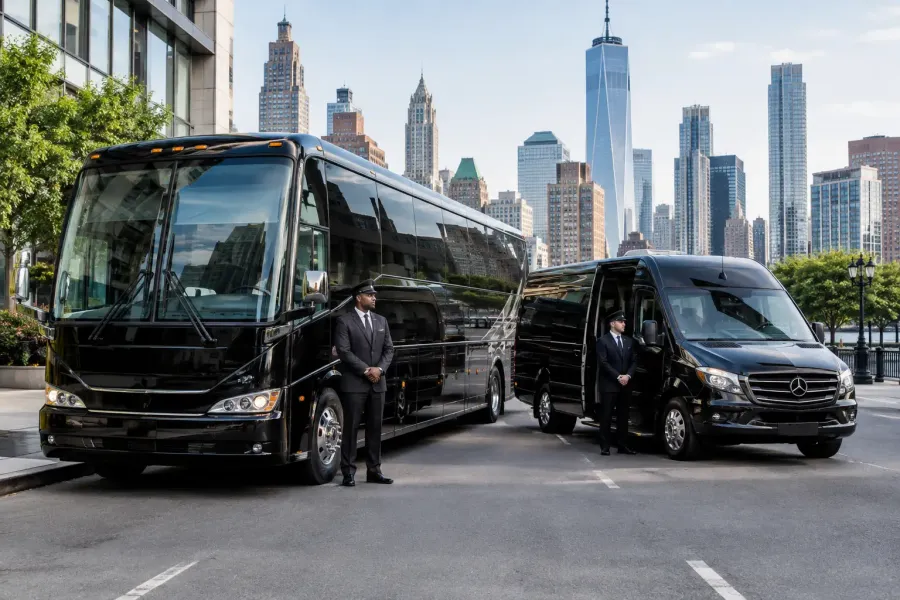
Vehicle selection should match the group and the trip. A Mercedes Benz Sprinter van can accommodate up to 14 passengers and is well suited for executive airport transfers or smaller teams. A 24 or 36 passenger minibus can serve department outings, conference transportation, and employee programs. For larger groups, a full size motor coach can accommodate up to 56 passengers and may include a restroom and WiFi, which can be useful for longer trips across Long Island or to regional meetings.
Comfort also supports safety. Passengers who are not driving can rest after a flight, prepare for a presentation, and stay together from pickup through arrival. Professional drivers handle the vehicle while organizers remain available to their guests instead of concentrating on traffic and directions.
Situations Where Rental Cars Can Be the Better Fit
A balanced transportation plan recognizes that one option does not fit every business trip. Rental cars may make sense when a very small group has independent schedules, multiple travelers are staying for an extended period, or destinations are widely dispersed with no shared meeting times.
They can also work when employees already know the region and need personal mobility outside a scheduled corporate program. Even then, planners should consider parking availability, reimbursement policies, and whether the group will need to travel together for any portion of the itinerary.
The decision changes quickly as the number of passengers rises. Once a group needs multiple vehicles, the benefits of a private shuttle become easier to see. Fewer vehicles mean fewer drivers, fewer parking decisions, fewer opportunities for delays, and a clearer arrival plan.
Plan the Vehicle Around the Itinerary
Before choosing transportation, map the trip in practical terms. Confirm the number of passengers, luggage requirements, pickup points, destination entrances, event timing, and any planned stops. Ask whether everyone needs to arrive together and whether the vehicle should remain available during the program.
It is also helpful to account for the return trip at the start. Evening departures, airport departures after a full day of meetings, and transportation from a venue to a hotel all deserve the same level of planning as the first pickup. A complete itinerary helps the transportation provider recommend the right vehicle and schedule realistic travel time.
New York Bus Service helps corporate organizers coordinate private transportation for teams traveling throughout New York City, Long Island, and nearby destinations. With professionally driven Sprinter vans, minibuses, and full size motor coaches, groups can select a vehicle that fits their passenger count, schedule, and comfort needs.
The best transportation choice is the one that lets your people arrive focused, together, and ready for what comes next. When the itinerary calls for accountability and coordinated timing, one professionally driven vehicle can make the entire business day easier to manage.