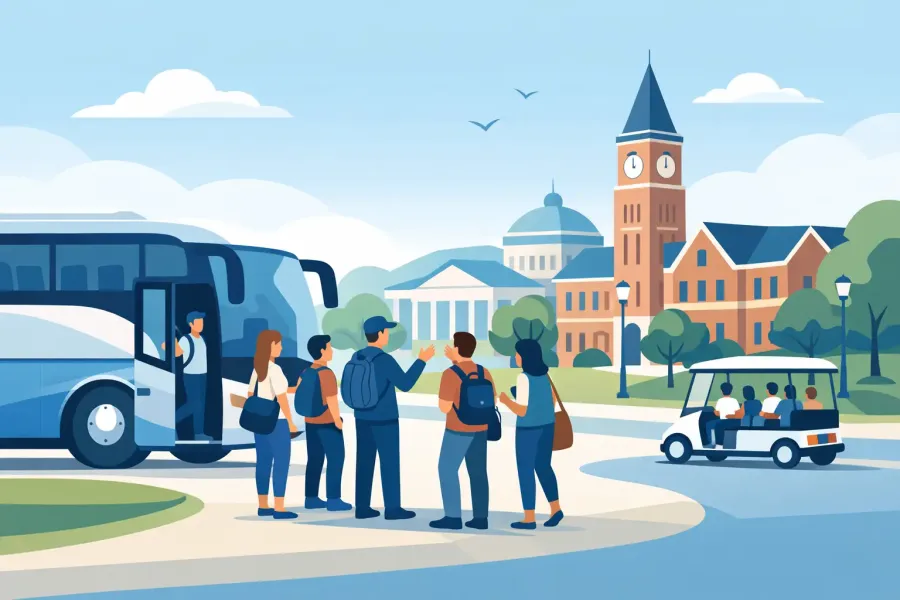
College Campus Visit Transportation for Groups
A campus visit often begins before anyone reaches the admissions office. A delayed airport pickup, families arriving separately, or a group searching for parking can put unnecessary pressure on a day that should be focused on academic fit, student life, and informed decisions. Professional college campus visit transportation gives schools, counselors, families, and student groups one coordinated plan from departure through the final stop.
For groups visiting colleges in New York City, Long Island, or nearby regional destinations, a professionally driven vehicle keeps the itinerary on track while passengers travel together in comfort. It also gives the organizer one point of coordination rather than several vehicles, different arrival times, and last-minute changes.
Why College Campus Visit Transportation Needs Planning
Campus tours run on fixed schedules. Information sessions, meetings with faculty, athletic department visits, and residence hall tours may each begin at a specific time. A transportation plan needs to account for more than the distance between locations. It should allow for traffic patterns, campus access rules, passenger loading, meal stops, and time to regroup after each visit.
This matters even more when a group is visiting multiple campuses in one day. A school counselor may be coordinating prospective students from several neighborhoods. A family may be bringing siblings and grandparents to compare two or three schools. An athletic program may need to arrive together for a recruitment visit. In each case, one vehicle with a professional driver creates a calmer, more organized experience.
Parking is another practical concern. Many campuses have limited visitor parking, permit-only lots, or designated drop-off points for larger vehicles. A transportation provider can plan the approach, arrival window, and pickup location in advance. That preparation helps the group step off close to the scheduled activity instead of losing valuable visit time in a parking area.
Match the Vehicle to Your Campus Visit Group
The right vehicle depends on passenger count, trip length, luggage, and the structure of the day. A small family group arriving through JFK, LaGuardia, Newark Liberty International Airport, or another regional airport may appreciate a Mercedes Sprinter van. With room for up to 14 passengers, it offers a comfortable option for airport transfers and campus appointments without dividing the group.
For a larger student group, a minibus can provide the right balance of capacity and flexibility. It is well suited to guided campus tours, school-organized college exploration days, and local transportation between hotels, campuses, and planned meals. Keeping students and chaperones together makes attendance checks easier and supports a more secure travel environment.
A full-size motor coach is often the strongest choice for groups of up to 56 passengers. This option works well for high school college tours, academic organizations, athletic groups, and multi-campus itineraries. When the day includes longer highway travel, a motor coach with a restroom and Wi-Fi can make the trip more comfortable and productive. Students can review campus materials, counselors can confirm the next stop, and families have a more relaxed place to travel between appointments.
Vehicle size should not be selected by headcount alone. Consider personal bags, carry-on luggage, mobility needs, the number of chaperones, and whether the trip includes an airport transfer. A group that technically fits in a smaller vehicle may still benefit from additional space, particularly after a flight or during a full day of campus walking.
Build a Schedule That Allows for Real Travel Conditions
The best campus visit itineraries include reasonable time between scheduled activities. A tight plan may look efficient on paper, but it leaves little room for traffic, an extended admissions conversation, or a student who needs a few extra minutes to return to the group. Adding practical buffer time protects the parts of the day that matter most.
Start with the appointment times supplied by each college. Then determine the preferred arrival time, which is usually earlier than the event start time. From there, factor in loading time at the hotel, school, airport, or meeting location. For multi-campus trips, confirm where the group will be collected after each tour rather than assuming the departure point will be the same as the arrival point.
It also helps to name one primary transportation contact for the group. That person should have the final itinerary, passenger count, organizer contact information, and any changes to pickup locations. Clear communication is especially valuable when students are traveling with school staff, when parents are joining part of the trip, or when the day includes multiple campuses.
A professional driver contributes more than transportation. An experienced driver follows the planned route, manages vehicle access and passenger loading, and remains focused on safe, punctual travel. That lets counselors, parents, and chaperones stay focused on students instead of navigation and timing.
Airport Transfers for Out-of-Town Campus Visits
For families traveling from outside the area, airport transportation can set the tone for the entire visit. Flight schedules may involve early arrivals, late departures, or travelers reaching the city on separate flights. A private group vehicle can be scheduled around the itinerary, with enough room for passengers and luggage before continuing to a hotel, campus, or another planned destination.
Airport-to-campus travel is particularly helpful when a family is unfamiliar with the region or needs to visit a college soon after landing. Rather than sorting out several forms of transportation, the group can travel together with a professional driver who is prepared for the pickup plan. The same arrangement can support a return transfer after the final campus appointment.
For longer campus tour programs, organizers may schedule transportation for the full itinerary. This can include airport arrival, hotel transfers, campus visits, meal stops, evening activities, and airport departure. A single coordinated plan reduces the chance that a key segment is overlooked.
Questions to Confirm Before Booking
Before reserving transportation, have the complete itinerary as close to final as possible. Confirm the number of passengers, including chaperones and family members. Provide all pickup and drop-off locations, campus appointment times, flight details when applicable, and any requested stops between locations.
Ask about the vehicle category that best fits your group, especially if luggage or extended travel is involved. It is also wise to discuss the anticipated trip duration, whether the vehicle should remain available between campus appointments, and what flexibility is possible if a tour runs longer than expected. A clear plan at the start supports a more dependable day on the road.
For schools and organizations, share any internal travel requirements early. Some groups need a specific chaperone ratio, a detailed passenger manifest, or a defined return time. Providing those details allows the transportation plan to support the school’s procedures rather than forcing staff to manage them during the trip.
Make the Visit Feel Organized From the Start
A college visit can influence a student’s next major decision. The transportation should support that moment, not compete with it. Clean, comfortable vehicles, punctual scheduling, and a professional driver help everyone arrive ready to listen, ask questions, and picture themselves on campus.
New York Bus Service can coordinate campus visit transportation for groups ranging from small family travel parties to full student groups, with Sprinter vans, minibuses, and motor coaches selected around the itinerary. The goal is simple: keep your group together, comfortable, and on schedule.
When planning the visit, leave enough room for the conversations that happen after the formal tour. Those candid questions between students, parents, counselors, and chaperones are often where a campus begins to feel like the right fit.